
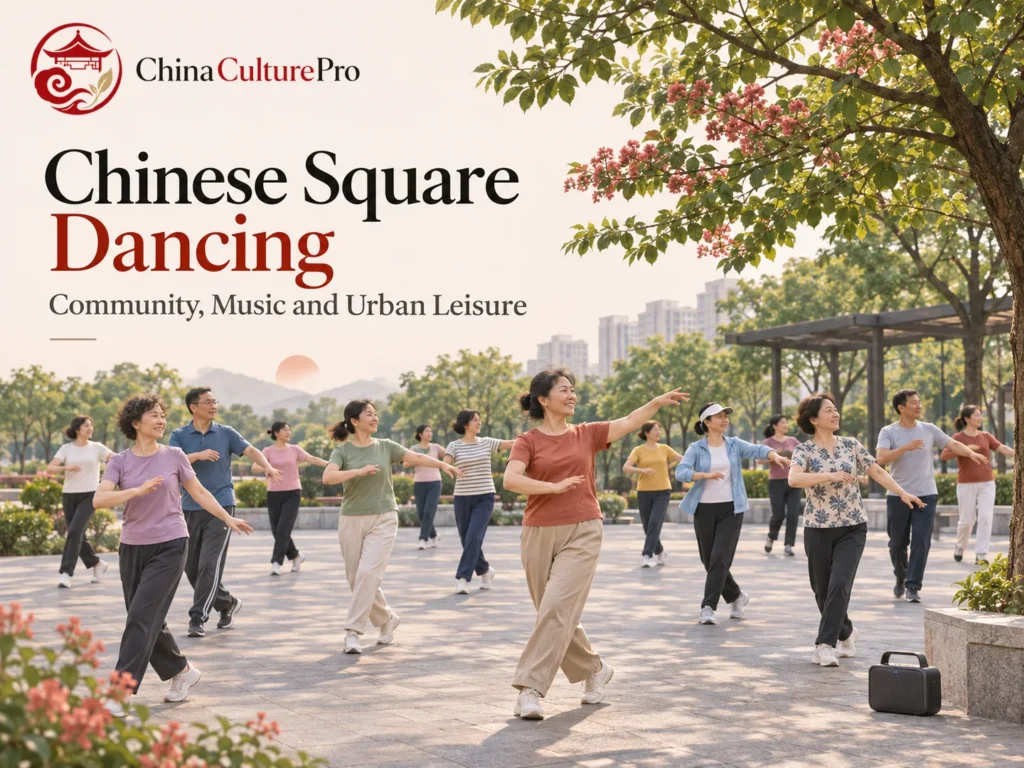

Quick Answer: What Is Chinese Square Dancing?
Chinese square dancing (广场舞, guǎngchǎngwǔ) is collective recreational dancing associated with open public spaces. Participants move to shared music, often following a leader or learned routine. The name covers varied dance and fitness styles rather than one fixed choreography, and it appears in both urban and rural community life.[1]
- Setting: Plazas, parks and neighborhood spaces provide a gathering place.
- Activity: Music and coordinated movement organize the session.
- Social role: Participation can bring regular companionship, learning and self-expression.
A daily gathering, a prepared showcase and a competition can involve different expectations.[2][11]
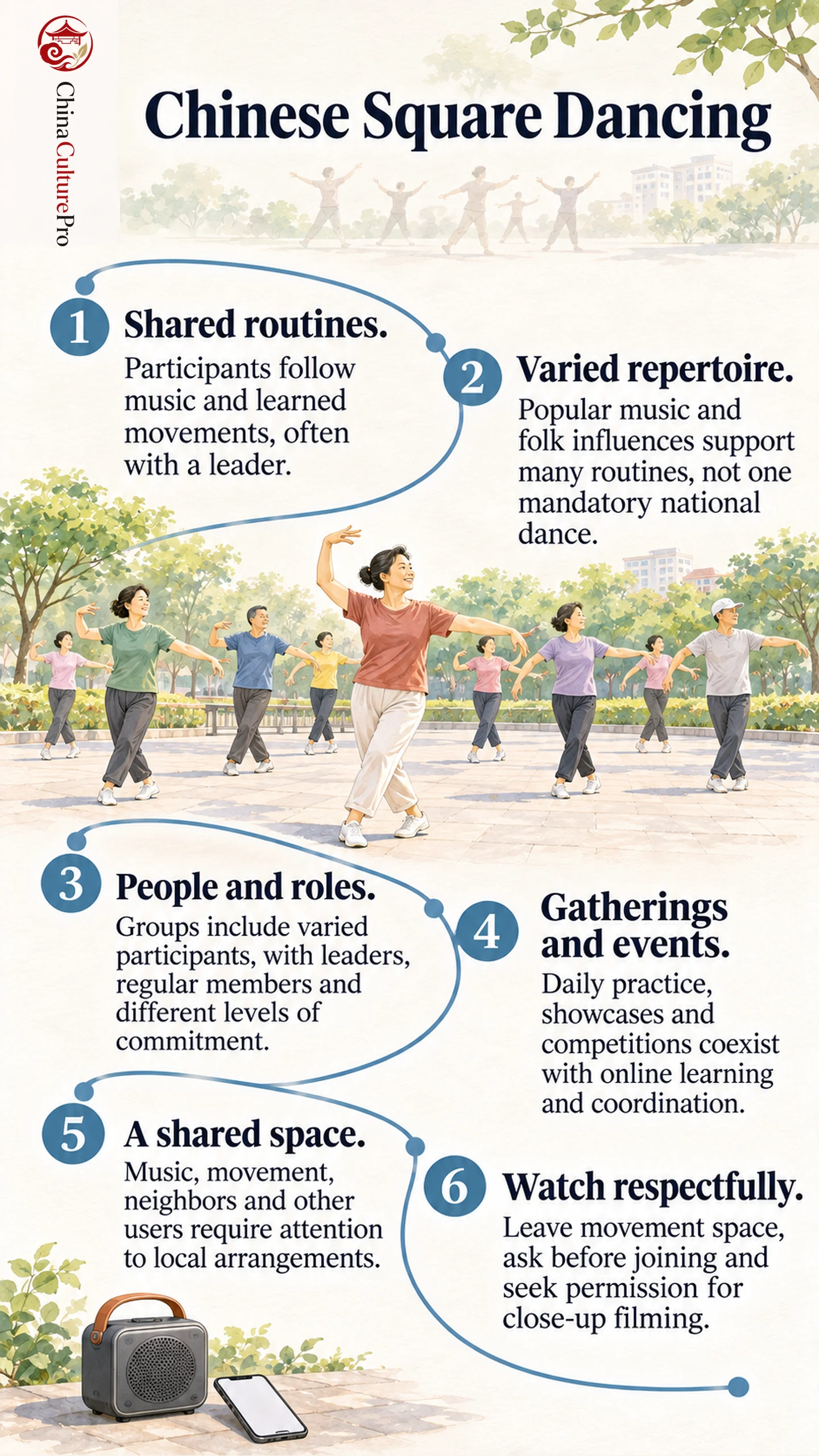
An open space can become a dance floor when neighbors arrive with music and a shared routine. Square dancing makes an everyday social world visible: people practicing, organizing and spending time together. It offers a useful window into leisure in modern Chinese culture.
What You See in a Square-Dance Session
A familiar scene has dancers arranged in loose rows, following a sequence together. A leader demonstrates or cues movements, and participants learn through repetition. Some groups concentrate on recreational practice; others devote substantial attention to improving a performance. In the Shanghai group studied by Yang and Qin, participants chose matching clothing for teaching or competition, while everyday dress was more flexible.[2]
“Square” points to a gathering space. It does not require four couples arranged around a square, as in the Western dance described by the Canadian Olde Tyme Square Dance Association. The overlapping English name can obscure the different social and choreographic settings.[9]
In Chinese public parks, dancing can share the wider environment with walking, games, music-making and other activities. A group’s regular use gives a space a recognizable rhythm, while the same area may serve different people at another time.
Music and Styles: There Is No Single Routine
The repertoire can draw on popular songs, exercise routines and movements associated with folk dance. The 2015 public-culture guidance explicitly treated square dancing as a broad category containing several styles. A connection with traditional Chinese dance can provide material for a routine without making every modern session an unchanged historical performance.[1]
Two songs included in the 2015 recommended program were Little Apple (小苹果, Xiǎo Píngguǒ) and The Most Dazzling Folk Style (最炫民族风, Zuì Xuàn Mínzú Fēng). They illustrate how Chinese popular music can move into community dance. They are examples from that program; local repertoires continue to vary.[3]
That year, national cultural and sports authorities promoted twelve dance works. An official interview specifically rejected the idea that the initiative imposed hard nationwide uniformity: it was intended to expand people’s choices. Local groups can choose and develop other routines.[4]
Who Dances and How Groups Organize
Middle-aged and older women are prominent participants, but age, gender and retirement status do not define eligibility. A 2016 national training event in Nanjing included men and participants from several age groups. This illustrates participation beyond older women, without establishing national demographic proportions.[5][10]
Groups also have internal organization. Yang and Qin’s study of one Shanghai team describes teachers, core members and other participants performing different roles. Familiarity and communication varied within the team. Sharing a routine creates opportunities for contact, while involvement can range from occasional attendance to a substantial commitment.[2]
Finding time can itself require work. Shang Li’s ethnographic research examines how women in three urban dance teams negotiated leisure alongside caregiving responsibilities. Their commitment connects with questions of personal time and family roles. These experiences explain why a session can matter to participants beyond the movements visible to an observer.[5]
Everyday Gatherings, Public Events and Online Learning
Organized events have grown alongside local gatherings. Public-cultural guidance in 2015 supported training, new works and opportunities to present them. The resulting occasions can have different purposes:[1]
| Konteks | Hal yang membedakannya |
|---|---|
| Everyday gathering | Regular shared dancing, with local routines and participation habits. |
| Showcase | A prepared presentation for an audience, often requiring coordinated rehearsal. |
| Competition | An organized event with its own entry and performance rules. |
For example, a 2015 national competition distinguished a prescribed routine selected from the twelve promoted works from a freely selected routine. That event’s rules did not govern every neighborhood dance session.[11]
Learning and organization can also extend online. Anthropologist Tom McDonald’s field report from rural Shandong describes women using private online spaces to organize their public dancing. Digital communication and face-to-face gatherings can reinforce one another, including in rural community life.[6]
Sharing Public Space: Music, Movement and Neighbors
Music helps a group coordinate, but sound reaches people who are not dancing. Residents, pedestrians and other users may have different expectations of the same space. Noise disputes concern the timing, location and management of an activity as well as the experience of hearing music.
Xiao and Hilton’s soundscape study in a Chinese county-level city investigated how people perceived square dancing. Its attention to context and appropriateness helps explain why the issue is more complex than whether a listener likes the song. Participants’ and nonparticipants’ experiences need to be considered together.[7]
Local arrangements can set specific boundaries. Yingde’s notice for named public-square areas, for example, specifies activity periods and sound limits. Its hours and limits apply to the places named, so they should not be treated as a national timetable.[8]
How to Watch or Join Respectfully
- Watch from the edge. Leave room for movement and avoid crossing through the formation during a routine.
- Ask before joining. Look for the leader or an organizer; a casual gathering and an event rehearsal may handle newcomers differently.
- Follow the group’s arrangement. If invited, use the suggested place and avoid interrupting the person demonstrating.
- Ask before close-up filming. Public visibility does not mean participants have agreed to become the subject of someone else’s video.
Comfortable participation begins with reading the situation. Observe the session’s purpose, respect site rules and accept a group’s response if it is concentrating on rehearsal. Treat the session as the participants’ shared leisure time and follow their cues.
FAQs About Chinese Square Dancing
Is Chinese square dancing the same as Western square dancing?
No. The Chinese term refers to public group dancing in varied styles. The Western namesake commonly organizes four couples into a set led by a caller.
Is square dancing only for older women?
No. They are prominent in many groups, but men and younger people also participate. The composition of one team or training event is not a national rule.
Does everyone perform the same twelve routines?
No. The twelve works promoted in 2015 were recommended choices. A competition may require particular routines under its own rules.
Can a newcomer join any group straight away?
Ask first. Some recreational groups welcome newcomers, while a rehearsal or organized event may have different expectations. Follow the organizer’s guidance.
Sumber
[1] Ministry of Culture of China. Guidance on Supporting Square-Dancing Activities
[2] Jun Yang and Tianli Qin, SAGE Journals. Chinese Square-Dancing: A Description of Group Cultural Life
[3] General Administration of Sport of China. Twelve Recommended Square-Fitness Dance Works Introduced
[4] General Administration of Sport of China. Liu Guoyong Explains the Recommended Dance Works
[5] Shang Li, Leisure Sciences. Negotiating Permission to Dance: Care-Embedded Serious Leisure in Urban China
[6] Tom McDonald, SAPIENS. Dancing “My Humps” in Rural China
[7] Jieling Xiao and Andrew Hilton, International Journal of Environmental Research and Public Health. Soundscape Factors Influencing Perceptions of Square Dancing in Urban Streets
[8] Yingde Municipal Government. Notice on Noise Management in Public-Square Areas
[9] Canadian Olde Tyme Square Dance Association. Basics, Movements and Calls
[10] Social Sports Guidance Center, General Administration of Sport of China. National Square-Dance Training in Nanjing
[11] General Administration of Sport of China. National Square-Dance Competition Uses Online Participation