


Quick Answer: What Is Chinese Silk Damask Ling?
Ling (绫, líng) is a Chinese silk name associated with twill. In figured historical examples, differences in the weave create a subtle motif against the twill ground.[1][2]
- Plain and figured: Plain ling can consist of twill alone, while figured ling adds a woven design.[1]
- Song example: One silk uses twills running in opposite directions for its background and birds.[3]
- Later usage: Some Huzhou silk used for mounting art retained the name ling with a satin structure.[1]
Read the date, weave and use in the record before identifying a silk as ling.
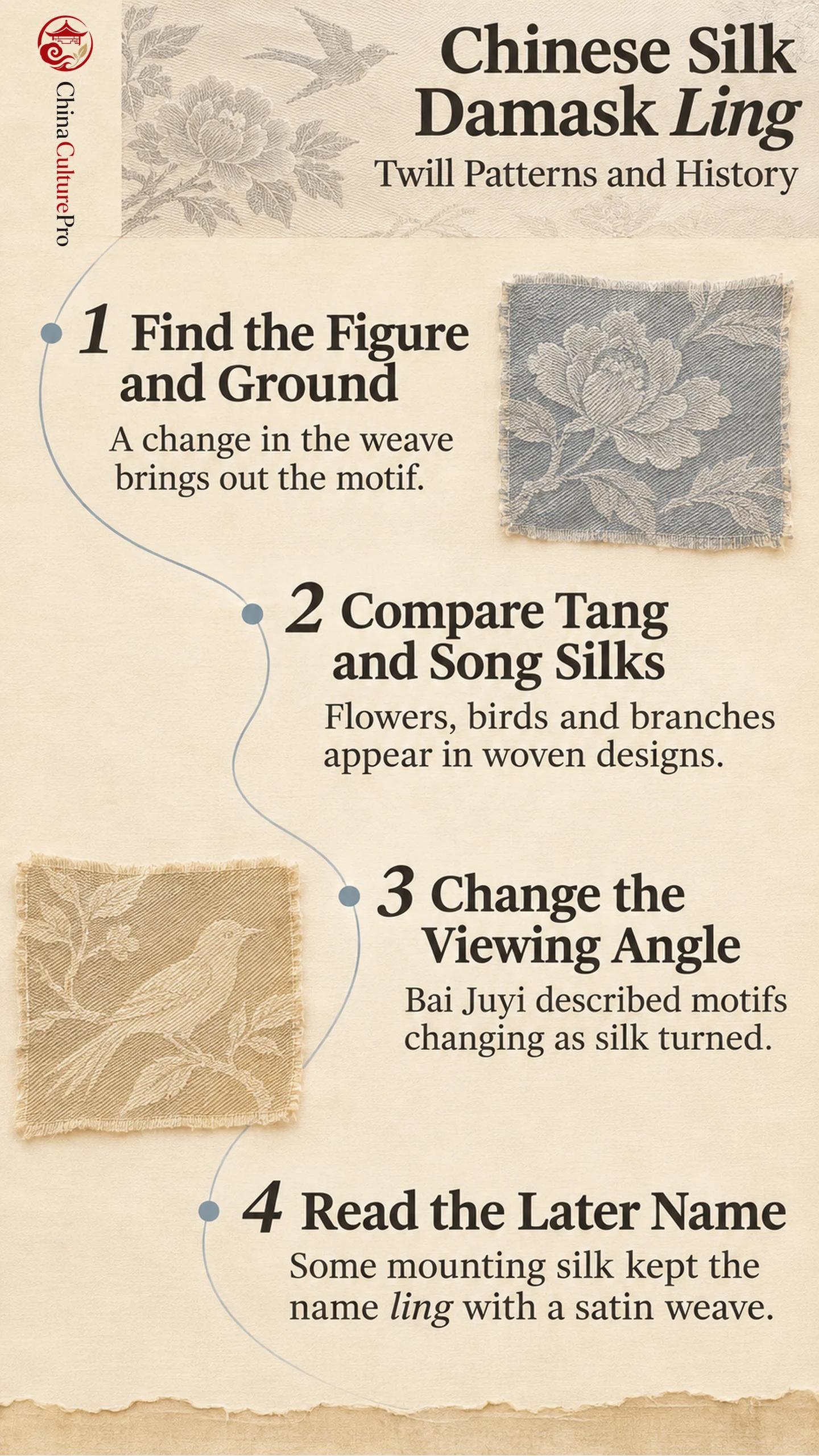
A flower can be hard to see on a single-color piece of silk until the light reaches it at an angle. The changing visibility offers a clue to how the cloth was made. A close view of the threads can show why the figure and ground catch the light differently.
How Ling Produces a Woven Pattern
Twill forms diagonal lines because the points where the threads cross are offset from one pass to the next. Plain ling can use one twill structure. In figured ling, a different interlacement reveals the motif against the twill ground.[1]
Compare photographs of the same textile taken from different angles when the catalog provides them. A close view helps you compare the diagonal texture in the ground and figure. An oblique view can make the contrast in luster easier to notice.[2][3]
Tang Flowers and Song Birds
A yellow Tang dynasty fragment in the China National Silk Museum measures 38.8 by 23 centimeters. Its large flower design belongs to the weave. The museum explains the pattern as a contrast between interlacements on a single layer of fabric.[2]
The museum also catalogs a yellow Song piece measuring 60 by 15 centimeters. Birds and flowering branches appear in a 1/5 left twill on a 2/1 right-twill ground. The ratios distinguish how much of each yarn system is exposed in the two weave structures. The directions describe the diagonals in the fabric, which run opposite ways on this piece.[3]
What Bai Juyi Saw in the Cloth
In Liaoling (缭绫, liáolíng), the Tang poet Bai Juyi describes designs whose visibility shifts as the silk turns. He also brings the cloth into a sequence of weaving, dyeing and cutting for garments. The poem draws attention to the labor of the women who made it.[4]
Read the poem for a description of the silk in motion. Use the Song catalog to examine how one surviving fabric was built. It records the two weave structures on a specific piece, down to their ratios and direction.[3][4]
Why Later Mounting Silk Kept the Name
The China National Silk Museum describes Huzhou mounting silk, or huling (湖绫, húlíng), used for paintings and calligraphy in Ming and Qing contexts. In examples woven in satin, the name continued as part of the mounting tradition. In a mounted work, paper behind the silk can support a relatively light fabric.[1][5]
The Palace Museum also catalogs a pink robe with a figured ling exterior, a chou silk lining and satin neck edging. Each material label refers to a particular part of the robe.[6]
FAQs About Chinese Silk Damask Ling
Are all ling silks patterned?
The historical category includes plain twill examples and figured examples with a woven design.[1]
Can you identify ling from shine alone?
Check the weave description and the object’s date and use. The Song fragment’s opposite twill directions are more specific evidence than its sheen.[3][5]
How does ling differ from gauze and crepe?
In figured ling, the design is woven on a twill ground. Silk gauze luo can have openings made by crossed warp yarns. Silk crepe zhou is recognized by its fine crinkling.[1][5][7]
Sumber
[1] China National Silk Museum. What Are Ling, Luo, Chou and Duan? Part One
[2] China National Silk Museum. Tang Ling with Large Floral Motifs
[3] China National Silk Museum. Yellow Ling with Birds and Flowering Branches
[4] Bai Juyi, Complete Tang Poems. Liaoling
[5] China National Silk Museum. Technology in Historical Silk
[6] The Palace Museum, Beijing. Pink Figured Ling Padded Robe
[7] China National Silk Museum. Yuan-Dynasty Silk Crepe Knot