

Quick Answer: What Is Chinese Satin Stitch?
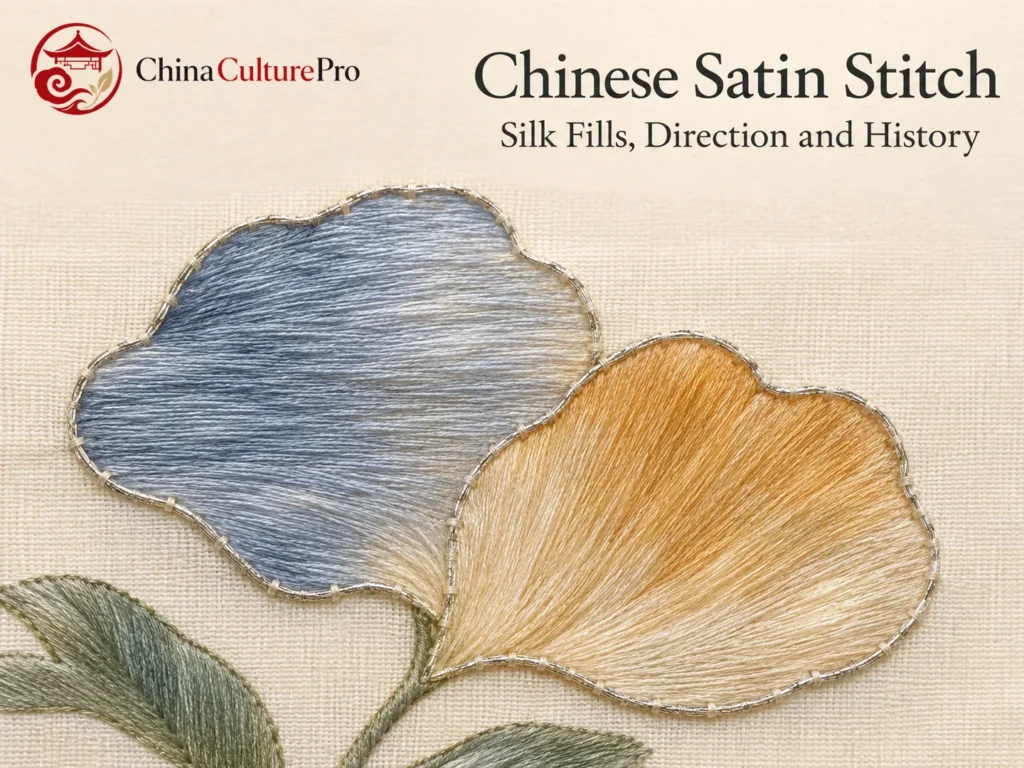
Satin stitch fills a shape with straight stitches placed side by side. Chinese examples include silk flower fills from Dunhuang, where separately couched metal-wrapped threads outline the design.[1][2]
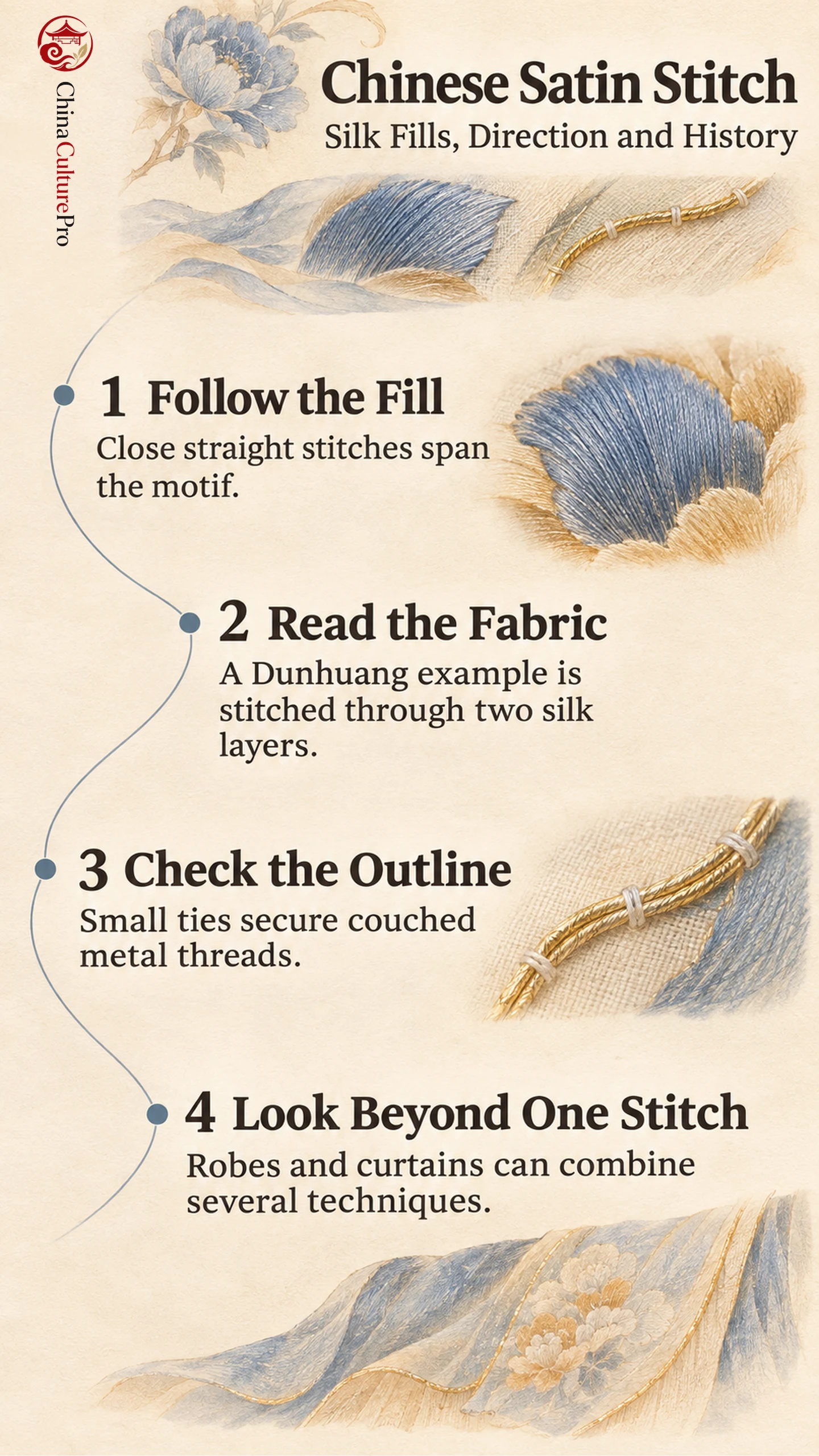
- Look for direction: Adjacent stitches span the shape and create a smooth surface.[1]
- Read the cloth separately: A patterned silk damask can be the fabric beneath satin stitch.[2]
- Compare nearby stitches: A Qing robe combines satin stitch, couching and a knotted stitch.[4]
Follow the path of the thread before identifying a stitch from gloss alone.
An embroidered petal can look solid from across a gallery. In a close view, the individual silk threads cross the shape and meet its edge. Their direction helps distinguish the fill from a woven background or a raised outline.
Read the Direction of the Silk
In a satin-stitched area, each stitch spans part of a motif, with its neighbors lying close alongside. Light falls across these parallel threads differently as the viewing angle changes. Follow the threads in one petal first. A change of direction can help its edge read clearly against the next petal.[1]
The Palace Museum describes qizhen (齐针, qízhēn) as densely arranged, straight or angled stitches with entry and exit points on the motif’s edge. Its Qing panel of birds lists this among more than ten techniques. Treat the label as one detail in a larger embroidered surface.[3]
Follow the Evidence in Dunhuang
A scientific study of a Dunhuang embroidery at the British Museum, MAS.857, identified untwisted colored silk used for satin stitch through two layers. The front is white twill damask with its own woven design. Plain-woven silk supports it behind. The satin stitches pass through the patterned front and its backing. The flowers belong to the embroidery on top.[2]
That distinction helps when looking at a fragment from either side. The silk damask guide explains how a pattern can be formed during weaving. The embroidered fill has separate needle entry points through the fabric.
Distinguish Fill, Couching and Knots
The Dunhuang piece’s petals use satin stitch. Silver-wrapped outlines and the gold-wrapped threads in small birds use couching stitches. Look for a thread laid along the surface and held by small ties. In a close view, look for the ends of the colored stitches inside the motif and the small securing ties across its metal outline.[2]
A Chinese knot stitch can add individual raised dots. The Ashmolean Museum lists Peking knot and satin stitch among the techniques used alongside the couched gold-wrapped dragons on a nineteenth-century official robe.[4]
Where to Look on Garments and Furnishings
On the Ashmolean robe, the label separates the couched dragons from other embroidered areas, where multiple stitches appear. Read the technique for the part of the garment you are looking at. Use the close-up to decide whether the thread spans the motif or follows an outline.[4]
The Asian Civilisations Museum records satin stitch on early twentieth-century wedding bed curtains from the Straits Settlements. The same pair also uses flat and raised metallic couching. Compare the close, smooth fills with the brighter raised portions described in the guide to Chinese goldwork embroidery.[5]
FAQs About Chinese Satin Stitch
Is satin stitch worked only on satin fabric?
It can be worked on other fabrics. The Dunhuang embroidery uses a twill damask surface backed by plain-woven silk.[2]
How does satin stitch differ from couching?
Satin stitch fills an area with neighboring straight stitches. In couching, small securing stitches hold the main thread on the surface.[1][5]
What does qizhen mean in a Chinese collection label?
It names a closely spaced straight-stitch technique with both ends of each stitch at the motif’s edges, according to the Palace Museum’s definition.[3]
Sumber
[1] Royal School of Needlework. Satin Stitch
[2] Diego Tamburini and colleagues, npj Heritage Science. The Use of Scientific Analysis to Reconstruct Archaeological Textiles from Dunhuang
[3] The Palace Museum, Beijing. Guang Embroidery Panel of Birds
[4] Ashmolean Museum. Man’s Formal Robes
[5] Asian Civilisations Museum. Embroidered Wedding Bed Curtains