

Quick Answer: What Does Chinese Popular Culture Include?
Chinese popular culture includes entertainment, creative work and shared practices that circulate through mass media, commercial spaces and everyday social life. Four connected areas offer an accessible introduction:
- Films, television and animation, with different regional histories and many genres.[1]
- Popular music shaped by language, recording, performance and changing audiences.[2][3]
- Games that make stories and imagined worlds interactive.[4][5]
- Online writing and video, where audiences can also become authors, commentators and participants.[6][7]
No single work represents the tastes of every Chinese-speaking audience. Region, language, generation and personal interest all matter when choosing where to begin.
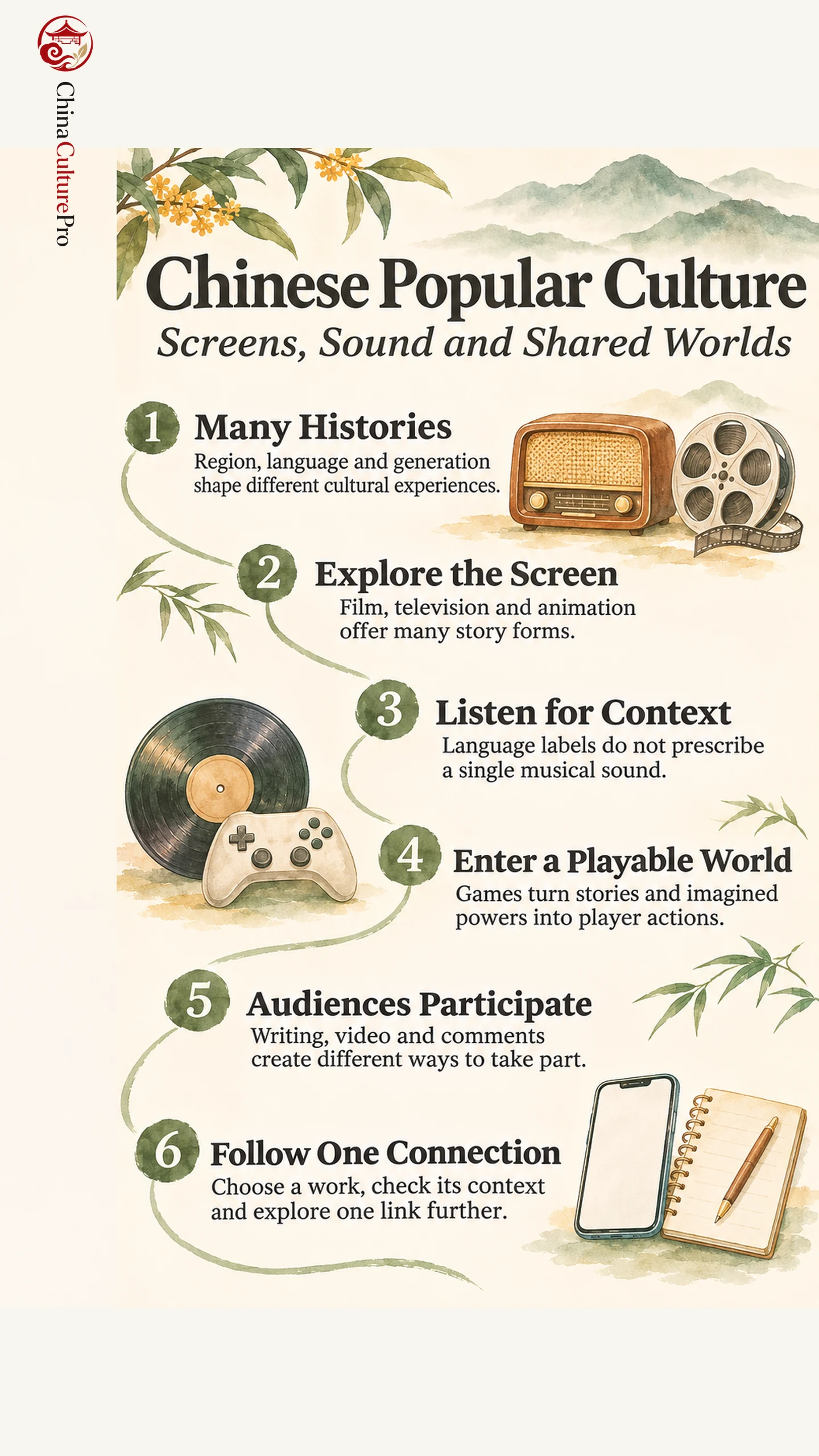
A dubbed animated film, an older Cantonese song and a gaming video can lead into very different cultural conversations. Looking at how a work was made and how people use it is more rewarding than treating its popularity as proof of one shared national preference.
Many Centers and Changing Media
This field has several histories. Chinese cinema, for example, developed through mainland, Hong Kong and Taiwanese production, with people and influences moving between them.[1] A regional or language label can therefore be useful without describing a sealed cultural world.
The media history is also longer than the smartphone era. Hong Kong’s postwar popular culture connects economic and social change with radio, television, film, records, comics and toys. These forms developed through cultural exchange as well as local creativity.[2]
That broader view changes what counts as a cultural object. A record sleeve, a comic or a treasured toy can be as revealing of an audience’s memories as a famous screen production. “Popular” need not mean newly released: older works can remain part of personal and generational life.
Film, Television and Animation
Chinese cinema offers more than a single export genre. Martial arts, comedy, social drama and filmmaking associated with different regional movements belong to a wider screen history.[1] Start with a story type that interests you, then look at its production place, language and date.
Television and streaming series provide another route. A genre label may describe a setting, a relationship focus or a fantasy world. The guide to Chinese drama genres explains how to read those overlapping descriptions before choosing a series.
Animation deserves its own attention. Ne Zha 2 (哪吒之魔童闹海, Nézhā zhī Mótóng Nàohǎi, 2025) follows a rebellious young figure with extraordinary powers.[8] Its existence as a modern production is a reminder to distinguish an inherited character from the particular film built around that character.
For techniques and formats beyond one feature, the Chinese animation guide connects older experiments with contemporary films and series. A production’s medium, audience and narrative genre are separate questions worth checking.
Music: Language, Place and Listening
Mandopop (国语流行音乐, Guóyǔ Liúxíng Yīnyuè) means Mandarin-language popular music. Its contemporary commercial development drew on earlier musical traditions, and Taiwan’s music circulated widely into mainland China during the 1980s and early 1990s.[3]
Cantopop (粤语流行音乐, Yuèyǔ Liúxíng Yīnyuè) refers to Cantonese-language pop. Hong Kong’s early-1970s development brought Cantonese lyrics about society together with Western rock influences; later stars and performances became important parts of its popular-cultural memory.[2]
These labels identify language traditions rather than prescribe one sound. They do not tell you in advance whether a particular track will feel intimate, theatrical, dance-oriented or restrained. Listen to the arrangement, vocal delivery and performance context as well as the lyrics.
A useful comparison is to hear a studio recording beside a live version. Ask what the audience responds to and which elements change. If using translated lyrics, treat the translation as an aid to meaning; sound, phrasing and wordplay may carry effects that the translation cannot reproduce.
Games and the Work of Adaptation
Black Myth: Wukong (黑神话:悟空, Hēi Shénhuà: Wùkōng) builds an action role-playing game from the literary world of Journey to the West (西游记, Xīyóu Jì). Staff techniques, spells and transformations become part of the player’s experience.[4] The guide to Black Myth Wukong’s cultural sources separates literature, temple art and living performance.
Genshin Impact (原神, Yuánshén) offers a different example: an open-world fantasy adventure in the imagined world of Teyvat.[5] A game can invite cultural interpretation without claiming that its entire world depicts a historical place.
When investigating an unfamiliar detail, distinguish the source from the playable rule. A mythic power may have an older narrative background; its cooldown, availability or effect within a particular encounter belongs to the game’s design. Studying that transformation is one way to understand adaptation as creative work.
Online Writing, Video and Participating Audiences
Online literature is one part of the story. Since the 1990s, writers in China have used internet spaces to develop new creative practices, themes and relationships with publishing. This history includes experimentation and questions of cultural control as well as commercial possibilities.[6] It is broader than a list of novels that later received screen adaptations.
Short video organizes cultural encounters differently. Douyin (抖音, Dǒuyīn) is a short-video service for the China market; TikTok is a distinct service in the same company’s portfolio. Their shared corporate background does not make the names interchangeable.[9] Knowing which service a clip came from is a useful first step in understanding its context.
On Bilibili (哔哩哔哩, Bìlībìlī), danmu (弹幕, dànmù), or bullet comments, place audience messages over a video. This creates a visible layer of responses rather than leaving all discussion below the image. Qualitative research with users explores how those messages can create shared jokes, interpretation and a sense of participation.[7]
A comment stream is still a particular audience in a particular setting. Read its jokes and arguments with that scale in mind. A highly visible remark can be interesting evidence of how some viewers respond; it cannot, by itself, establish what an entire society believes.
Choose an Entry Point by Interest
Choose something you can experience in enough depth to notice its form. Then follow one connection rather than trying to absorb the whole field at once.
| If you are curious about… | Try this approach | A question to carry with you |
|---|---|---|
| Screen storytelling | Watch a complete film or a manageable portion of a series | How do language, setting and genre shape the story? |
| Musik | Compare a recording with a live performance | What changes between the two versions? |
| Mythical characters | Use the guide to Chinese animation and mythology | Which character traits are inherited, and which are rewritten? |
| Interactive worlds | Explore Chinese mythology in video games | What becomes a player action rather than a narrated event? |
| Online writing | Read a work with its publication context in mind | How might the medium affect pacing or interaction? |
| Participating audiences | Compare a video with and without its comment layer | Which meanings come from the work, and which from viewers? |
For any specific work, check its credits and original title where possible. For access, subtitles or content suitability, check the particular edition offered in your region. Those practical details help identify the work you intend to experience.
FAQs About Chinese Popular Culture
Is Chinese popular culture the same as traditional culture?
The fields interact, but they are not identical. Contemporary creators can adapt older stories, develop new fictional worlds or focus on everyday life. An ancient reference is one possible creative resource rather than a requirement.
Is Chinese pop music all in Mandarin?
No. Mandopop and Cantopop identify different language traditions. Language is useful context for listening, but it does not determine a single musical style.[2][3]
Are Douyin and TikTok the same service?
No. The company lists them as distinct products, with Douyin serving the China market. Identify the actual service before treating a clip or trend as evidence about its audience.[9]
Do popular games and films represent historical reality?
A work can use cultural sources while inventing characters, environments and events. Investigate a particular historical claim separately rather than assuming popularity or detailed visuals establish accuracy.
Sumber
[1] Noah Cowan, British Film Institute. A Century of Chinese Cinema: an introduction
[2] Hong Kong Heritage Museum. Hong Kong Pop 60+
[3] Marc L. Moskowitz. Mandopop under siege: culturally bound criticisms of Taiwan’s pop music
[4] Game Science. Black Myth: Wukong—official description
[5] PlayStation. Genshin Impact
[6] Michel Hockx, Columbia University Press. Internet Literature in China
[7] Yeyang Cao and Weihua Wu. Digitalized deep play and the Bilibili bullet comments
[8] A24. Ne Zha II
[9] ByteDance. Products and Services