


Quick Answer: How Historical Are Chinese Historical Dramas?
Chinese historical dramas use the past in different ways. Some foreground named rulers and political events; others build romance, intrigue or adventure within a period-styled world. Historical drama and costume drama have overlapping, debated boundaries.[1]
- A historical setting identifies a frame for the story, not the accuracy of every scene.
- Costume can combine research with imaginative design.[2]
- A real person can appear within a constructed plot, as a director’s account of one major historical series makes clear.[3]
- Production research can inform a convincing environment without making the entire narrative a documentary.[4]
Judge specific claims about events, clothing or institutions separately. A whole-series label such as “accurate” is usually too broad to explain what you are seeing.
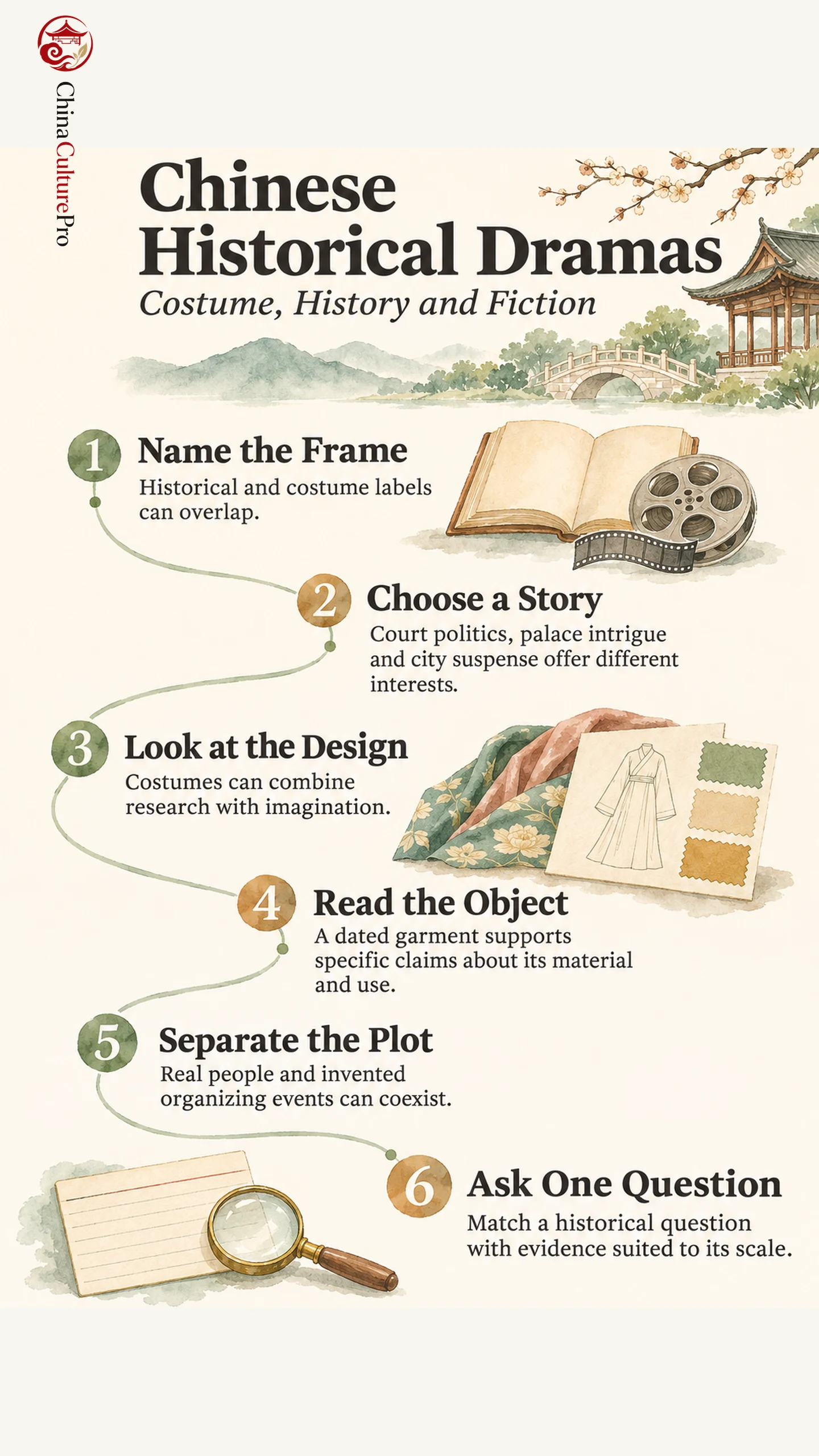
You can enjoy a period thriller for its suspense and still investigate its city setting. You can admire a court costume and ask which objects informed it. These are complementary kinds of viewing, provided the drama and the evidence each keep their own role.
Historical Drama and Costume Drama Are Overlapping Labels
Guzhuang ju (古装剧, gǔzhuāng jù), or costume drama, is a broad category. Historical drama can more narrowly suggest a focus on historical or legendary people, but usage is not consistent enough to make either label a guarantee of factual fidelity.[1]
A Tang dynasty (唐朝, Táng Cháo) urban setting, a Ming dynasty (明朝, Míng Cháo) court and a Qing dynasty (清朝, Qīng Cháo) palace are different historical frames. They should not be collapsed into one timeless “ancient China.” Equally, naming an era does not establish where a production has followed evidence and where it has made dramatic choices.
For viewing purposes, ask two questions together: “What period does this claim to depict?” and “What kind of story does it tell there?” The wider guide to Chinese drama genres explains how setting, romance, intrigue and fantasy labels can overlap.
Three Series and Three Different Starting Points
These productions offer contrasting interests rather than an accuracy ranking. The years below identify their original broadcasts.
| Series | Setting and narrative interest | A useful viewing question |
|---|---|---|
| Ming Dynasty 1566 (大明王朝1566, Dà Míng Wángcháo 1566), 2007 | A Ming court story centered on the Jiajing Emperor (嘉靖帝, Jiājìng Dì) and political conflict.[3][5] | How does the drama turn a view of political power into a concentrated conflict? |
| Story of Yanxi Palace (延禧攻略, Yánxǐ Gōnglüè), 2018 | Palace intrigue during the reign of the Qianlong Emperor (乾隆帝, Qiánlóng Dì), following a young woman who enters as a maid.[6] | How does the story organize ambition, loyalty and personal danger? |
| The Longest Day in Chang’an (长安十二时辰, Cháng’ān Shí’èr Shíchén), 2019 | A novel-based thriller about a threat to the Tang capital.[4] | How do a city’s setting and a race-against-time plot work together? |
Choosing by interest is more useful than assuming every historical series mainly concerns palace romance. Political conflict, an individual’s court journey and a city thriller organize attention in different ways.
What a Costume Can Reveal—and What It Cannot
Costume is both an image of the past and part of a production’s storytelling. Research on a particular group of heroine-centered costume dramas describes designs that combine historical references with imagined elements.[2] That finding is a reason to investigate a design, rather than assume that every attractive garment is either a perfect replica or wholly invented.
A museum object provides a different kind of evidence. One man’s semiformal court robe in the Asian Art Museum collection is dated approximately 1800–1900 and made in slit-silk tapestry with embroidery. Its catalogue explains that the robe belonged to the Qing official-uniform tradition and that decoration could communicate cosmic order and rank.[7]
The date, material and recorded function are specific. They do not make this robe a model for every century, social group or occasion. Nor does a similar-looking screen garment prove that a production copied this particular object.
When a detail interests you, compare the museum description with what is visible: cut, fastening, material, decoration and context of use. The guide to simbolisme Tionghoa dalam pakaian offers a next step into questions of color, rank and motifs.
Fact and Fiction Can Share the Same Plot
Ming Dynasty 1566 supplies a useful case. In a 2007 interview, director Zhang Li (张黎, Zhāng Lí) discussed the story’s conversion of rice fields to mulberry cultivation. The interviewer identified this policy plot as invented; Zhang explained it as a concentrated dramatic event through which to express his interpretation of land concentration and official behavior.[3]
That is a statement about creative intention. It does not independently prove every historical argument in the director’s account. Its value is that it makes the dramatic construction visible: using real historical figures and a serious visual style can coexist with an invented organizing event.
A different production may invest heavily in material detail. The Longest Day in Chang’an’s team researched objects and artworks for costume and setting references.[4] Such work can inform particular choices while the thriller remains an adaptation of a novel. Evidence for one researched feature cannot simply be transferred to every conversation or plot turn.
Watch with a Specific Historical Question
Keep the question small enough to investigate. “Was this ruler a real person?” differs from “Did this private conversation occur?” “Does a dated robe have this motif?” differs from “Did everyone at this court dress this way?” Each question needs a source suited to its scale.
A production interview helps explain why a creator made a choice. A surviving object and its catalogue can support a claim about that object. Historical scholarship can compare records and debate interpretations. None of those sources automatically performs all the others’ jobs.
You do not need to interrupt every scene. Note one detail, finish the episode and investigate it afterward. You can then return with a clearer distinction between a compelling dramatic choice and a claim about the past. If selecting a longer series, also check its particular edition, runtime, subtitles and content guidance before committing to the whole production.
FAQs About Chinese Historical Dramas
Are all costume dramas based on real events?
No. Costume drama is a broad category, and even stories about historical people can contain invented situations. Identify the claimed setting and the source of the particular plot rather than relying on the label.[1][3]
Which Chinese historical drama is the most accurate?
A useful comparison needs a defined subject: costume, chronology, institutions or specific events. This guide compares viewing interests and evidence types rather than assigning a whole-series accuracy winner.
Does beautiful clothing prove a costume is authentic?
No. Visual appeal and documented historical correspondence are different judgments. Compare a specific garment with dated evidence and its intended use; costume design may combine researched and imagined elements.[2]
Do historical dramas sound like everyday modern conversation?
No single register covers every series. A scripted court exchange or title of address should not be assumed to show how people ordinarily speak today. Attend to the scene and speaker before borrowing an expression for conversation.
Sumber
[1] Xueping Zhong. Re-collecting “History” on Television
[2] Zheng Ying. Costume, authenticity and an alternative history of women of power
[3] Lei Dan, The Beijing News, interview with Zhang Li. The history behind the history, republished by CCTV
[4] Xinhua, original production reporting. The Longest Day in Chang’an and its Tang setting
[5] Jinghua Times, launch-event reporting. Ming Dynasty 1566 broadcast announcement, republished by CCTV
[6] iQIYI. Story of Yanxi Palace
[7] Asian Art Museum. Man’s semiformal court robe, object 2002.23