


Quick Answer: What Makes a Polite Apology?
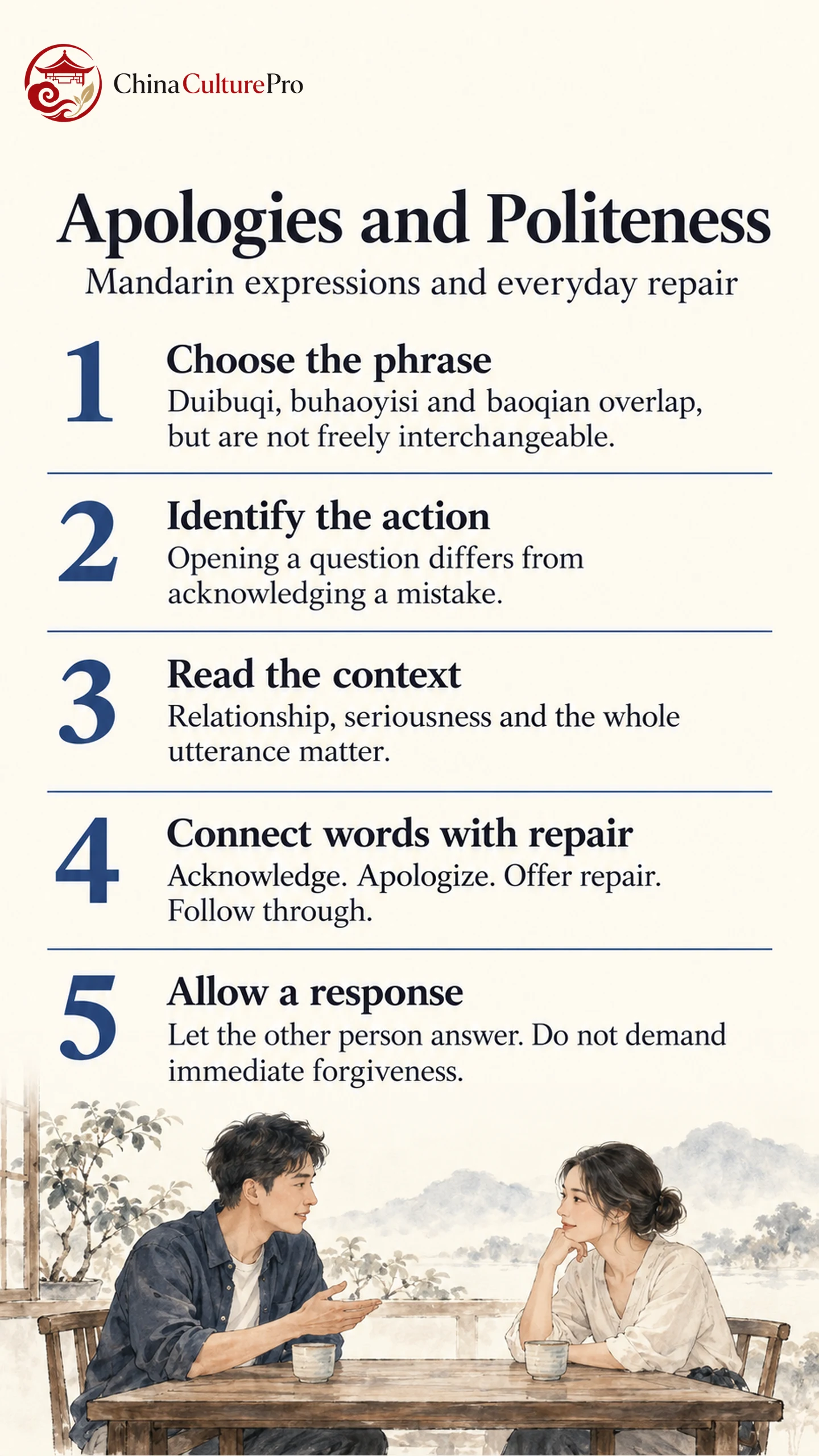
A polite apology connects the words with the situation: what happened, who was affected and what you can do next. First decide whether you are apologizing for a mistake or simply asking for someone’s attention.
- Choose the action: An apology, a question and a thank-you do different work.
- Use a suitable phrase: Mandarin has several common apology expressions with overlapping uses.
- Acknowledge the effect: Make the inconvenience or mistake understandable.
- Offer a useful response: Explanation, responsibility and practical repair can support the words.
The examples below are Mandarin learning aids. Relationships, tone and the actual event influence how an expression is understood.
English “sorry” can apologize, interrupt or soften a request. Translating it into Chinese therefore requires more than choosing one equivalent word. Ask what you are trying to accomplish, then make that action clear.
This guide explains common Mandarin expressions and how to combine them with an appropriate response. Chinese greetings covers opening an encounter, and Chinese languages and dialects explains the wider language setting.
Three Common Ways to Apologize
These three expressions commonly participate in Mandarin apologies.[1] Their descriptions are starting points for a learner, not guarantees about every conversation.
| Ungkapan | Basic function | Useful consideration |
|---|---|---|
| Duibuqi (对不起, duìbùqǐ) | An explicit expression of apology | Make the mistake or responsibility clear |
| Buhaoyisi (不好意思, bù hǎoyìsi) | An expression of embarrassment or inconvenience that can function as an apology | Common in everyday inconveniences and some request openings |
| Baoqian (抱歉, bàoqiàn) | An expression of regret used to apologize | Can suit a more formal or serious apology |
A 2025 analysis of naturally occurring Mandarin conversation found that the forms were not freely interchangeable: their selection helped participants express differences in seriousness and responsibility. Other features of the sentence also affected how the apology worked.[6]
Learn a short expression you can say clearly and connect it to the event. “I’m sorry I’m late” communicates more than searching for the supposedly strongest apology word. The pinyin guide explains the pronunciation notation used here.
An Apology and a Request Opening Have Different Jobs
Qingwen (请问, qǐngwèn), meaning “may I ask,” is a polite opening before a question. It draws attention to the question rather than admitting that you have already done something wrong. Apology expressions can also serve as attention-getters before requests.[2]
For example, 请问,洗手间在哪儿? (qǐngwèn, xǐshǒujiān zài nǎr?) asks, “Excuse me, where is the restroom?” The phrase opens a request for information. If you have damaged someone’s belongings, merely asking for attention would leave the actual problem unaddressed.
Keep the request itself clear. A long chain of polite openings can make a simple question harder to follow. A greeting, an appropriate form of address or one short attention-getter may be enough for the situation.[2] The forms of address guide helps with names and titles.
After someone helps, thank them. That is a separate action from apologizing for the interruption. The thank-you guide covers expressions of gratitude without turning every request into an admission of fault.
Match the Situation and the Relationship
Consider both the relationship and the effect of the event. Being slightly late to meet a close friend and causing a serious inconvenience to someone you barely know can require different amounts of explanation and acknowledgment. How well people know each other and how much inconvenience was caused help shape the apology.[3]
That does not mean close friends never deserve a direct apology. Familiarity may make a short explanation understandable, but it does not erase the other person’s experience. If a friend is upset, respond to that rather than assuming that informality makes the issue disappear.
Formality can also come from the setting. A message to a new colleague may need the problem and next action stated more explicitly than a quick exchange with someone who saw what happened. The business etiquette guide covers communication around meetings and follow-up.
Avoid judging sincerity from a single word. Listen to the whole response: acknowledgment, explanation, concern and action. The related discussions of face in Chinese culture and Chinese modesty explain other aspects of self-presentation without making them excuses for a broken promise.
Add Responsibility and Practical Repair
An apology can combine an explicit expression with an explanation or acknowledgment of fault.[4] Keep an explanation relevant: it should make the event understandable, not make the other person responsible for being inconvenienced.
For an everyday mistake:
- Identify the problem: Say what happened and acknowledge its effect on the other person.
- Apologize clearly: Use a suitable apology expression without burying it in excuses.
- Offer a practical repair: Suggest a useful action that you can actually carry out.
- Follow through: Carry out the agreed action and change the behavior where needed.
Offers of repair, attention to the other person and commitments about future behavior can support an apology.[5] The useful promise is one you can keep, not the most dramatic one you can produce.
Here is an illustrative example: “I sent the wrong version and caused extra work. I’m sorry. I’ll send the corrected file this afternoon and clearly mark the change.” It names the problem, acknowledges its effect and gives a checkable next step. The same structure can be expressed in the language you can use accurately.
A short Mandarin example is 对不起,我迟到了 (duìbùqǐ, wǒ chídào le), “I’m sorry I’m late.” If someone has been waiting, add whatever practical information they now need. Do not invent an excuse merely because you have learned the grammar for one.
Leave Room for the Other Person’s Response
An apology is part of an exchange. After making the point, let the other person respond. They may accept it, ask a question, explain the inconvenience or need time before discussing a solution.
Repeating yourself can prevent that response from happening. If the issue has been acknowledged and a next step agreed, follow through instead of repeatedly asking whether you have been forgiven. If an important misunderstanding remains, clarify it briefly.
When receiving an apology, you can acknowledge the words and still explain what needs to change: “Thank you for telling me; please send the corrected details.” Accepting an apology and agreeing that nothing more is needed are different decisions.
At a home visit or after a cultural-etiquette misunderstanding, a small correction may be enough. Let the actual person’s reaction guide the response rather than assuming the incident requires a prescribed ritual.
FAQs About Chinese Apologies and Politeness
Can I use the same phrase for sorry and excuse me?
Some apology expressions also open requests, but their job changes with the situation. Before a question, an attention-getter may suffice; after causing a problem, acknowledge the problem itself.
Is an explanation enough without saying sorry?
Sometimes an explanation participates in an apology, especially when people share the context. For a learner, a clear apology plus a relevant explanation is often easier to understand than relying on implication.
Should I keep repeating an apology?
Give the other person room to answer. Once a next step is agreed, carrying it out is more useful than repeating the same words. Clarify only what remains unresolved.
Is thank you a substitute for an apology?
Gratitude acknowledges help or consideration; an apology addresses a mistake or inconvenience. They can occur together, but thanking someone does not automatically acknowledge responsibility for what happened.
Sumber
[1] Kansas State University, Chinese Pragmatics. Unit 2: Direct Apology Strategies in Chinese
[2] Kansas State University, Chinese Pragmatics. Requests, Unit 3: Alerters
[3] Kansas State University, Chinese Pragmatics. Unit 6: Social Variables that Affect Apologetic Behaviors
[4] Kansas State University, Chinese Pragmatics. Unit 3: Indirect Apology Strategies in Chinese, Explanation and Responsibility
[5] Kansas State University, Chinese Pragmatics. Unit 4: Indirect Apology Strategies in Chinese, Repair and Concern
[6] Ocean University of China, School of Foreign Languages. Research on apology formats in naturally occurring Mandarin conversation, 2025