


Quick Answer: How Do You Say Thank You in Chinese?
The basic Mandarin expression for thank you is 谢谢 (xièxie). It can stand alone as a short acknowledgment of help or kindness. [1]
- Everyday thanks: Begin with a straightforward thank you; elaborate when the occasion calls for it.
- Respectful address: 您 (nín) means a respectful “you”; respect and emotional emphasis are different choices. [2]
- Specific acknowledgment: Recognizing effort or inconvenience adds information that a generic thank you may leave unstated.
- A reply: Learn a response to gratitude as well as an expression of thanks.
These readings are Mandarin. Other Chinese languages have their own pronunciations and expressions; the same written characters do not guarantee the same spoken form.
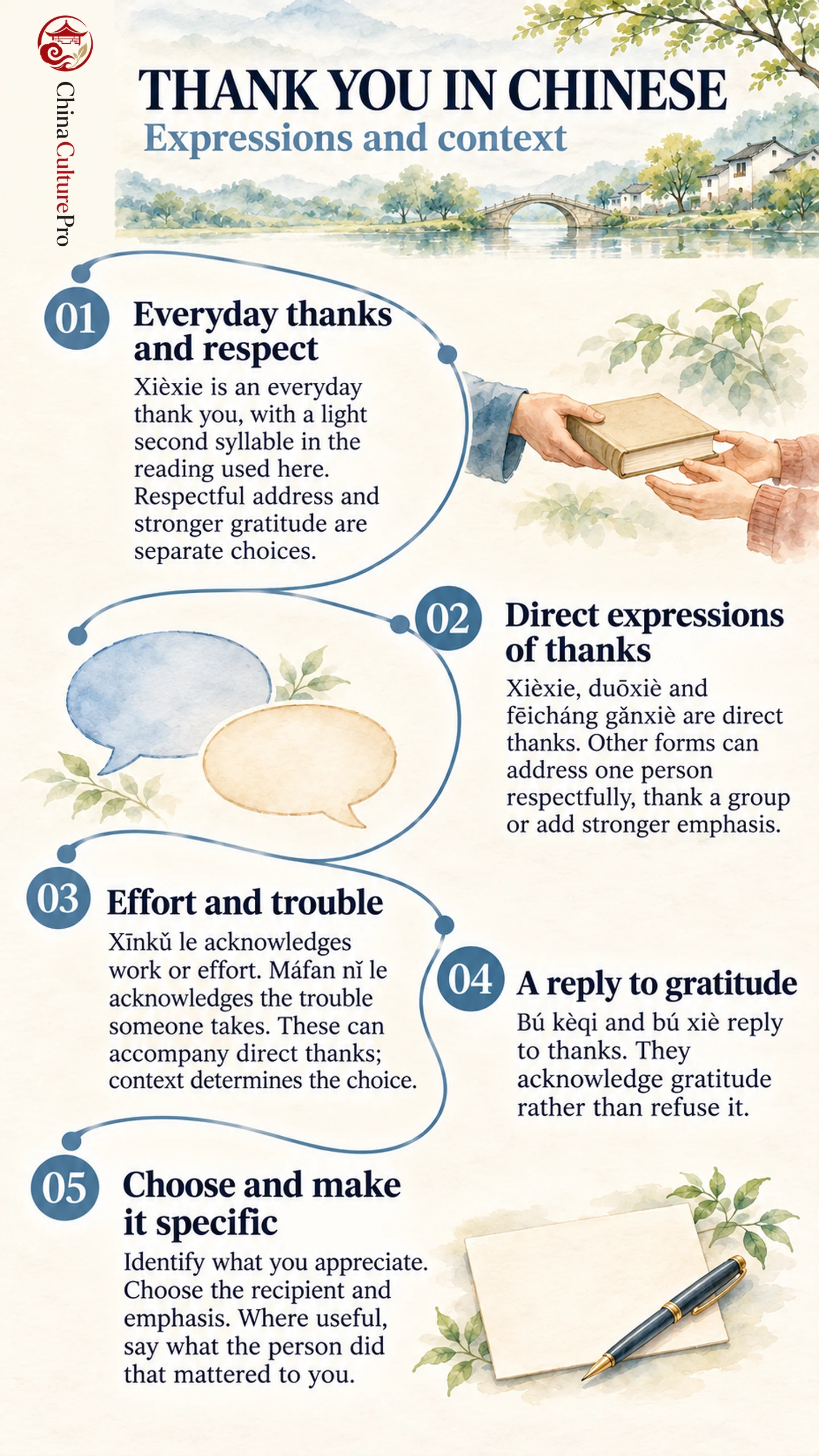
A useful thank you fits both the person and the help received. Returning a borrowed book, acknowledging several hours of assistance and thanking a group need not sound identical. You do not need a long speech to make the distinction clear.
This guide separates direct thanks from expressions that recognize work or trouble. It also explains how to answer when someone thanks you. For the wider relationship between words, address and setting, see Chinese greetings and etiquette.
Everyday Thanks, Respect and Stronger Emphasis
In the conversational pronunciation used here, xièxie starts with a falling fourth tone, while the second syllable is light and neutral. The absence of a tone mark on that second syllable is deliberate. Practise the pair together rather than giving both syllables equal stress. [3]
If the spelling is unfamiliar, pinyin explains the sound notation, while the guide to Mandarin tones explains why pitch matters. An English sound approximation cannot reproduce all these distinctions reliably.
Adding respectful address identifies how you are addressing the recipient. It does not by itself announce that the favor was unusually large. The respectful pronoun is often relevant with elders or people addressed with particular deference, but a person’s age alone does not supply a universal rule for every relationship. [2]
Another useful word is 感谢 (gǎnxiè), meaning to thank or express gratitude. Its meaning concerns appreciation for a benefit received. [8] It often suits speeches and more formal messages, but describing that tendency does not make it a word restricted to writing. [3]
Six Direct Ways to Express Thanks
These six expressions provide direct ways to thank someone. Choose the recipient and meaning first. The English translations describe their function; they are not word-for-word templates for every sentence.
| Expression and Mandarin pinyin | Makna | A useful distinction |
|---|---|---|
| 谢谢 (xièxie) | Thank you; thanks. | A short direct acknowledgment. [1] |
| 谢谢您 (xièxie nín) | Thank you, with respectful address. | Adds respectful “you,” rather than an intensifier. [2][3] |
| 谢谢大家 (xièxie dàjiā) | Thank you, everyone. | Addresses a group collectively. [3] |
| 多谢 (duōxiè) | Many thanks. | A concise expression of gratitude. [4] |
| 非常感谢 (fēicháng gǎnxiè) | Thank you very much. | Makes the strength of appreciation explicit. [5] |
| 太谢谢你了 (tài xièxie nǐ le) | Thank you so much. | An emphatic thanks addressed to one person. [5] |
The last two expressions both add emphasis. They need not replace a simple thank you for every small action. In a message, choose one opening that matches what you mean, then explain the particular help if that would add something useful.
A group thank you also has a different job from a respectful singular form. If several people helped, consider whether you are thanking everyone together or addressing one person within the group. Changing the recipient is not the same operation as making the gratitude stronger.
Acknowledging Effort and Trouble
辛苦了 (xīnkǔ le) recognizes someone’s work or effort. Its point is the exertion involved, so it adds a different emphasis from merely naming a gift or benefit. It can accompany direct thanks when the person has put time and energy into helping. [6]
麻烦你了 (máfan nǐ le) acknowledges the trouble someone takes for you. It can convey appreciation alongside recognition that a request has imposed on the other person. Do not treat it as a necessary admission that you have done something wrong: its meaning depends on the exchange. [6]
These phrases are useful because they say what is being noticed. They are not compulsory lines assigned to particular occupations. Think about whether effort or inconvenience is actually relevant; otherwise, a direct thank you may communicate your intention more clearly.
How to Reply When Someone Thanks You
Two useful replies are 不客气 (bú kèqi), equivalent to “you’re welcome,” and 不谢 (bú xiè), another response to thanks. Their negative wording does not mean that the speaker is rejecting the other person’s gratitude. [7]
A minimal practice exchange can simply pair “Xièxie” from one speaker with “Bú kèqi” from the other. Practise the response as part of the exchange rather than translating each character separately. [7]
A greeting opens an interaction, while a reply to thanks answers appreciation already expressed. If you also need an opener, the guide to saying hello in Mandarin covers that separate task.
Choosing the Thanks That Fit the Help
Use these three steps when you are deciding what to say or write:
- Identify what you appreciate: Decide whether you are thanking someone for a simple action, sustained effort or extra trouble. That distinction helps you choose direct thanks and any useful acknowledgment.
- Choose the person and emphasis: Address one person, a group or someone you wish to address respectfully. Add stronger emphasis when it reflects your appreciation rather than assuming that every thank you needs an intensifier.
- Make the thanks specific: Where useful, add what the person did that mattered to you. A brief, accurate explanation can make your gratitude clearer than a string of increasingly elaborate expressions.
When a message needs a family title, check the relevant Chinese family term rather than guessing from an English word such as “uncle.” The right recipient matters as much as the opening formula.
FAQs About Saying Thank You in Chinese
Is duōxiè a Mandarin expression?
Yes. Duōxiè is a Mandarin reading for “many thanks.” Seeing the same characters in another Chinese language does not make that language’s pronunciation interchangeable with Mandarin; compare regional readings and romanization for the broader distinction. [4]
Can I thank a close friend or family member directly?
Yes. Direct thanks can be used between close people as well as strangers. Choose wording that fits your relationship and the particular favor rather than following a blanket rule that family members must never thank one another. [3]
Does a respectful form automatically express stronger gratitude?
No. Respectful address concerns the recipient, while an intensifier concerns the strength of the appreciation. You can address someone respectfully without claiming that every favor was extraordinary. [2]
Sumber
[1] Routledge. Chinese Language Course: Lesson 1
[2] Taiwan Ministry of Education. Revised Mandarin Chinese Dictionary: 您
[3] ChineseClass101. How to Say Thank You
[4] Taiwan Ministry of Education. Revised Mandarin Chinese Dictionary: 多謝
[5] That’s Mandarin. Four Ways to Say Thank You in Chinese
[6] Chénjìn. Thank You in Chinese: Xièxie and Nine More Ways to Say Thanks
[7] The Open University. Getting Started with Chinese 1: Responding to Xièxie
[8] Taiwan Ministry of Education. Revised Mandarin Chinese Dictionary: 感謝