
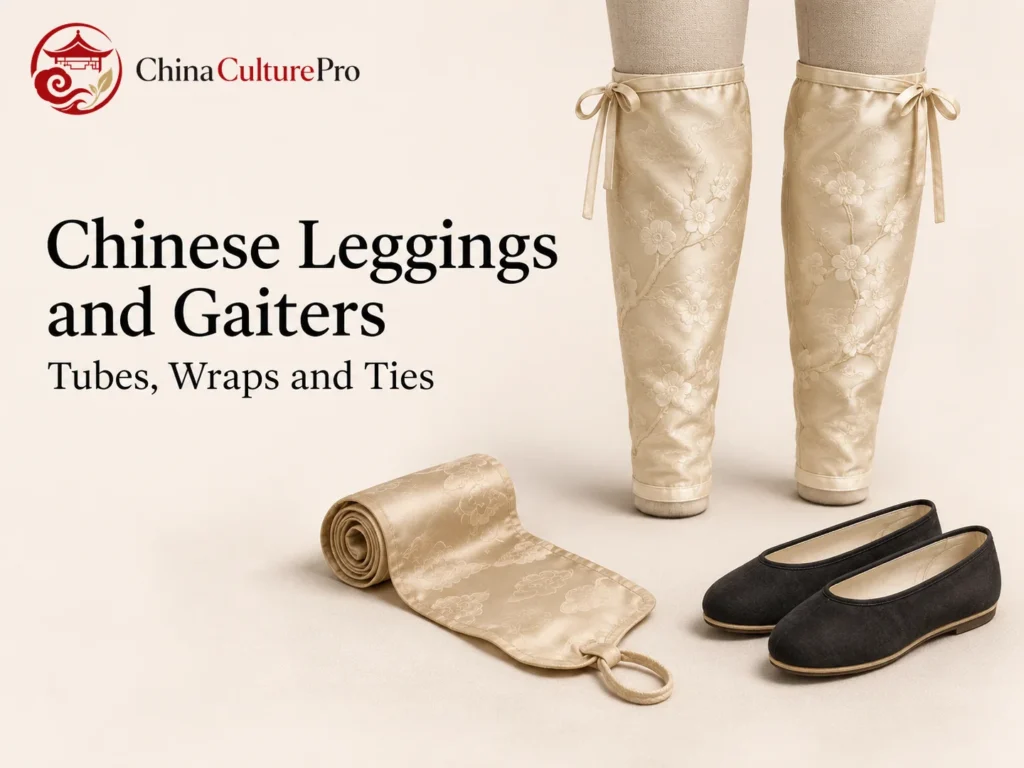

Quick Answer: How Did Chinese Leggings and Gaiters Work?
Chinese leggings and gaiters covered the lower leg. The historical term xiku (膝裤, xīkù) refers to one group of lower-leg coverings, including separate cloth tubes.[1][3]
- Coverage: Many examples cover the shin and ankle, leaving the foot to a separate sock or shoe.[2][3]
- Fastening: A covering can have an upper tie or a lower loop.[2][3]
- Use: Examples range from practical warmth to embroidered accessories and uniform pieces.[1][3][4]
The garments form part of the history of Chinese clothing.

To identify a leg covering, look at both ends. The top can show how it stayed up, and the bottom can show how it met the foot or shoe.
Leg Coverings, Socks and Trouser Legs
The term jingyi (胫衣, jìngyī) can describe clothing for the shin. A separate tube or wrap covers one leg. An enclosed toe suggests a sock. A shared waistband connects the two legs of a pair of trousers. Some garments combine features, including a lower strap on a trouser leg.[1][2]
The Southern Song objects from Zhoutangqiao (周塘桥, Zhōutángqiáo) include socks and trousers as well as a separate leg covering. One pair of trousers has a lower strap and connected waist. A strap can therefore appear on either a separate covering or a trouser leg.[2]
A Song Leg Wrap and Ming Tied Tubes
Changzhou Museum describes a beige silk xingteng (行滕, xíngténg), or lower-leg wrap, from Zhoutangqiao. A strap sewn at the bottom helped it sit close when worn with shoes.[2]
A study of Ming clothing from Dingling (定陵, Dìnglíng) compares short leg coverings from the imperial tomb with xiku from tombs in Taizhou, Jiangsu. The latter examples are cloth tubes with an opening and two ties at the upper end. The study describes these as protection against cold.[3]
Ming studies also document women’s xiku as a decorative part of dress. In those examples, decoration changed the appearance of the area between skirt and shoes.[1]
Uniform Leggings and Modern Fit
A Qing pair catalogued as palace-guard leggings by the Asian Art Museum uses embroidered silk satin and gilt-bronze studs. The museum associates the pair with a matching jacket. In this case, the leg pieces belong to a documented ensemble.[4]
Try a modern reproduction with the shoes and lower hem you intend to wear. Bend the knee to check the upper edge. Walk a few steps to see whether the lower edge bunches inside cloth shoes. A raised toe, as on some cloud shoes, changes what is visible below a long hem.
FAQs About Chinese Leggings and Gaiters
Were Historical Leggings the Same as Socks?
A lower-leg wrap covers the shin. A sock can enclose the foot. Museum labels sometimes use terms that overlap.[2][3]
Were Gaiters Always Worn With Boots?
The Song wrap is described in relation to shoes.[2]
Do the Old Terms Identify One Exact Cut?
The Dingling study compares coverings with different dimensions and openings. The object’s shape and fastening can clarify the name.[3]
Sumber
[1] Chen Chen and Chen Fang, Beijing Institute of Fashion Technology. Changing Uses of Women’s Xiku in the Ming Dynasty
[2] Changzhou Museum. Textiles From the Southern Song Tomb at Zhoutangqiao
[3] Beijing Wenbo. Imperial Clothing Excavated at Dingling
[4] Asian Art Museum. Leggings for Palace Guard, Pair With Jacket