
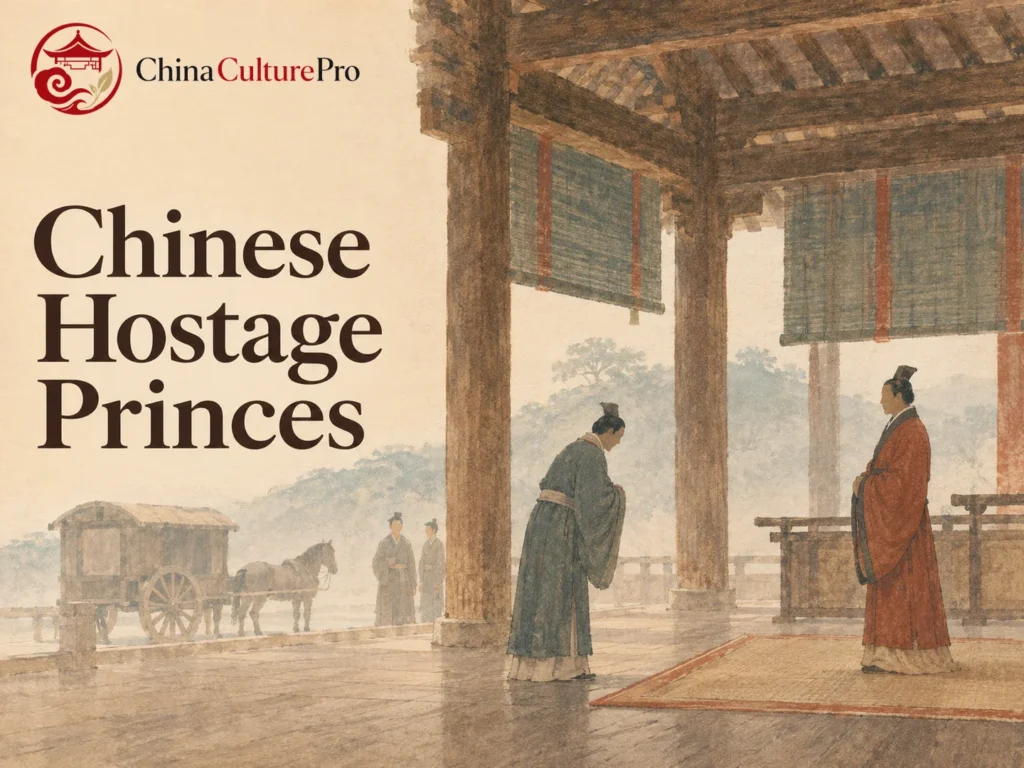

Quick Answer: What Was a Chinese Hostage Prince?
A hostage prince (質子, zhìzǐ) was a member of a ruling family sent to another court as a pledge in a political relationship. The receiving court could hold him if relations broke down. Rulers in pre-imperial China used such arrangements, and the Han later negotiated them with neighboring powers. [1][4]
- Sending court: A ruler could use a relative’s presence abroad to back a promise, seek peace or maintain ties.
- Receiving court: The host gained leverage, including a say in when the hostage could leave.
- Hostage: A prince’s rank could earn him a position at court while his movement remained subject to political decisions. [1][3][4]
The terms of an exchange depended on the parties and their balance of power.

Sending a ruler’s son away could help keep a bargain in place. It could also put the receiving court in a position to influence who ruled when a throne fell vacant. A case from Loulan (樓蘭, Lóulán) shows how the timing of one prince’s return could shape a succession. [4]
Why Courts Sent and Received Hostage Princes
A promise was easier to make than to enforce. The presence of a valued relative gave the other ruler a reason to take it seriously. If the agreement failed, the host could delay the prince’s return or change how he was treated. The arrangement left the sending court with something to lose even before a war began. [1][3]
Sometimes both courts provided a pledge. In an early Spring and Autumn account in the Zuo Tradition (左傳, Zuǒzhuàn), a prince of the Zhou royal house went to Zheng, while a prince of Zheng went to Zhou. The two men had different names in Chinese, 狐 and 忽, both often rendered Hu in English without tone marks. The exchange moved people in both directions. That tells us how the parties pledged themselves, without establishing that the two courts held identical rank. [2]
Other arrangements were one-sided. The difference is worth checking before assuming that “hostage exchange” always refers to two people sent in opposite directions. A single court might seek a prince as evidence of submission, while a sender could see the same arrangement as a way to gain a hearing or keep an agreement alive. [1][4][5]
Yiren in Zhao: From Qin Hostage to King
During the Warring States period, the Qin prince Yiren (異人, Yìrén), also known as Zichu (子楚, Zǐchǔ), was sent to Zhao. He was one of Lord Anguo’s many sons. The account of the merchant Lü Buwei (呂不韋, Lǚ Bùwéi) in the Shiji (史記, Shǐjì) describes a prince with limited standing at home and little favor at his host court. Qin had repeatedly attacked Zhao, making Yiren’s position there especially difficult. [3]
Lü saw a political opportunity. He helped secure support for Yiren in Qin by working through Lady Huayang, who had no son of her own and held influence with Lord Anguo. Yiren eventually returned and became King Zhuangxiang of Qin. His son Zheng later became the First Emperor. Yiren was the prince sent as a pledge. Zheng spent part of his childhood in Zhao before joining his father in Qin. [3]
The account comes to us as part of Lü Buwei’s biography, which gives the merchant’s intervention particular prominence. Reading the story within that genre helps distinguish the attested political sequence from the biographer’s portrait of ambition. See Chinese historiography for how biographies fit within early histories. [3]
Loulan and the Han Frontier: Pledges to Two Powers
Loulan, a kingdom of the Western Regions, faced demands from both Han and Xiongnu. It sent a son to each power. When one king died, Loulan asked Han to release a prince it wanted to enthrone. Han declined, and another ruler was installed. After a later death, the Xiongnu sent back their Loulan hostage and the prince took the throne. The Han court subsequently summoned the new king, who put off the visit. [4]
For a small kingdom, sending princes in two directions could keep relations open with rival powers. For the receiving powers, returning one prince could have as much political value as holding him. The Han also received an attendant son (侍子, shìzǐ) from the Xiongnu leader Huhanye in 53 BCE. His rival Zhizhi sent a son as well, showing that separate rival leaders could seek a connection with the same imperial court. [4][5]
| Contoh | Who sent a pledge | What the arrangement shows |
|---|---|---|
| Zhou and Zheng | A prince went from each court to the other. | Two-way pledges could accompany a disputed relationship. [2] |
| Qin and Zhao | Qin sent Yiren to Zhao. | A prince with little standing at home could later become a ruler. [3] |
| Loulan, Han and Xiongnu | Loulan sent sons to both larger powers. | The power that returned a prince could influence succession. [4] |
How Hostage Diplomacy Differed From Marriage Alliances
A hostage pledge gave a receiving court leverage through the presence of a relative. Marriage diplomacy, including heqin (和親, héqīn), used a marriage to create or renew a relationship between ruling houses. Both devices could appear in a negotiation. When the Han envoy Yang Xin demanded a crown prince in talks with a Xiongnu ruler, the ruler objected that the demand had not been part of their previous marriage arrangement. The episode shows why a marriage agreement did not automatically carry a hostage clause. [1][5]
A marriage could create continuing obligations between courts even when no prince was sent abroad. For the related practice of negotiating kinship and peace, see heqin marriage diplomacy. [1][5]
FAQs About Chinese Hostage Princes
Did Hostage Princes Live in Prison?
Living conditions varied. Yiren received allowances in Zhao but had little favor there. Some Han records describe princes attending at court. The diplomatic role concerns why they were present and who controlled their departure. [3][4][5]
Was the Hostage Always the Crown Prince?
A ruler could demand a crown prince, but Yiren was chosen from among several sons with unequal standing. The choice depended on what the host demanded and what the sending court would concede. [3][5]
Why Do Some Sources Say Attendant Son?
The expression describes the person’s place at the receiving court. In some Han cases, the same arrangement also gave the host a pledge. Read the surrounding account to see who could authorize the prince’s return. [4][5]
Sumber
[1] Robin D. S. Yates. ‘International Law’ and Interpolity Relations in the Early Empires on the East Asian Subcontinent
[2] Jiahui Shen. Manifest the Hidden: Wen 文 and Zhi 質 as a Conceptual Pair in Early Chinese Thought
[3] Robert Eno. The Warring States Period
[4] Taishan Yu. A History of the Relationship Between the Chinese Dynasties and the Western Regions
[5] Turkic Atlas. Diplomacy of the Steppe Empires