


Quick Answer: What Did Chinese Court Banquets Do?
Chinese court banquets marked events such as imperial birthdays and formal receptions. Qing examples show how a shared meal could make differences in rank visible. Officials assigned seats, arranged food and vessels, and planned the sequence of service and ceremony. The venue and guest list depended on the occasion.[1][2][3][5]
- Seating: The position of a guest relative to the ruler expressed rank and role.
- Service: Several offices could help prepare or present food and drink.
- Evidence: Plans, accounts and edicts preserve different details.
The examples here focus on well-documented Qing practices.
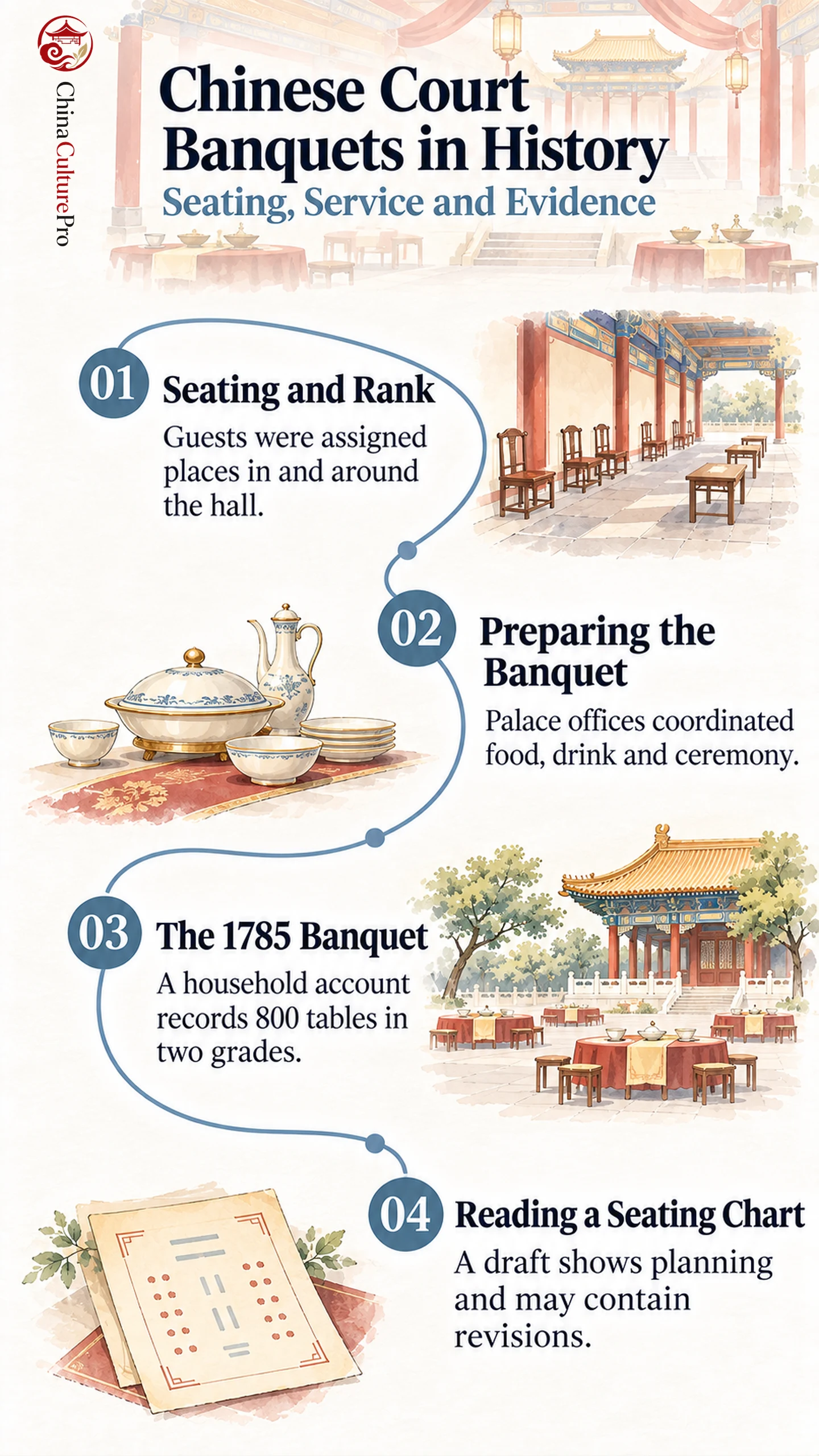
A place at a court banquet told guests more than where to sit. A table inside the hall and one in the courtyard could indicate different standing. Kitchen accounts and surviving seating plans show how the palace organized that distinction.
How Seating Made Rank Visible
At formal banquets in the Hall of Supreme Harmony (太和殿, Tàihédiàn), the Qing ruler’s table stood on a raised area. The Palace Museum describes other tables placed within the hall, along the front corridor or in temporary shelters outside. For example, some princes and titled guests had places in the hall, while many officials sat in temporary shelters in the courtyard.[1][2]
The layout was also subject to revision. The Imperial Palace History records an instruction that grand secretaries and ministers sit within the hall at the New Year banquet, reflecting how the ruler wanted their rank shown. The buildings of the Forbidden City provide the setting, while the written orders explain who was entitled to a particular place.[1][2]
Who Prepared the Food and the Ceremony
A large banquet required preparations across several offices. The ceremonial account describes the Board of Rites requesting approval, palace staff arranging tea and the ruler’s food, and other offices and titled guests providing parts of the banquet. The ceremonial text also gives a sequence for presenting tea, food and wine, with gestures of thanks and performances at specified points.[1][2][3]
The palace also maintained kitchens for ordinary meals and particular groups. Those daily arrangements had their own staffing and provisions. A formal reception record describes service on that occasion. The broader guide to Chinese banquets covers meals beyond the imperial court.[1][3]
The 1785 Banquet of a Thousand Elders
The Qianlong emperor held a Banquet of a Thousand Elders (千叟宴, Qiānsǒuyàn) at the Palace of Heavenly Purity (乾清宫, Qiánqīnggōng) in 1785. Academia Sinica’s description of an edict from the same anniversary year identifies an expanded guest list, including members of the imperial clan, older commoners and Joseon representatives. For the role of envoys, see Chinese diplomatic missions.[5]
The Palace Museum cites a household account that records 800 tables in two grades and gives a wine allowance for each table. It is evidence of provision and scale. The account tells us how many tables were provided for. Establishing how many people came requires attendance evidence.[4]
What a Seating Chart Can Tell Us
Academia Sinica preserves a seating chart from the Tongzhi reign, item 038315. Written labels mark positions and their order. The museum interprets the changes and corrections on the sheet as signs of a working draft. The museum provisionally connects it with plans for a birthday banquet. The changes show that officials revised the placement of guests during planning.[6]
To establish who actually attended, look for records that name the people present or describe the occasion after it happened. A draft chart can be strong evidence of planning in the Qing dynasty even when the final seating or attendance remains uncertain.[1][5][6]
FAQs About Chinese Court Banquets
Was a court banquet the emperor’s everyday meal?
Court kitchens supported daily meals as well as ceremonial events. A formal banquet had a particular occasion, guest list and protocol.
Were all guests served the same banquet?
The 1785 accounts distinguish two grades of tables. Check the records of the specific banquet before assuming which guests had the same service.
Can a seating chart prove who attended?
A seating chart records an arrangement. Revisions, approvals and accounts of the event can help establish whether that plan was used and who was present.
Sumber
[1] Qing Palace History, Continuation, Wikisource. Imperial Palace History, Continuation, juan 40
[2] Palace Museum. Banquets in the Hall of Supreme Harmony
[3] Palace Museum. Qing Palace Food and Drink
[4] Palace Museum. Drinking at the Qing Court
[5] Museum of the Institute of History and Philology, Academia Sinica. Imperial Edict on the Occasion of Emperor Qianlong’s 50th Anniversary of Enthronement
[6] Museum of the Institute of History and Philology, Academia Sinica. Seating Chart for the Imperial Banquet at the Hall of Supreme Harmony (Modified)