

Quick Answer: What Is Chinese Cosmology?
Chinese cosmology is a family of traditional ideas about the world’s order, change and the place of human life within it. It connects natural patterns with philosophical, religious and practical concerns.[1][8]
- Qi (气, qì) provides a vocabulary for the changing material and vital character of things.
- Yin and yang (阴阳, yīnyáng) describe relational contrasts and transformations.
- Wuxing (五行, wǔxíng), often called the Five Elements or Five Phases, organizes five interrelated processes.
- Calendars coordinate observed cycles, while divination interprets signs and situations through particular traditions.
These systems often interact, but they have different histories and functions. Describing a traditional interpretation does not establish its predictive reliability.
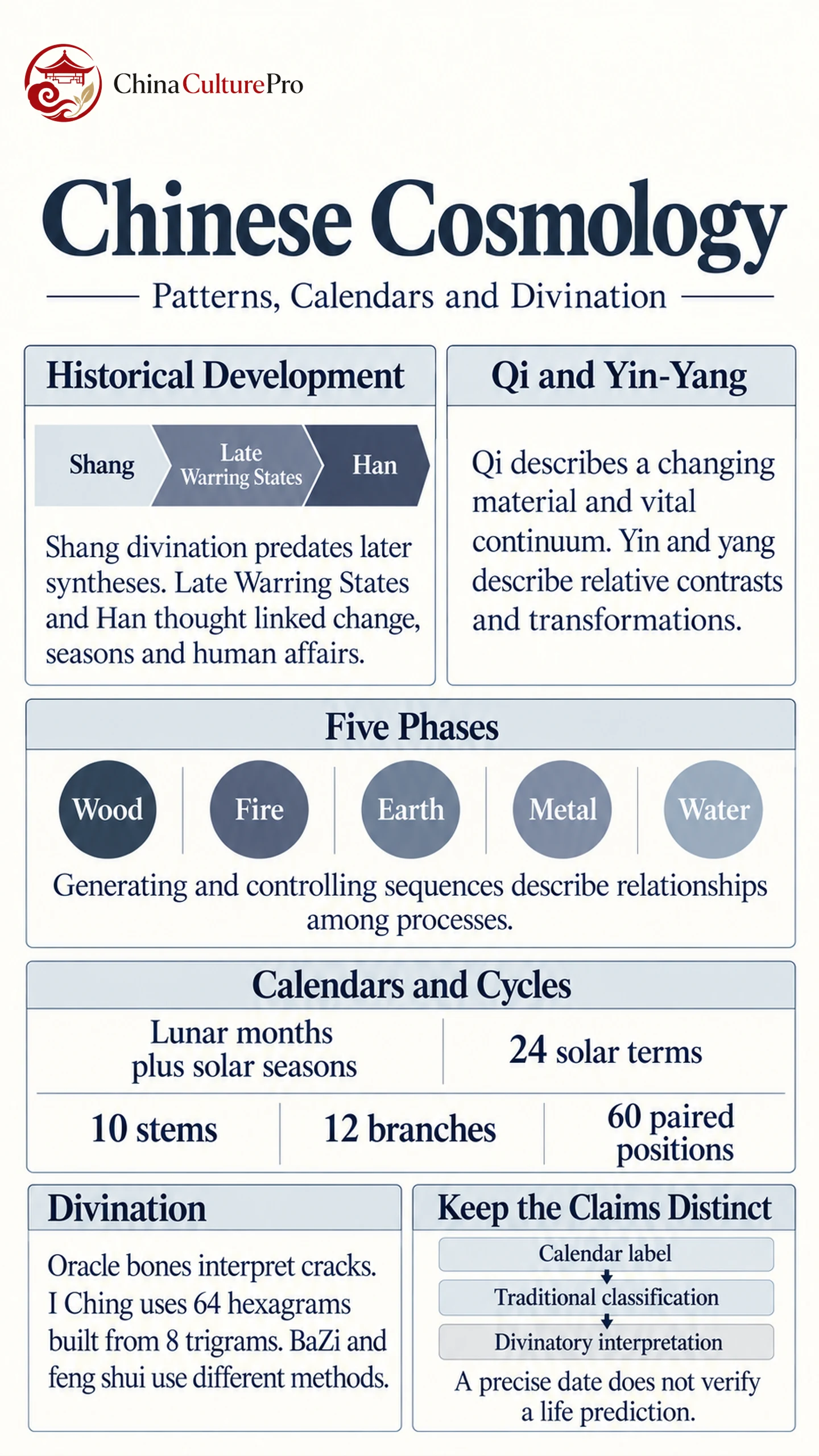
A date, a seasonal association and a divination symbol can belong to the same cultural setting without doing the same job. Chinese cosmology becomes easier to understand when those jobs remain visible. This guide maps the concepts and their connections within Chinese culture, with deeper articles for each system.
A Historical Family of Ideas
Chinese cosmological thought developed through many texts, practices and debates. It was never one unchanged doctrine held identically by everyone. Later combinations should not be projected backward onto every early practice.[1][8]
- Shang divination inscriptions record questions involving ancestors, harvests, warfare and royal affairs. Their ritual setting predates later cosmological syntheses.[7]
- During the late Warring States period and Han dynasty, increasingly elaborate schemes connected change, directions, seasons and human affairs.[8]
- Later philosophical and religious traditions reinterpreted these materials for their own questions. Familiar vocabulary could therefore carry different emphases.
The persistent interest is in patterned relationships: how change occurs, how parts belong within a wider order, and when a human response fits its circumstances. The related philosophy of nature explores the human place in that order.
Qi, Yin and Yang: Continuity and Changing Relations
In many traditional accounts, qi describes the continuum through which concrete things and processes take form. English translations include breath, vital force and material force. None should be treated as an exact equivalent of energy measured in modern physics. The guide to qi in Chinese thought explains this vocabulary more closely.[1]
Yin and yang describe relative modes within changing relationships. Shade and sunlight provide an accessible starting image; contraction and expansion, rest and activity offer other applications. An object need not possess one permanent classification independent of the comparison being made.[2]
For example, a shaded slope is yin in relation to a sunny slope. That comparison does not classify the shaded slope as morally bad or useless. Complementarity concerns the relationship of the paired terms.
Historical social uses could also rank the members of a pair, particularly in discussions of gender and status. A careful account can recognize conceptual interdependence without claiming that every historical application was egalitarian.[1]
Wuxing: Five Phases and Patterns of Correspondence
The five phase names are Wood (木, mù), Fire (火, huǒ), Earth (土, tǔ), Metal (金, jīn) and Water (水, shuǐ). In this framework they classify dynamic processes and relationships; they are not five chemical substances from which every object is literally assembled.[3]
Two common sequences describe their interaction. The generating sequence runs Wood → Fire → Earth → Metal → Water → Wood. The controlling sequence runs Wood → Earth → Water → Fire → Metal → Wood. “Controlling” concerns regulation within the model, rather than a judgment that one phase is evil.[3]
Correspondence schemes can connect phases with seasons, directions, colors, sounds or other categories. Such tables belong to particular textual and historical settings, and details can differ. The Wuxing overview explains the framework; the Five Elements cycles guide follows the two sequences.
A correspondence is a traditional classification or explanatory relationship. It does not by itself establish the kind of experimentally demonstrated causation expected in modern science.
Calendars: Coordinating Moon, Sun and Cycles
The traditional Chinese calendar combines lunar months with the solar seasonal year. Months have 29 or 30 days; a year normally has 12 months, with a leap month producing 13 in an intercalary year. Calling it simply a lunar calendar misses the solar side of the system.[4]
Solar terms (节气, jiéqì) divide the annual solar cycle into 24 named points. They help express seasonal timing and should not be confused with 24 equal lunar periods. See the Kalender lunisolar Tiongkok and 24 solar terms for the calendar’s structure.
The ten Heavenly Stems (天干, tiāngān) and twelve Earthly Branches (地支, dìzhī) also supply repeating time labels. Together they form Gan-Zhi (干支, gānzhī), whose sequential pairings repeat after 60 positions: the sexagenary cycle (六十甲子, liùshí jiǎzǐ). The stem-and-branch system is related to calendars but is not a separate set of lunar phases.[5]
Year boundaries depend on the application. Public calendar practice marks the new Chinese year at Lunar New Year; many fortune-telling practices use Start of Spring (立春, Lìchūn) for their year change. A date near those boundaries needs the relevant convention specified.[4]
Divination: Interpreting Signs and Situations
Divination includes different ways of seeking guidance. Shang oracle-bone practice applied heat to prepared bone or shell and interpreted the resulting cracks. Inscriptions could record a question, a divination and sometimes an outcome. These records are important evidence for early ritual and Chinese writing.[7]
The I Ching (易经, Yìjīng), or Book of Changes, uses 64 six-line figures, called hexagrams. Bagua (八卦, bāguà), the eight trigrams, comprises the possible three-line patterns. Later commentaries draw philosophical meanings from these symbols alongside their divinatory uses. The I Ching guide and eight-trigram guide explain their structures.[6]
Other methods organize interpretation differently. BaZi (八字, bāzì) examines the stem-branch labels of a birth’s year, month, day and hour; feng shui (风水, fēngshuǐ) concerns traditional judgments about places and orientation. Shared cosmological vocabulary does not make these interchangeable practices.[1][5][8]
The broader Chinese fortune-telling traditions deserve historical study while their predictive claims remain distinct from documented cultural use.
How to Keep Related Systems Distinct
Use the question a system answers to identify its role before combining it with another.
| Concept or system | Main conceptual job |
|---|---|
| Qi | The changing material and vital continuum described in many traditional accounts |
| Yin and yang | Relational modes used to describe contrasts and transformations |
| Wuxing | A five-phase framework for classifying processes and their relationships |
| Gan-Zhi | A repeating system of paired stem and branch labels for time |
These distinctions explain why one calendar date can carry a stem-branch name, a phase association and a divinatory interpretation. The label, classification and interpretation remain separate claims. The yin-yang and Five Elements comparison develops the distinction between the first two frameworks.
FAQs About Chinese Cosmology
Is Chinese cosmology the same as Daoism?
No. Cosmological ideas appear across Confucian, Daoist, religious and technical traditions. Daoism develops distinctive accounts within that broader history.
Are yin and yang the same as the Five Elements?
No. Yin and yang describe paired relations and transformations; the Five Elements supply a five-phase classification. They can be combined without becoming identical.
Is the Chinese calendar purely lunar?
No. It combines lunar months with solar seasonal timing, including solar terms and leap-month adjustments.
Does an accurate calendar prove a fortune-telling prediction?
No. Calculating a date or astronomical event and interpreting it as a prediction about a person’s life are different operations.
Does Chinese cosmology describe the universe like modern physics?
It belongs to historical philosophical, religious and technical traditions with different questions and standards of explanation. Its concepts should not be equated directly with modern physical quantities.
Sumber
[1] Columbia University, Asia for Educators. The Chinese Cosmos: Basic Concepts
[2] Internet Encyclopedia of Philosophy. Yinyang
[3] Internet Encyclopedia of Philosophy. Wuxing
[4] Hong Kong Observatory. What Year Is It Today?
[5] Hong Kong Observatory. Heavenly Stems and Earthly Branches
[6] Stanford Encyclopedia of Philosophy. Chinese Philosophy of Change
[7] Columbia University, Asia for Educators. Oracle Bone Inscriptions of the Late Shang Dynasty
[8] Lisa Raphals, Oxford handbook chapter hosted by University of Washington. Which Gods, If Any?