


Quick Answer: What Is Chaozhou Gongfu Tea?
Chaozhou gongfu tea(潮州工夫茶,Cháozhōu gōngfu chá)is a regional practice of preparing and sharing tea, especially oolong, associated with eastern Guangdong.[1]
- Identity: A brewing and drinking tradition, rather than a separate tea-leaf category.
- Equipment: Small brewing vessels and tasting cups support attentive preparation and service.
- Experience: The session brings together aroma, flavor, skilled handling and hospitality.
A formal presentation can be elaborate, while everyday practice is more flexible. Neither the name nor heritage recognition gives every cup an identical flavor or requires every household to stage a performance.
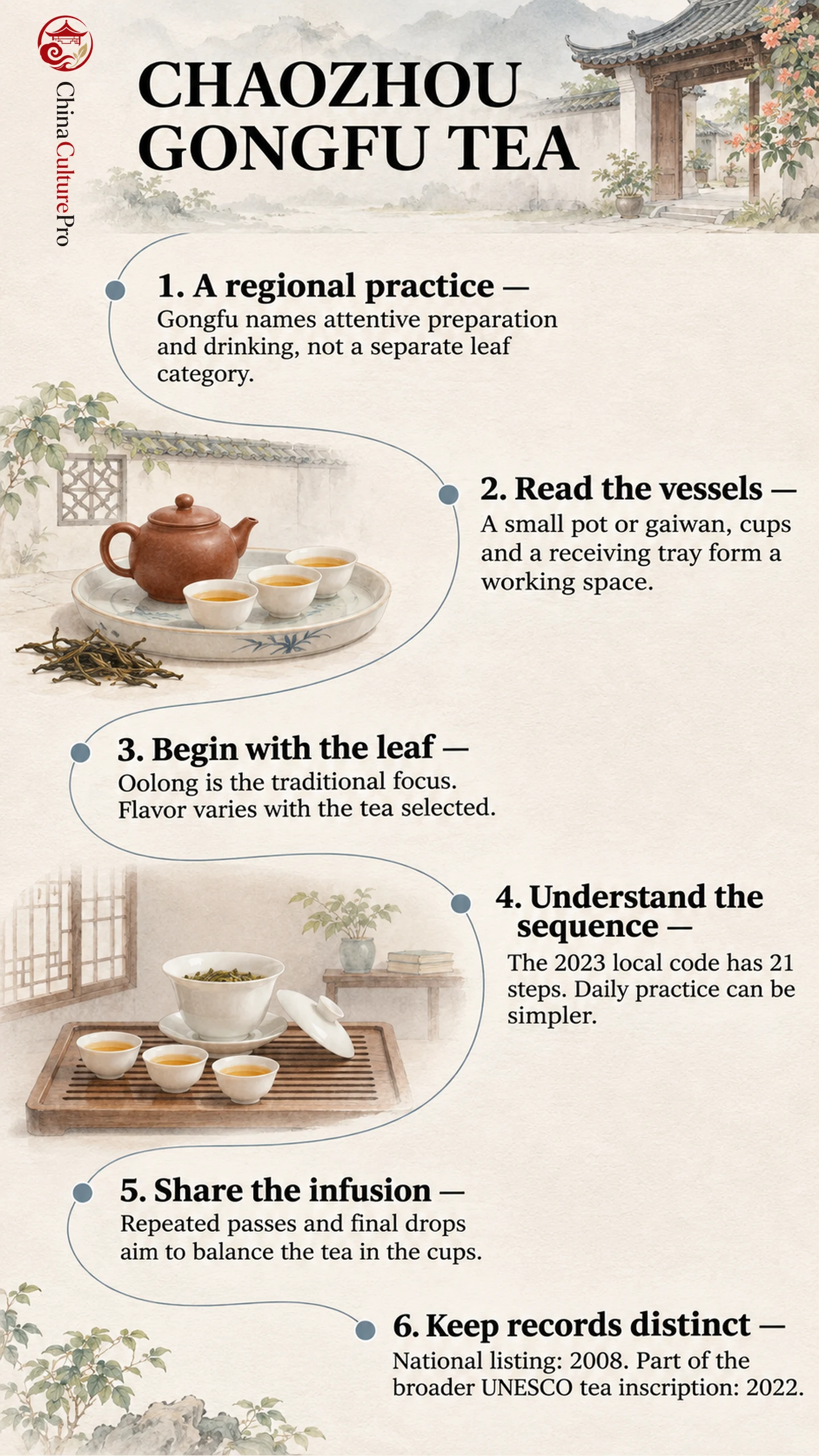
A small pot moves above a cluster of cups, sharing amber tea in several passes. The action looks decorative until you notice its purpose: each drinker receives part of the same infusion. Understanding Chaozhou gongfu tea begins with these working details—how the vessels, leaves, water and pouring fit together.
What the Name Means—and What It Does Not
Here, gongfu conveys meticulous attention and care. The local tradition favors the characters 工夫; the familiar English spelling does not make the practice a form of martial arts. The pinyin above gives the Mandarin reading, not a transcription of local speech.[2]
“Chaozhou” identifies the regional tradition within a wider world of small-vessel brewing. It does not mean that everyone using a small teapot is performing precisely this local form. Nor does “tea ceremony” necessarily mean a solemn occasion: field research records tea being prepared amid ordinary work, shops and conversation.[2] The distinction helps a visitor understand why a street-side session may look different from a rehearsed demonstration.
Teaware: Small Vessels and a Working Tea Tray
The local technical code permits both a small red-clay pot and a gaiwan(盖碗,gàiwǎn), a lidded bowl. It also describes white-porcelain cups, a clay kettle and stove.[3]
The set must also work as a workspace. Hot-water handling, pouring and collecting excess liquid happen close together; the tray or receiving vessel has a practical role beyond displaying attractive ceramics. Our gaiwan versus teapot guide explains the vessel choice in more detail.
Modern daily arrangements can be simpler. Ethnographic observations describe a gaiwan, three small cups, a receiving tray and an electric kettle.[2] A charcoal stove therefore belongs to an important traditional equipment setting, rather than being a prerequisite for every present-day session. For a beginner, watching the brewer’s grip and drainage is more useful than buying a large ceremonial set immediately.
Choosing the Tea and Understanding Its Flavor
Phoenix Dancong(凤凰单丛,Fènghuáng Dāncóng)is a representative Guangdong oolong. Its many aroma styles already show why “gongfu flavor” cannot be one tasting note. Oolongs can have natural floral or fruity characteristics, with differences linked to plant material, growing conditions and manufacture.[4]
Leaf processing comes before the tea reaches this table. A typical oolong manufacturing sequence includes withering, zuoqing(做青,zuòqīng), pan-firing, rolling and drying. Zuoqing alternates agitation and resting, managing moisture changes and enzymatic oxidation.[4] Brewing these finished leaves is a separate operation; the session is not manufacturing or fermenting the tea anew. Our oxidation and fermentation comparison explains that vocabulary.
When tasting, describe what is actually in your cup. Notice the aroma first, then the taste and the sensation left in the mouth. Does the next round seem lighter, more drying or differently fragrant? These are useful questions, not a promised sequence. The tea aroma vocabulary guide offers descriptive language without requiring you to find a particular flower in every tea.
The Brewing Sequence and Its 21 Formal Steps
Preparation, brewing and sharing offer a useful way to understand the sequence. In this teaching framework, preparation brings together utensils, water and leaves; brewing involves the handling and distribution of the infusion; sharing completes the experience.[5]
The 2023 code’s 21 headings can be grouped by function while retaining their order.[3]
| Fase | Steps in the 2023 code | Main purpose |
|---|---|---|
| Prepare | 1 Arrange utensils; 2 Light fire; 3 Clean hands; 4 Tend fire; 5 Present leaves; 6 Heat dry leaves; 7 Warm pot; 8 Warm cups | Ready the space and materials |
| Brew and serve | 9 Load leaves; 10 Moisten leaves; 11 Skim foam; 12 Scald cups; 13 Pour high; 14 Roll cups; 15 Pour low; 16 Distribute final drops; 17 Invite drinking | Prepare and share the infusion |
| Appreciate and close | 18 Smell aroma; 19 Sip; 20 Assess lingering aroma; 21 Thank guests | Taste and conclude |
This is an orientation to the formal sequence, not a complete home-brewing recipe. A teacher can demonstrate the connected movements and handling of hot vessels. Everyday practice may abbreviate the presentation; learning the purpose of a movement is more useful than treating the count alone as a test of authenticity.
Balanced Pouring into Small Cups
The characteristic serving action moves the pot across the waiting cups, rather than filling one completely before starting another. The last drops are distributed among them as well. This aims to balance the amount and character of tea each person receives. Three cups are familiar, but descriptions also record two or four.[6]
Two memorable names describe these actions: Guan Gong patrols the city(关公巡城,Guān Gōng xún chéng)for the repeated passes, and Han Xin counts the soldiers(韩信点兵,Hán Xìn diǎn bīng)for sharing the final drops.[6] They name brewing gestures; they do not establish that the historical figures invented them.
The contrast between pouring water into the vessel from higher up and serving tea close to the cups is another recognizable feature.[6] Observe the controlled movement rather than trying to reproduce a dramatic height. For questions about accepting cups, thanking the host and joining a gathering, see Chaoshan tea etiquette.
Historical Evidence and Heritage Recognition
Origin accounts require care. The national heritage entry traces the tradition to the Song dynasty, while the 2023 code describes its popularity from the Ming and Qing periods.[1][3] These summaries do not establish one inventor or a precisely documented first session.
The modern records are clearer: Chaozhou gongfu tea art entered China’s second national intangible cultural heritage list in 2008, under the folk-custom category.[1] In 2022 it formed part of the broader UNESCO inscription, Traditional tea processing techniques and associated social practices in China.[7] That international recognition covers a larger body of knowledge and social practices. It is not a separate certification awarded to each tea set, shop or brewed cup.
FAQs About Chaozhou Gongfu Tea
Is Chaozhou gongfu tea a type of oolong?
No. It is a preparation and drinking practice. Oolong is its principal traditional tea choice.
Do you need a charcoal stove?
No. Traditional equipment includes one, but electric kettles appear in contemporary daily practice.
Must every session follow all 21 steps?
No. The formal code is a detailed reference; ordinary sessions can use simpler arrangements.
Is Chaozhou gongfu tea a separate UNESCO inscription?
No. It is a component of the broader Chinese tea techniques and social-practices inscription.
Sumber
[1] China Intangible Cultural Heritage Network. Tea art: Chaozhou gongfu tea art
[2] Zhang Jinghong. The marginalization and mobility of gongfu tea heritage
[3] Chaozhou Administration for Market Regulation. DB4451/T 4—2023: Technical code of practice of Chaozhou gongfu tea ceremony
[4] Chinese Tea Science Society, Guo Yaling. Oolong tea production regions and classifications
[5] China Daily, Li Yingxue. A lesson steeped in tradition
[6] ChinaCulture. Tea Ceremony
[7] Guangdong Department of Culture and Tourism. Chinese tea techniques and associated customs inscribed, including Chaozhou gongfu tea art