
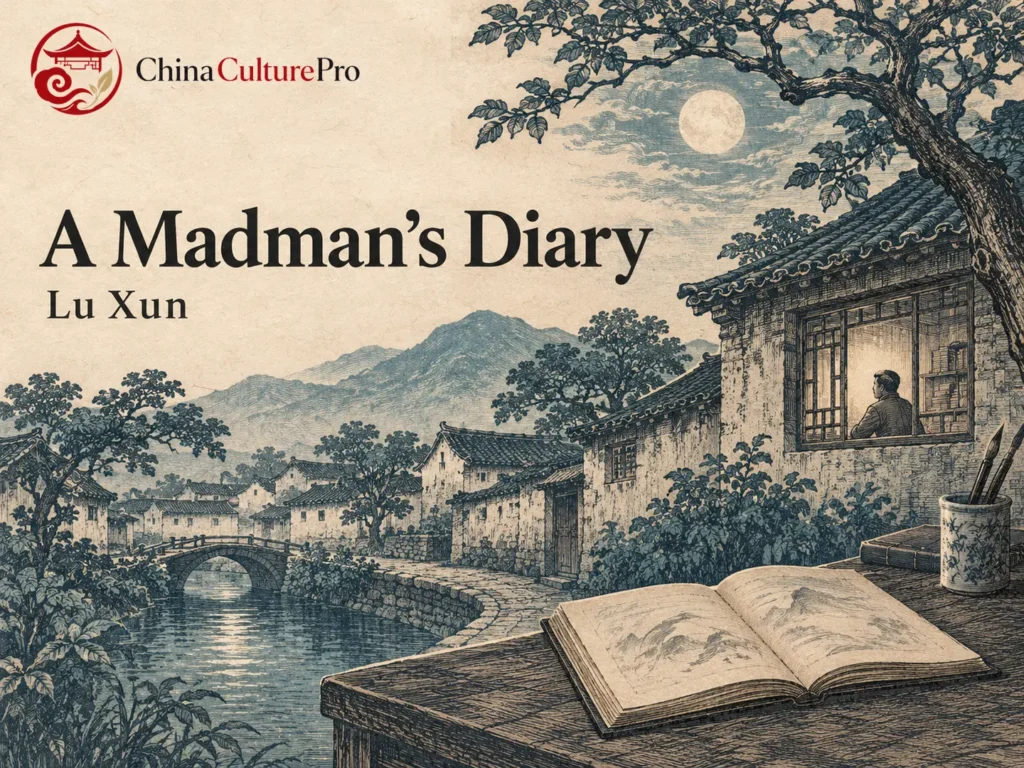

Quick Answer: What Is A Madman’s Diary About?
*A Madman’s Diary* (狂人日记, Kuángrén Rìjì) is a short story by Lu Xun (鲁迅, Lǔ Xùn), published in *New Youth* (新青年, Xīn Qīngnián) in May 1918. A man becomes convinced that the people around him eat human beings and intend to eat him. He starts to see the same appetite behind the moral language of the books he reads.[1][2]
- The form: A polished classical Chinese preface introduces a series of anxious vernacular diary entries.
- The tension: The diarist may misread a look or gesture, yet his suspicions expose forms of cruelty people around him accept.
- The focus: The story asks how harm becomes a habit people teach and defend.
Read the brief preface closely. It changes what the last entry means.[1]

Lu Xun puts two ways of telling the story on the same page. The first calls the diarist ill. The second lets him speak at length.
Who Gives Us the Diary?
The unnamed writer of the preface has known two brothers since their school days. Hearing that one has been ill, he goes to see them and meets the elder brother. The elder says the younger has recovered and gone elsewhere to await an official appointment. He shows the visitor two notebooks and lets him take them. The visitor says he has selected entries for medical readers and changed the names. He also reports that the diarist chose the title after his recovery.[1]
The preface is compact and written in classical Chinese. The entries use a more conversational vernacular and bring us close to a man who addresses what he sees in short, urgent bursts. The change of register matters even in translation. The writer of the frame can sound composed and socially credible while the diarist sounds erratic. Each voice gives the reader a different standard for what counts as normal.[1][2]
How the Village Becomes Threatening
The first entry starts with beautiful moonlight. A dog gives the diarist a look, and the look unsettles him. Later he notices people whispering, a man smiling and children watching. He gathers each detail into a single explanation. He thinks people have organized against him, and even the children have learned to do what their parents do.[1]
You can read these scenes twice. On the first reading, keep track of what he sees. On the second, keep track of what he thinks it means. A dog can look at him without knowing anything about him. Children can acquire a community’s fears and habits while the specific plot remains his own interpretation. The difference lets Lu Xun make the diarist’s reasoning frightening and perceptive in the same story.
What Cannibalism Means in the Story
The story’s phrase for eating people (吃人, chī rén) works in several registers. The diarist fears an actual meal in which he will be the meat. He also invokes accounts of people eating human flesh. When he opens an undated history, he reads words about benevolence and morality on the surface. Staying up late over the book, he decides that the words for eating people is written between the lines.[1]
That scene gives readers a way to understand the metaphor. A custom can have a respectable name and still cost somebody a great deal. The preface classifies the diarist’s writing as evidence of illness. The diary asks what the supposedly healthy people expect each other to tolerate. In Kong Yiji, Lu Xun uses a different speaker and setting to let everyday laughter reveal a community’s tolerance for humiliation.
What the Ending Asks of the Reader
From here, the discussion reveals the ending. The diarist tells his older brother that people could change even if the practice is old. Then he suspects that his brother ate their little sister and that he himself might unknowingly have eaten some of her flesh. His accusations are unconfirmed. Their direction matters. He has started asking whether he could belong to the system he fears.[1]
His last entry wonders whether there are children who have never eaten anyone and asks that the children be saved. The question leaves hope open, without declaring children innocent by default. At the front of the story, the brother already announced that the diarist recovered and gone to await a post. Reading that report again leaves a question about what his community would count as a successful recovery.[1]
What to Read Alongside A Madman’s Diary
William A. Lyell’s translation appears in *Diary of a Madman and Other Stories*, published by the University of Hawaii Press. Start with the preface, read the short entries in order, then return to the preface once you have reached the plea about children.[3]
Lu Xun’s My Old Home gives another narrator a troubling return to a familiar community. The True Story of Ah Q looks at the ways a person can adapt to humiliation, with a different kind of narrative distance.
FAQs About A Madman’s Diary
Is this the same story as Gogol’s Diary of a Madman?
They are separate stories. Nikolai Gogol’s is a nineteenth-century Russian work. Lu Xun’s takes place in a Chinese community and uses the diarist’s fear of being eaten to test how that community thinks about morality.[1][2]
Was this the first modern Chinese short story?
It is a landmark of modern Chinese vernacular fiction. Its publication in 1918 is closely tied to the New Culture Movement. An absolute claim about the first modern story depends on how one defines modernity and what kinds of earlier fiction are included.[2]
Sumber
[1] Lu Xun. A Madman’s Diary, the text published in New Youth
[2] D. E. Pollard. The Influence of Western Literature on Lu Xun’s Diary of a Madman
[3] University of Toronto Press Distribution. Diary of a Madman and Other Stories, translated by William A. Lyell