


Quick Answer: How Do You Say Hello in Chinese?
In Mandarin, nǐ hǎo (你好, nǐ hǎo) means “hello.” A more respectful option is nín hǎo (您好, nín hǎo). Choose between them with the relationship and setting in mind. [1][2]
- One person: A general hello is a useful starting point when meeting someone.
- Extra respect: The respectful form can suit a senior person or a more formal encounter.
- A specific audience: A teacher or a group can be greeted with a more specific expression.
- A particular setting: Morning greetings and telephone openers have their own uses.
This guide teaches Mandarin forms. Chinese languages and regional usage should not be treated as one identical set of sounds and social habits.
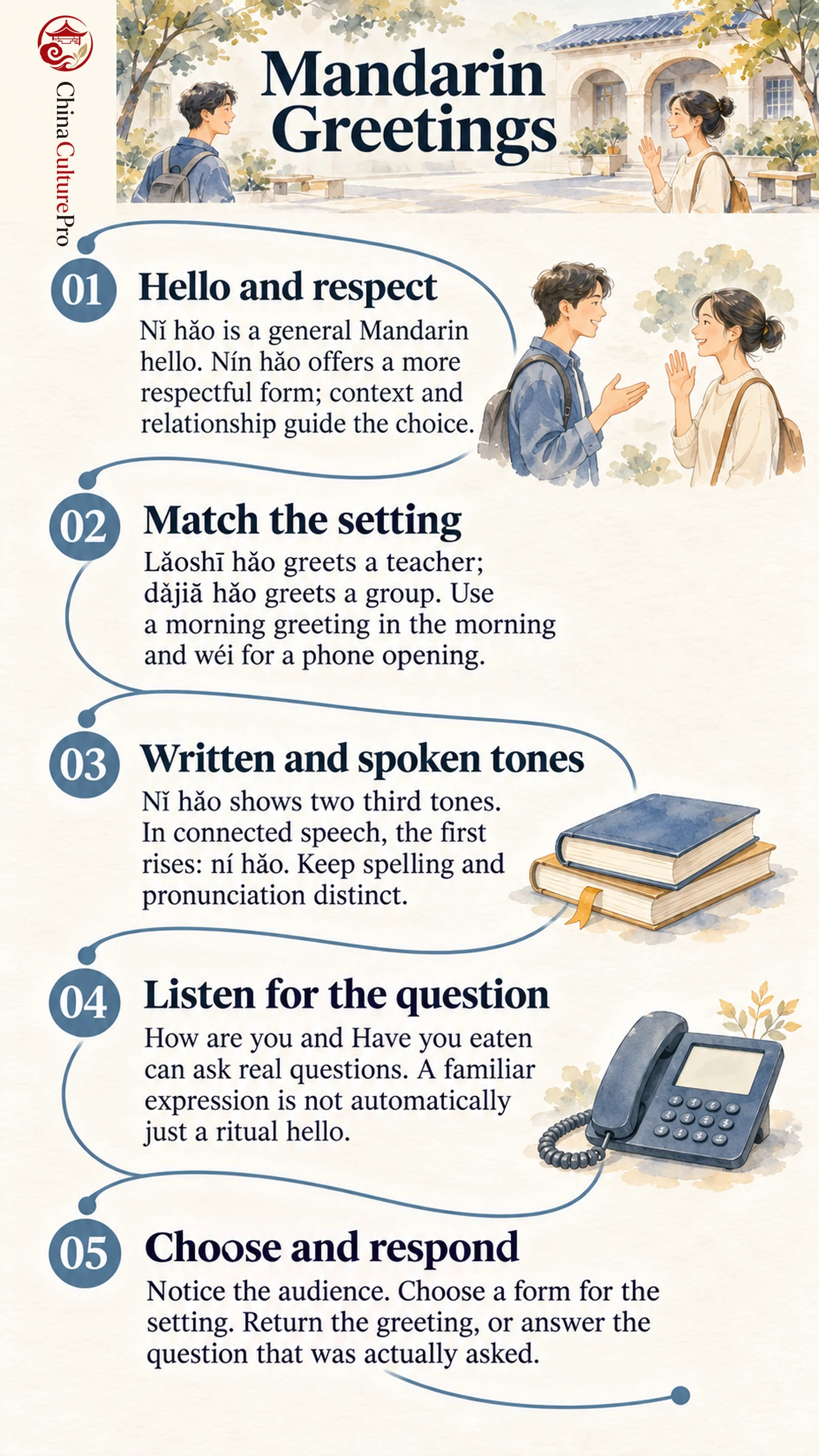
Learning “hello” gives you an opening, but it does not determine the whole conversation. A greeting also acknowledges whom you are speaking to and what is happening around you. The same wording can feel different in a first meeting, a classroom or a familiar exchange.
For the wider social context, see Chinese greetings and etiquette. Start with a small set of forms you understand, then listen to how people in your own setting address one another.
Nǐ Hǎo and Nín Hǎo: Greeting and Respect
The ordinary “you” (你, nǐ) and respectful “you” (您, nín) explain the basic contrast. The latter is an honorific pronoun, commonly associated with respectful address to elders. It gives the greeting a more deferential form. [2]
Nǐ hǎo is a general greeting that can be used throughout the day. Nín hǎo is useful when you want a more respectful opening, such as in a first or formal encounter. The choice is about the relationship and setting, not a rule that every ordinary greeting is impolite. [1][2]
A person’s preferred form of address is useful information. If a teacher, colleague or relative uses a particular name or title, follow that context rather than mechanically increasing the formality of every sentence. For relatives, the distinctions in Chinese family terms can help you understand the relationship being acknowledged.
These are practical choices, not a fixed age threshold. A title can also acknowledge the relationship, as the teacher greeting below illustrates.
Seven Greetings for Different Settings
The table gives seven forms with different jobs. Zǎo ān (早安) is especially familiar in Taiwan (台湾, Táiwān) Mandarin; it is not the only way to greet someone in the morning. [1][5]
| Greeting and pinyin | Makna | Setting to recognize |
|---|---|---|
| Nǐ hǎo (你好) | Hello; a general Mandarin greeting. | A general opening to one person. [1] |
| Nín hǎo (您好) | Hello in a more respectful form. | A respectful opening in an appropriate relationship or formal setting. [2] |
| Lǎoshī hǎo (老师好) | Hello, teacher. | Greeting a teacher through their role. [3] |
| Dàjiā hǎo (大家好) | Hello, everyone. | Addressing a group rather than one individual. [4] |
| Zǎoshang hǎo (早上好) | Good morning. | A morning greeting; the reading here uses neutral shang. [4] |
| Zǎo ān (早安) | Good morning; a familiar form in Taiwan Mandarin. | Another morning greeting, with usage shaped by the community. [1][5] |
| Wéi (喂) | Hello when opening a telephone exchange, in the reading used here. | A telephone opener rather than a general-purpose replacement for every greeting. [6] |
The teacher greeting shows how a role can become part of the expression; the group greeting acknowledges several listeners together. Neither is simply a more elaborate way to say the same thing to anyone.
For the telephone form, learning materials can give different readings: the dictionary also marks 喂 as wèi, an interjection used to call attention. The table follows the rising-tone phone example in the course material. Keep the example and its use together instead of deciding that one tone is the only possible reading of the character. [6][7]
Why Nǐ Hǎo Sounds Different in Connected Speech
The familiar spelling nǐ hǎo shows two third tones. In connected Mandarin speech, a third tone before another third tone changes to a rising second tone: the greeting sounds ní hǎo. The first syllable rises rather than making two separate full dipping contours. [8]
This is a pronunciation change within the phrase, not a different greeting or a reason to discard the underlying pinyin spelling. Keep nǐ hǎo in your vocabulary notes while practicing the connected pronunciation. Nín hǎo already starts with a second tone, so the two greetings should not be confused. [2][8]
Practice the greeting as a short expression rather than relying on an English sound-alike. Pinyin and Mandarin tones explain the notation and the sound patterns in more detail.
A Greeting Question Can Still Be a Real Question
Nǐ hǎo ma (你好吗, nǐ hǎo ma) asks “How are you?” It is not simply another spelling of “hello.” A teaching dialogue uses it as a question followed by an answer about how the speaker is doing. If you use it, be ready for a response rather than treating the question as an empty sound. [3]
Another expression, nǐ chī le ma (你吃了吗, nǐ chī le ma), means “Have you eaten?” It can function as a familiar greeting, as illustrated in language teaching about exchanges between neighbors. But the words can also ask about an actual meal. [1]
Listen to the situation and the follow-up. A passing acknowledgment and a question asked while arranging a meal can have different purposes. The phrase alone does not establish an invitation, and familiarity does not mean that every question should be ignored as a ritual.
Choosing a Greeting and Responding Naturally
A small decision process is more useful than memorizing a long list without knowing when its entries fit.
- Identify the audience: Notice whether you are greeting one person, a teacher or a group. Choose a form that fits the relationship and the situation rather than treating one phrase as compulsory everywhere.
- Use the greeting that fits the setting: Use a general hello, a respectful form, a time-specific greeting or a telephone opener as appropriate. Keep the wording short and use the person’s preferred form of address when you know it.
- Respond to what was actually said: Return a greeting with a greeting. If the speaker asks a genuine question, answer the question in context instead of assuming that every familiar expression is only a ritual hello.
As the conversation develops, learn the expressions you need for the next exchange. Saying thank you in Chinese is one useful companion topic.
FAQs About Saying Hello in Chinese
What is a simple reply to nǐ hǎo?
Replying nǐ hǎo is a straightforward way to return the greeting. If the other person asks how you are, respond to that question instead of automatically repeating hello. [3]
Does nín hǎo mean that nǐ hǎo is rude?
No. Nín hǎo offers a more respectful form, but that does not make nǐ hǎo inherently rude. The relationship, setting and way you address the person all matter.
Are these greetings pronounced the same in every Chinese language?
No. This guide supplies Mandarin readings. Other Chinese languages and regional traditions have their own forms and pronunciations; see regional readings and romanization for why Chinese writing and one spoken reading should not be equated.
Sumber
[1] The Open University. Beginners’ Chinese: A Taster Course — Greetings
[2] Ministry of Education, Taiwan. Revised Mandarin Chinese Dictionary: 您
[3] Routledge. Modern Mandarin Chinese: The Routledge Course — Lesson 1
[4] ChineseClass101. How to Say Hello
[5] Ministry of Education, Taiwan. Concise Mandarin Chinese Dictionary: 早安
[6] Rosetta Stone. Chinese (Mandarin): Course Content, Level 2
[7] Ministry of Education, Taiwan. Concise Mandarin Chinese Dictionary: 喂
[8] Routledge. Modern Mandarin Chinese: The Routledge Course — Lesson 2