


Quick Answer: What Are Nuo Masks?
Nuo masks (傩面具, Nuó Miànjù) are carved faces used in several Chinese ritual and performance traditions. They can identify a deity, a legendary figure or another character. Local practice determines when a mask is worn, carried or kept for veneration.[1][2][4][5]
- Object: A wooden face can include a carved headdress and side ornaments.[2][5]
- Performance: Where a performer wears the mask affects how you read it in motion.[1][4]
- Context: Start with the village, troupe or ceremony before interpreting the colors.[1][2][5]
Watch where the mask sits and how the performer moves before trying to identify the figure by its features.
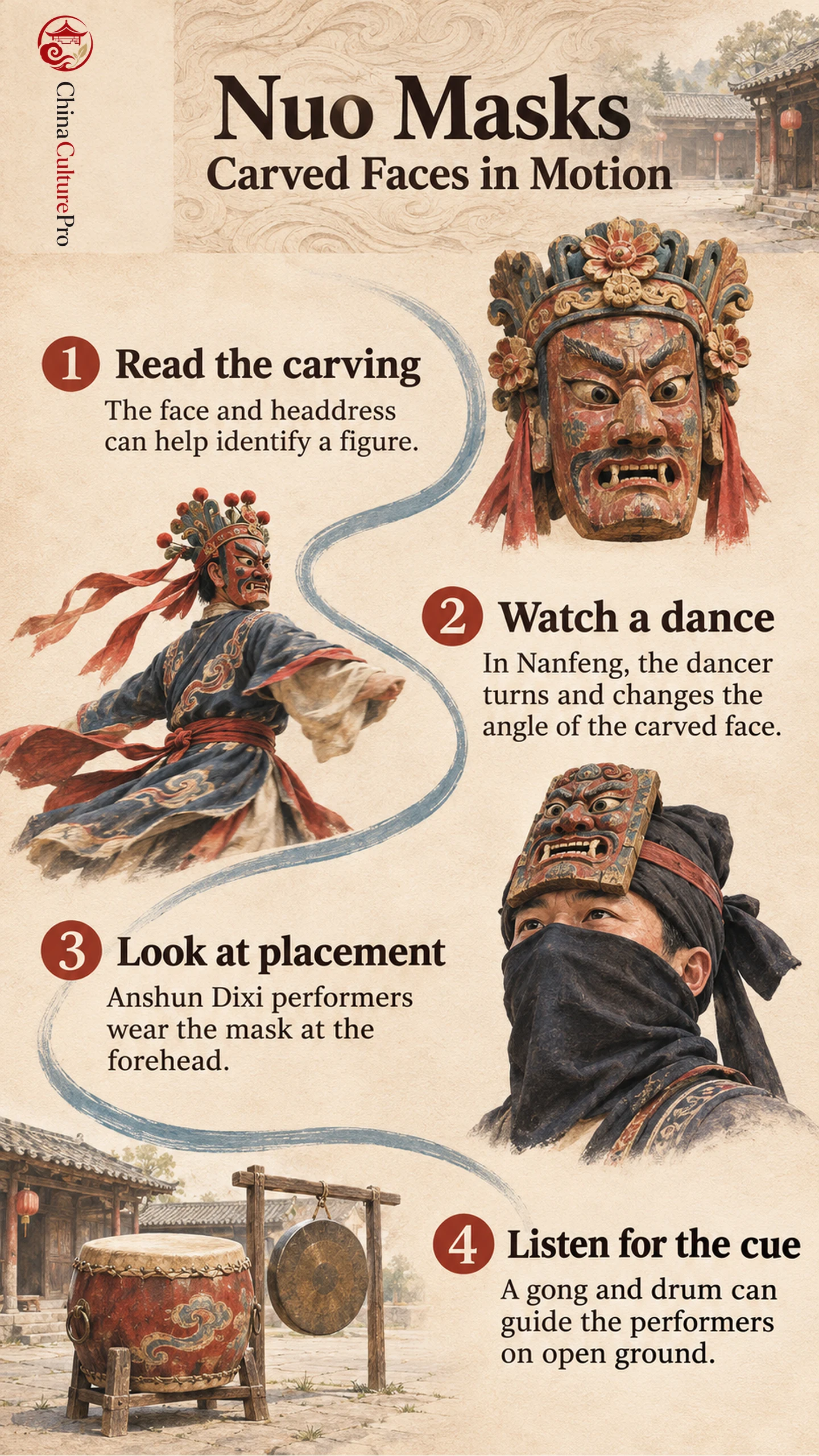
When a dancer dips or turns, the carved eyes may suddenly seem to meet those of someone in the crowd. The performer changes the expression’s effect by changing its angle.
What a Carved Face Can Tell You
In Jiangxi, carvers have used woods such as camphor and poplar. A figure’s carved headpiece and side ornaments can carry as much identifying detail as the face. Reports on the region describe distinct local carving styles. Accounts of Anshun masks likewise point to differences in brows, eyes and beards across roles.[2][5][7]
Use these features with local labels. In a mask made for a general, the sculpted brows and the shape of the eyes can give the face its force. A mask’s meaning also depends on where it is kept and which figure the community associates with it. The guide to Chinese Nuo opera gives the wider ritual and theatrical setting.[1][2][5][7]
Nanfeng: The Mask in a Dance
Nanfeng (南丰, Nánfēng) in Jiangxi has a masked dance tradition associated with the lunar New Year period. The repertoire can include deities, figures from stories and everyday characters. The repertory documented for dancer Luo Huiwu (罗会武, Luó Huìwǔ) includes pieces featuring the Thunder God and the legendary Zhong Kui (钟馗, Zhōng Kuí).[1][3]
Follow the carved eyes as the dancer changes direction or lowers the body. The movement can give one fixed expression a different effect at each point in the dance.[1]
Anshun: The Face Above the Face
In Guizhou, Anshun Dixi (安顺地戏, Ānshùn Dìxì) performers wear a mask at the forehead above a dark cloth covering. The local name lianzi (脸子, liǎnzi) refers to the carved face. Accounts describe the mask in performances of historical and legendary stories associated with Tunbao communities.[4][5][6]
A gong and drum can guide performers on open ground. A side view shows the placement. Follow the angle of the carved face as the performer turns to a cue.[4][6]
FAQs About Nuo Masks
Are Nuo masks the same as Peking opera face paint?
Nuo masks are separate objects that performers can wear and remove. Painted faces in Peking opera are applied to the performer’s skin. Both can help identify roles, with conventions that belong to their own traditions.[1][2][4]
Can a displayed Nuo mask tell you how it was used?
Use the place, troupe, character and recorded use to read a displayed piece. In some Jiangxi communities, masks used in dance have a distinct place from those kept for devotion.[2]
Sumber
[1] China Intangible Cultural Heritage Network. Nanfeng Nuo Dance
[2] China Intangible Cultural Heritage Network (Jaringan Warisan Budaya Takbenda Tiongkok). Jiangxi Nuo Masks
[3] China Intangible Cultural Heritage Network. Luo Huiwu
[4] China Intangible Cultural Heritage Network. Anshun Dixi
[5] China Intangible Cultural Heritage Network. Anshun Dixi and Tunbao Culture
[6] Chinese People’s Political Consultative Conference. Anshun Dixi on a Wider Stage
[7] Guizhou Provincial Government. Anshun Mask Carving and Its Public