

Quick Answer: What Is a Yixing Teapot?
A Yixing teapot (宜兴紫砂壶, Yíxīng zǐshā hú) is associated with the pottery tradition of Yixing in Jiangsu, especially Dingshu. Its characteristic material is zisha (紫砂, zǐshā), often translated as “purple sand”: a family of local ceramic clays used for stoneware, usually left unglazed.
- Material: The fired clay surface, rather than a glassy glaze, normally contacts the tea.
- Form: A body, lid, handle and spout form a functional pouring vessel.
- Tradition: Practical brewing and ceramic craftsmanship meet in objects ranging from plain to sculptural.
Not every brown clay pot is Yixing ware, and not every Yixing pot is purple. Material claims and workmanship require evidence beyond appearance.
A small unglazed teapot can be both a working brewing vessel and an object of ceramic art. Understanding its clay, construction and pouring behavior is more useful than assuming that a famous name automatically improves every cup of Chinese tea.
Zisha Clay and the Names on a Pot’s Label
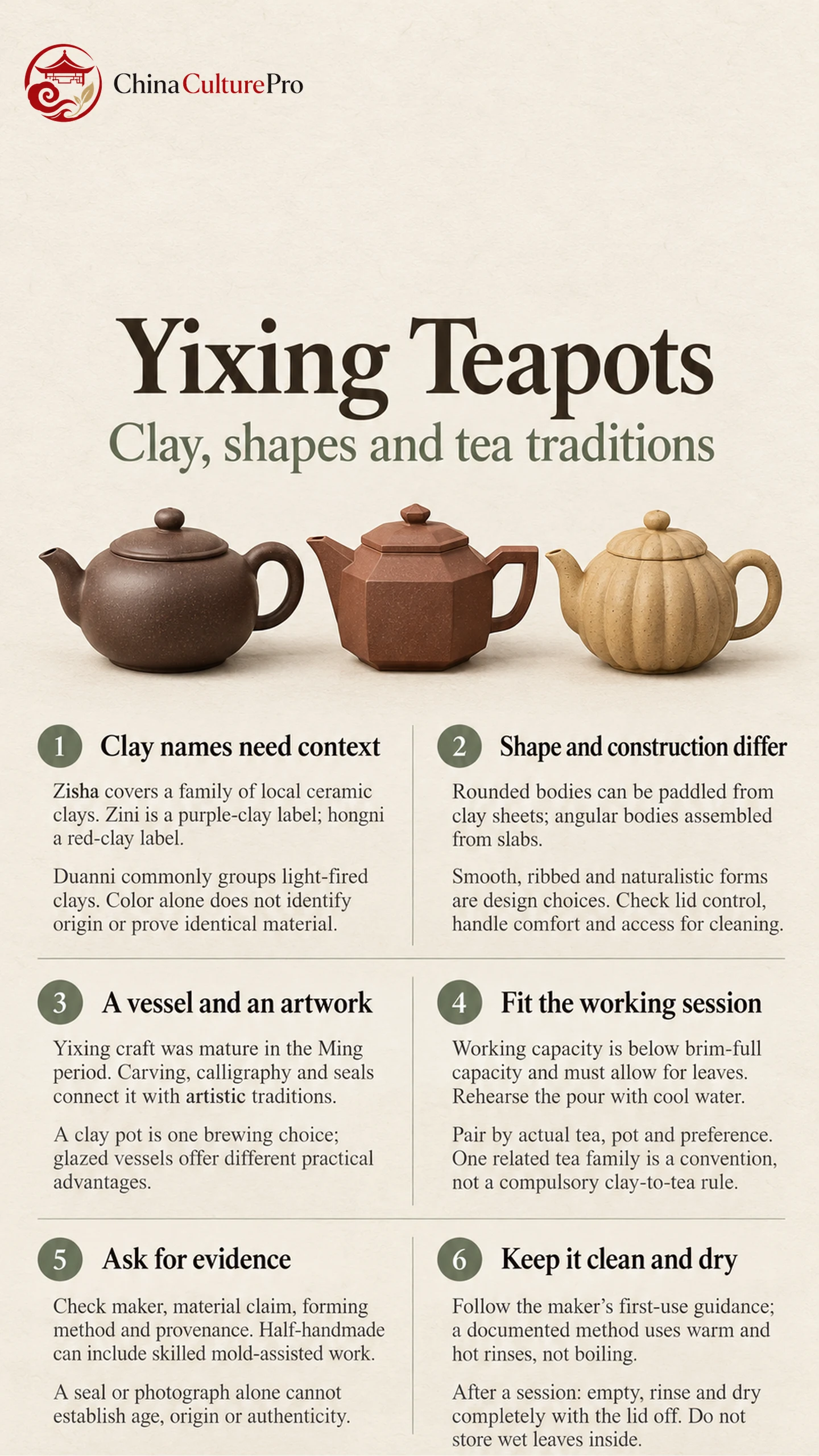
The collective name describes more than one clay. The official craft record names purple, red and other local raw materials; commercial labels further divide them into many subtypes. A translated color word is not a complete mineral analysis or a guarantee of firing behavior.[1]
| Nom | What the label conveys | Useful limit |
|---|---|---|
| Zini (紫泥, zǐní) | A common purple-clay designation. | Fired pots often appear brown with a purple cast rather than bright violet. |
| Hongni (红泥, hóngní) | A red-clay designation. | Ask which specific clay and firing the maker means. |
| Duanni (段泥, duànní) | A broad commercial grouping often used for light or yellow-toned fired clays. | Subgroups differ; do not treat the label as one uniform clay recipe. |
A maker’s account groups several light-fired materials under duanni. That is useful naming context, not a national rule that all pale pots have identical porosity or belong to the same deposit. Ask for a specific material description, not just a color photograph.[3]
Round, Angular, Ribbed and Naturalistic Shapes
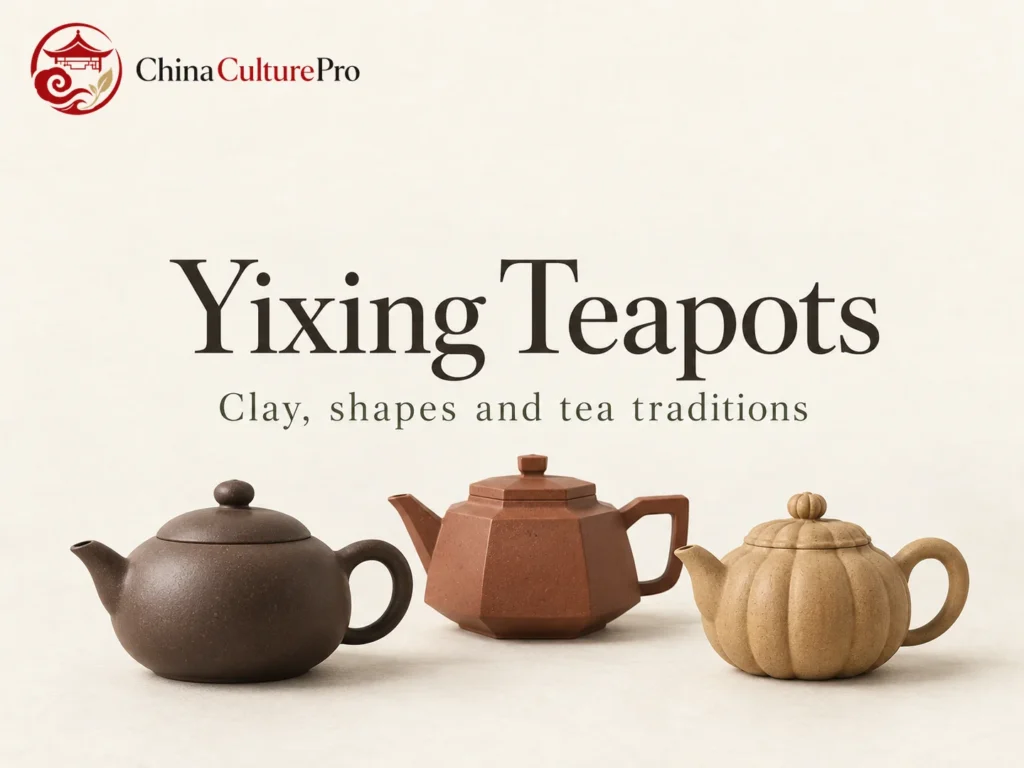
Traditional forms include smooth rounded and angular bodies, ribbed forms and naturalistic designs. A sculptural pot may borrow the shape of a plant or fruit, while a restrained geometric pot lets the material and proportions remain prominent. These are ceramic design choices rather than a hierarchy of tea quality.[1]
In traditional slab-based construction, round bodies can be formed by joining and paddling clay sheets; angular bodies are assembled from cut slabs. Spouts, handles and lids must still work with the body. These are distinct ways to build the body.[2]
For use, look beyond the silhouette. A broad mouth helps with leaf removal, a secure handle affects pouring, and a stable lid must remain controlled as the pot tilts. An impressive sculptural surface does not replace these checks.
Yixing Craft and Tea-Drinking Traditions
The craft developed over time and was mature in the Ming period. Later makers combined pottery with carving, calligraphy, seals and other decorative techniques. This helps explain why a teapot can be studied as an artwork as well as a utensil; it does not identify one securely documented inventor for every form.[1]
The material’s reputation is closely connected with attentive leaf brewing. A clay pot is one of several vessels used for attentive brewing. A glazed pot or covered bowl may suit a drinker who changes teas frequently or wants to inspect the liquor easily. The gaiwan and teapot comparison considers those practical differences.
Choosing a Pot for the Tea and the Pour
Start with working capacity, not the volume of a brim-full pot. Leaves occupy space, and retained water changes the next infusion. Test a comfortable handle grip and controlled emptying with cool water before brewing. A slow or obstructed pour can make a short infusion difficult to repeat.
Tea pairing is a matter of the actual pot and drinker’s preference. Compare oolong and green tea, or the different characters of raw and ripe pu-erh, without assuming that one clay name dictates the only permitted leaf. Roast level is another useful descriptor when choosing similar teas for a pot.
Using one pot for a related family of teas can simplify comparison and limit unwanted aroma carryover. It is a practical convention, not a requirement to dedicate a separate pot to every named cultivar or harvest.
Buying Clues, Maker Marks and Provenance
Ask who made the pot, what material is claimed, how it was formed and what documentation supports the account. Distinguish a functional contemporary pot from an attributed antique or collectible. A seller’s fully handmade claim and a maker’s stamp are claims to evaluate, not self-verifying certificates. One producer describes mold-assisted bodies and lids with freehand components and hand assembly, illustrating that half-handmade work still includes substantial manual skill. Forming method and clay provenance remain separate questions.[6]
A current museum record describes a fluted pot once attributed to 1620 as likely dating instead to the nineteenth or early twentieth century. Even catalogued objects can require revised attribution. That is a concrete reason to examine provenance rather than reading a date from appearance or an inscription alone.[5]
For ordinary use, clear answers, sound construction and a satisfactory pour matter. The tea authenticity guide discusses the broader habit of checking product claims; it cannot authenticate a particular ceramic object from a photograph.
How to Clean and Dry a Yixing Teapot
For a new pot, follow the maker’s first-use guidance. One published care method rinses with warm water and then hot water to remove dust, and advises against boiling the pot because agitation can chip or crack it. It does not require a tea bath to make the pot usable.[4]
- Empty: When safe to handle after a session, remove the leaves and remaining liquor.
- Rinse: Rinse the interior and lid with water, clearing loose leaf from the spout. Avoid strongly scented cleaners on absorbent unglazed clay; follow the maker’s care instructions.
- Dry: Leave the lid off and let both pieces dry thoroughly before putting the pot away. Do not store it with wet leaves inside.
The aim is a clean, dry vessel between sessions, rather than an accumulating layer of old wet tea. These water-cleaning and lid-off drying principles are also part of the documented care method.[4]
FAQs About Yixing Teapots
Are all Yixing teapots purple?
No. Zisha is a collective material name. Brown, reddish and pale yellow-toned pots all appear within Yixing-related clay traditions; color alone cannot verify a pot’s origin.
Must one pot be used for only one tea?
No universal rule requires it. Dedicating a pot to similar teas is a useful convention for managing aroma carryover, but the clay label does not prescribe one compulsory tea.
Should you boil a new Yixing teapot?
Not as a default. A maker’s published method uses warm and hot rinses and warns that boiling can damage the vessel. Follow instructions for the particular pot.
Does a maker’s seal prove a pot is authentic?
No. Marks and inscriptions need to be assessed alongside workmanship, documentation and provenance. They cannot alone establish maker, age, clay origin or suitability for food use.
Sources
[1] China Intangible Cultural Heritage, official project record. 宜兴紫砂陶制作技艺
[2] Wuxi Museum. 宜兴紫砂制作工艺
[3] MudandLeaves, original clay account. Yixing Clay: Duanni
[4] MudandLeaves, original care guide. Don’t Boil that Teapot!
[5] Smithsonian National Museum of Asian Art, current collection record. Yixing ware Teapot, F1939.64a–b
[6] Red Blossom Tea Company, original manufacturing description. Artisan Yixing, Style 634