
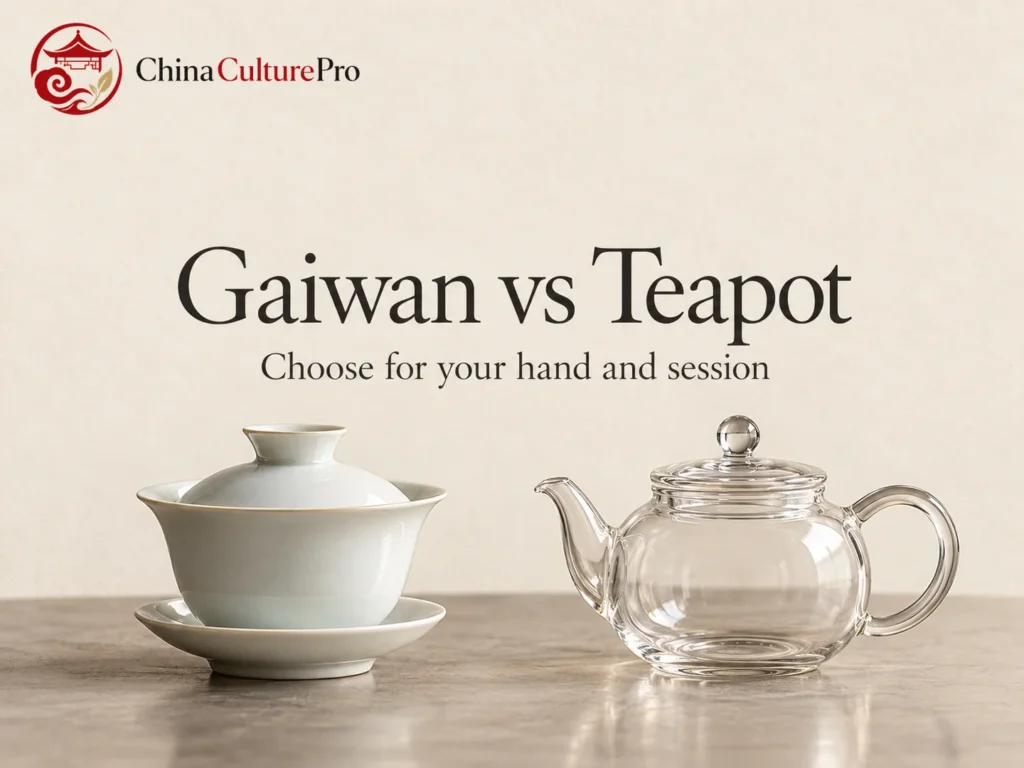

Quick Answer: Should You Choose a Gaiwan or a Teapot?
A gaiwan (盖碗, gàiwǎn) is a lidded bowl, commonly with a saucer, that can brew or hold tea. A teapot (茶壶, cháhú) usually pours through a spout while the brewer holds a handle. Neither format is universally better.
- Gaiwan: Broad leaf access and an adjustable lid gap suit a brewer comfortable controlling the rim and lid.
- Teapot: A suitable handle and spout can make pouring comfortable, but balance and flow still need checking.
- Material: Glazed ceramic, glass and unglazed clay are separate choices; the vessel name alone does not determine them.
Choose a secure, controllable pour first. A comfortable glazed pot may suit one beginner, and a well-fitting covered bowl another.
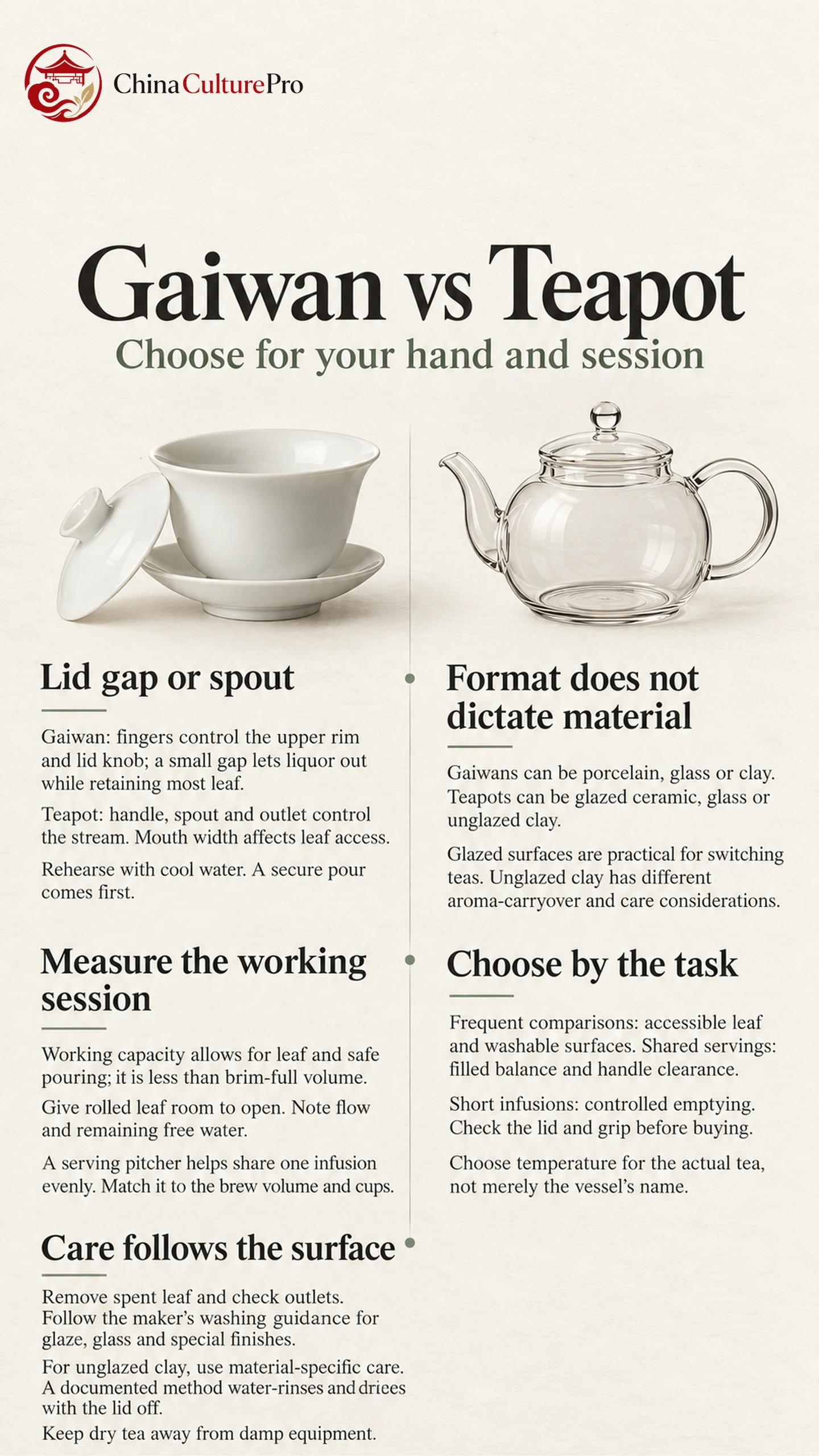
A lid-controlled bowl and a handled, spouted pot solve the same brewing task in different ways. The useful choice depends on your grip, the material and the amount you serve. Consider those details before adding another vessel to your Chinese tea routine.
How the Vessels Pour and Give Access to the Leaf
| Format | Pouring mechanism | Access to leaves |
|---|---|---|
| Gaiwan | The lid is moved to create a pouring gap; fingers control the rim and lid knob. | The open bowl makes adding, inspecting and removing leaves straightforward. |
| Teapot | The spout and its openings guide the stream while the handle supports the pot. | Mouth width and any built-in filter determine access and how readily leaf can be removed. |
For a covered bowl, the gap retains most leaf rather than acting as a fine strainer. A common grip uses thumb and middle finger on opposite rim edges and the index finger on the lid knob. Overfilling can heat the contact area and encourage spills.[2]
Rehearse with cool water over a tray. If the grip is insecure, change the vessel rather than forcing it. The gaiwan guide covers handling. Covered bowls also have a documented direct-drinking history; decanting is not their only use.[1]
Material Is a Separate Decision
A porcelain covered bowl versus an unglazed clay pot is a comparison of both format and material. It cannot establish what every covered bowl or every pot will do. Gaiwans are also made in glass and clay, while handled pots can be glazed ceramic or glass.[5]
Glazed surfaces are generally convenient when you change teas and want to rinse away the previous brew. Glass gives a view of the leaves, but comfort still depends on the actual rim or handle. Check the maker’s hot-water and care guidance rather than assuming that any transparent vessel is suitable.
Unglazed clay brings different care and aroma-carryover considerations. One published care method warns against scented cleaners and calls for thorough drying. Such considerations belong to the material, not automatically to the word teapot.[4] The Yixing teapot guide examines one specific clay tradition.
Leaf Room, Working Capacity and Infusion Control
Working capacity is the water actually used after leaving space for leaves and a controlled pour. A brim-full listing is not the amount that will reach the cups. Compare working volumes when setting a leaf dose; otherwise a smaller vessel can make the same weight taste much stronger.
Rolled leaves need room to open. A narrow mouth or blocked outlet can affect emptying, while a wide bowl makes the leaf easier to inspect. Neither an adjustable lid nor a long spout guarantees a fast, complete pour. During the cool-water trial, note the stream and any free water left behind.
Gongfu tea (工夫茶, gōngfūchá) uses attentive brewing and sharing; field records describe both small pots and covered bowls in Chaozhou practice.[3] A gongdao bei (公道杯, gōngdào bēi) is a serving pitcher that receives an infusion before it is shared. Match it to the working brew volume and the drinking cups.
Choosing for Your Hand and Your Tea Session
For frequent comparisons, prioritize easy leaf access and a washable surface. For a larger shared serving or sensitive fingers, examine a handled pot’s filled balance and handle clearance. For short infusions, check how confidently you can stop and empty the brew. Choose the criteria that match the way you actually serve tea.
Both formats can serve a tea-sharing session. Nor should vessel shape alone set water temperature. Research on selected green and oolong samples found different temperature preferences within the tea styles. Choose brewing conditions for the actual tea, with the oolong and green tea comparison as a starting explanation.[6]
When possible, check lid security, the room for your fingers, and the pour before buying. Visual ornament can be part of the enjoyment, but it cannot answer those functional questions.
Cleaning and Switching between Teas
After use, check the spout and filter openings for trapped leaf as well as emptying the body. Wash and rinse glazed or glass vessels according to their maker’s instructions, especially when they have special decoration or non-ceramic components.
For absorbent unglazed clay, follow material-specific care. A documented method empties and water-rinses the pot after use, then dries it with the lid off. Do not store either vessel with old wet leaves inside.[4] Keep unused dry tea separate from damp equipment; the tea storage guide covers that separate task.
FAQs About Gaiwans and Teapots
Which is easier for a beginner?
Choose the one you can pour securely. A handle may feel familiar, while a well-fitting covered bowl can be easy to inspect and clean once the grip is practiced with cool water.
Can you use a teapot for gongfu tea?
Yes. Small pots and covered bowls both appear in Chaozhou tea practice. Vessel capacity, controlled infusions and sharing matter more than declaring one format compulsory.
Can one vessel brew different tea types?
A suitably glazed or glass vessel can be practical for switching teas when cleaned between sessions. Unglazed clay needs separate consideration of aroma carryover and care.
Do you need a serving pitcher?
Not for every serving. A pitcher helps distribute one infusion evenly among several cups; direct pouring can also work. A solo drinker may decant into one cup or mug.
Is a gaiwan always cheaper than a teapot?
No fixed price hierarchy follows from the name. Material, scale of production, decoration and workmanship can vary in either format. Compare function and the actual product rather than assuming one category is always the budget choice.
Sources
[1] National Museum of Natural Science. 蓋碗
[2] Teasenz, original brewing demonstration. How to Use a Gaiwan without Burning your Hands
[3] Zhang Jinghong, original field research. 工夫茶遗产的边缘化和游动性
[4] MudandLeaves, original care method. Don’t Boil that Teapot!
[5] Teasenz, original teaware catalog. Gaiwan Tea Sets and Easy Gaiwan Sets
[6] Taiwan Tea and Beverage Research Station. 水質及水溫對茶湯品質之影響