


Quick Answer: What Are Chinese Flower Teas?
Chinese flower teas include drinks made from flowers alone as well as products combining flowers or floral fragrance with tea leaves. Check what is actually being infused before assuming a tea category or caffeine level.
- Chrysanthemum (菊花, júhuā): dried buds or flowers used for a floral infusion.
- Osmanthus (桂花, guìhuā): tiny fragrant blossoms drunk alone or combined with tea.
- Rose (玫瑰, méiguī): dried buds or petals used for an aromatic drink or blend.
These are representative ingredients, not one standardized recipe. Plain flowers, scented tea and mixed ingredients can all appear under broad English flower-tea wording, so the name alone is incomplete.[1][2][3]
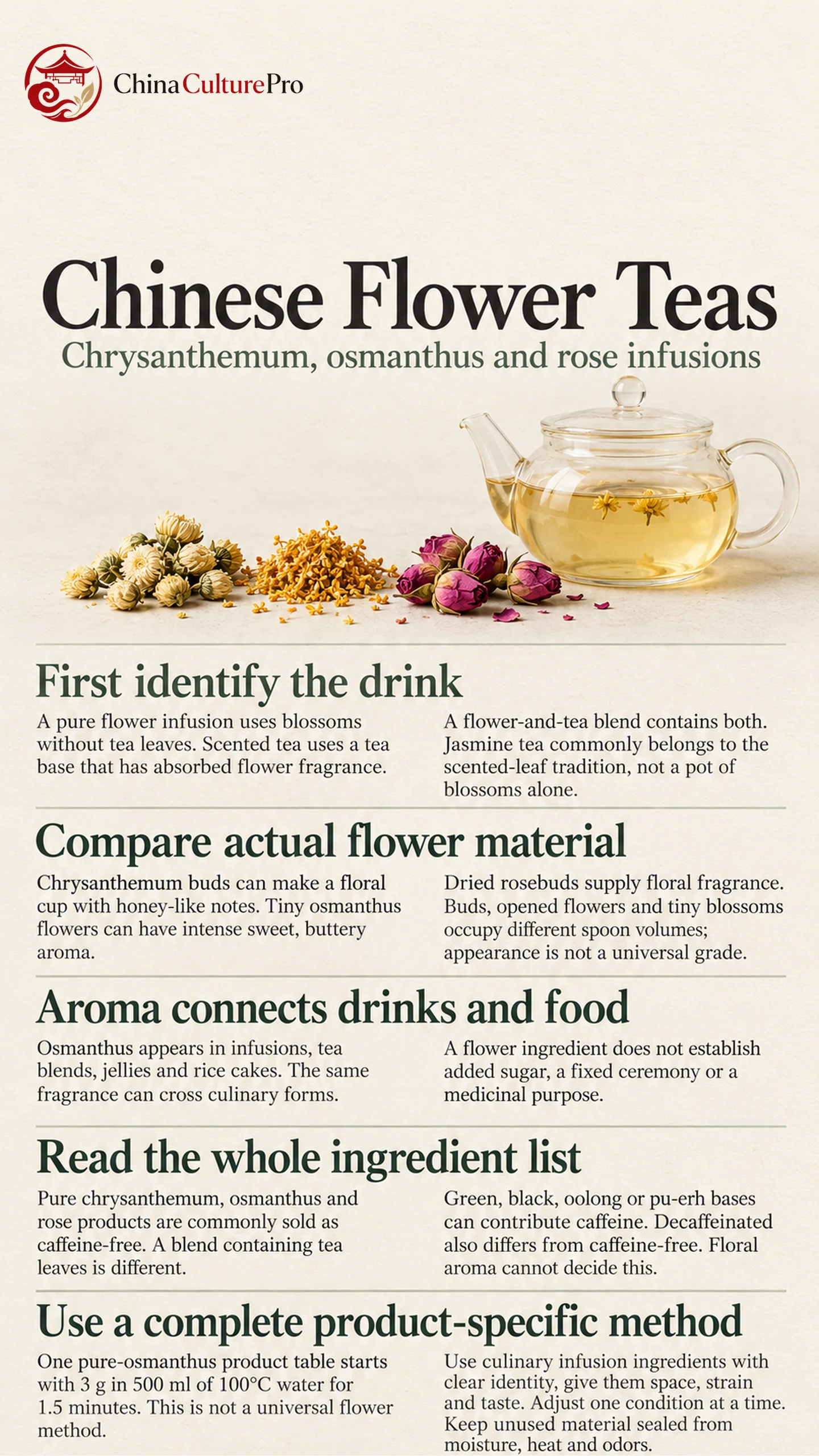
Chinese floral drinks can look similar while containing very different ingredients. A pot of dried blossoms, a scented green tea and an oolong mixed with flowers need separate descriptions. This guide explains the distinction before comparing aroma, caffeine and practical brewing choices.
Pure Flower Infusions, Scented Tea and Blends
Huacha (花茶, huāchá) in Chinese tea-industry usage often refers to tea leaves scented with flowers. That differs from a herbal infusion made only from blossoms. Everyday English labels are less precise, which is why the ingredient list matters.
| Forme | What is infused | Ce qu’il faut reconnaître |
|---|---|---|
| Pure flower infusion | Flowers or buds, without tea leaves | The flowers supply the drink’s aroma and character |
| Scented tea | A tea base that has absorbed flower fragrance | Visible petals are not needed to explain the fragrance |
| Flower-and-tea blend | Tea leaves mixed with flower material | Both ingredients contribute; the tea category still matters |
The official Fuzhou jasmine craft account describes prepared green tea absorbing fragrance from fresh flowers. That process explains why jasmine tea is usually a tea-leaf drink rather than a pot of jasmine blossoms. Scenting and simply mixing dried ingredients are related floral approaches, but not identical operations.[4]
Chrysanthemum, Osmanthus and Rose in the Cup
A documented chrysanthemum product consists of whole flower buds and is described with delicate honey-like notes. The form matters: a bud and a fully opened flower occupy different volumes in a spoon. Their appearance alone does not establish one national quality ladder.[1]
Osmanthus flowers are much smaller. One pure-flower product is described as intensely fragrant, sweet and buttery in aroma. A visually small quantity can make an aromatic impression; it should not be visually dosed as if it were a large rosebud.[2]
A sourced rose product uses unopened buds from Longnan in Gansu. Its floral character comes from the dried flower material. Rose aroma does not automatically mean rose syrup, sugar or a pink-colored infusion; those are separate ingredients or visual features to check.[3]
Flowers in Everyday Chinese Drinking and Food Culture
Flowers cross the boundary between drinks and food. Osmanthus appears in jellies and rice cakes as well as in infusions, and a sourcing guide describes pairing it with light oolong. The familiar aroma can link a cup with a dessert without making the drink a sweetened preparation.[2]
The same ingredient can also be presented as a plain household drink or part of a more elaborate blend. That flexibility is a useful way to understand the culture: floral fragrance is an ingredient choice, not evidence that every cup follows one ceremony or serves one medicinal purpose. The broader range of Chinese drinks includes many such everyday choices.
Caffeine Depends on the Complete Ingredient List
Pure chrysanthemum, osmanthus and rose products are commonly sold as caffeine-free infusions. Once tea leaves are included, however, the drink has a potential contribution of caffeine from tea leaves. A small amount of visible flower does not tell you what proportion of the blend is tea.[1][2][3]
Green, black, oolong and pu-erh bases should not be treated as caffeine-free just because a floral name leads the label. The comparison between oolong and green tea concerns processing, while caffeine per serving depends on the product and brewing conditions.
Check the complete ingredient list, including any added tea or other caffeinated ingredient. Decaffeinated is also different from caffeine-free: the FDA notes that decaffeinated tea can still contain caffeine. A floral aroma cannot settle that distinction.[5]
How to Brew and Choose Flower Infusions
Choose flowers sold for culinary infusion with a clear identity and ingredient list. A decorative flower, garden plant or common name is not a substitute for that information. When using a blend, follow the finished product’s method rather than combining unrelated flower and tea guides.
- Start with one documented product method: One pure-osmanthus product table gives 3 g for 500 ml of water at 100°C and a 1.5-minute infusion. Treat this as that product’s starting point, not the required method for every flower.
- Give the ingredients space and strain: Use a clean heat-suitable vessel and a strainer fine enough for the small blossoms. Separate the infusion from the material when the chosen contact time is reached.
- Taste and adjust one condition: Let the drink cool to a comfortable temperature, then assess aroma and strength. Change dose or contact time separately on a later brew so that the effect is clear.
The numerical example comes from the osmanthus product’s own table. It should not be transferred unchanged to rosebuds, chrysanthemum flowers or a tea-leaf blend.[2] Keep unused material sealed from moisture, heat and odors; storage guidance also helps protect floral aroma.
FAQs About Chinese Flower Teas
Are all Chinese flower teas caffeine-free?
No. A pure flower infusion and a blend containing tea leaves are different products. Check all ingredients rather than inferring caffeine from the floral name.
Is jasmine tea the same as a pure flower infusion?
Usually not. Jasmine tea commonly uses a tea-leaf base that has absorbed flower fragrance. A drink made only from blossoms is a different preparation.
Must a floral tea contain visible petals?
No. Scented tea can carry floral fragrance without a display of petals. Conversely, visible petals do not tell you the full composition of a blend.
Can I use flowers from a florist?
Choose flowers sold for culinary infusion with a clear identity and intended use. Flowers sold for decoration should not be substituted simply because they look similar.
Sources
[1] Teasenz, original product and sourcing description. Chrysanthemum Flower Tea Buds
[2] Teasenz, original product and sourcing description. Osmanthus Tea
[3] Teasenz, original product and sourcing description. Rose Bud Tea
[4] China Intangible Cultural Heritage Network. “中国传统制茶技艺及其相关习俗”福建篇
[5] US Food and Drug Administration. Spilling the Beans: How Much Caffeine is Too Much?