

Quick Answer: What Is Mengding Ganlu Tea?
Mengding Ganlu (蒙顶甘露, Méngdǐng Gānlù) is a green tea associated with the Mengding mountain area of Ya’an in Sichuan. Ganlu is commonly translated as sweet dew; it names a tea, rather than a sweetened drink.
- Appearance: small curled leaves and buds, often with visible fine hairs.
- Processing: early heating, shaping and drying preserve a green-tea character.
- Cup: a clear yellow-green infusion, with fresh flavor and a rounded finish.
These features identify a style, not a guarantee that every packet tastes identical. Cultivar, leaf selection, manufacture, freshness and brewing all matter. Mengding tea alone is incomplete: the mountain produces several named styles.[1]
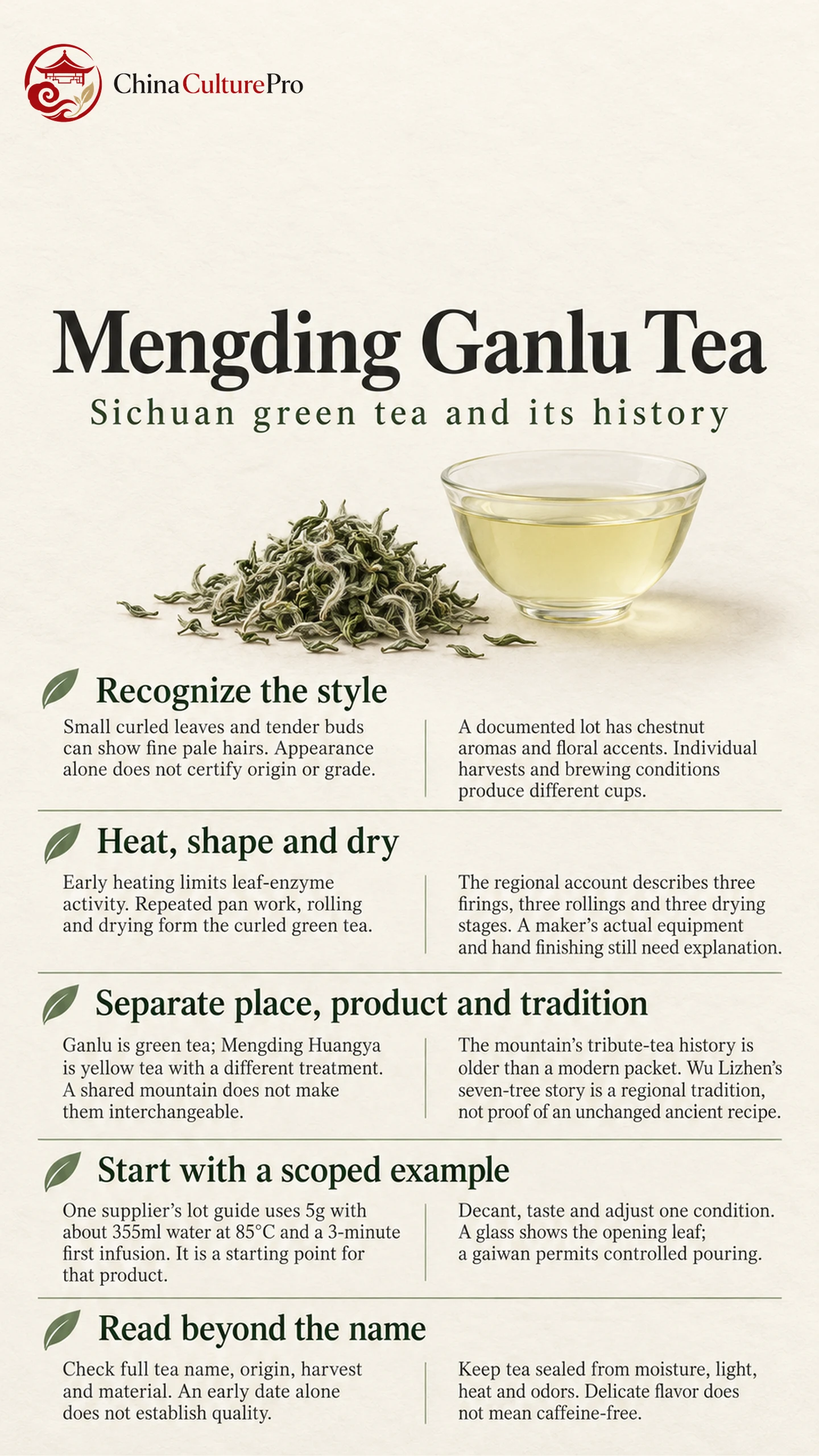
Mengding Ganlu (蒙顶甘露, Méngdǐng Gānlù) is a Sichuan green tea with small curled leaves and a fresh, rounded cup. Its mountain’s long tea history helps explain its cultural place, but identifying the tea also requires attention to processing and the individual harvest.
Curled Leaves and a Fresh, Rounded Taste
Look at the dry tea before brewing: the curled form is different from a broad flat leaf or a tightly rolled oolong pellet. Fine pale hairs can be part of the tender leaf material. They are not themselves proof of origin, a grading certificate or evidence of added flavor.
A documented sourced lot is described as sweet and full-flavored, with chestnut aromas and floral accents. That is one useful sensory example, not an obligatory tasting checklist. A cup can show freshness, body and a little briskness together. Sweetness here describes a taste impression or finish; it does not establish sugar in the ingredients.[2]
How the Leaves Become Green Tea
The official regional account describes tender bud-and-leaf material, a resting stage, heat treatment, repeated pan work and rolling, followed by drying and shaping. The repeated handling helps produce the characteristic curl. The account summarizes a traditional sequence as three firings, three rollings and three drying stages.[1]
The important category distinction is the timing of heat. Green-tea manufacture limits leaf-enzyme activity early, rather than deliberately developing the extensive enzymatic oxidation associated with black tea. Drying then prepares the shaped leaf for keeping. This explains the category without turning the description into a factory recipe.[3]
Photographs from a documented maker show hand handling and successive shaping and drying stages. A description of that lot does not establish that every product is entirely handmade. Ask what a maker means by hand-finished or traditional instead of treating those phrases as self-explanatory grades.[2] The wider distinction between tea oxidation and fermentation helps interpret processing language.
Mengding Ganlu, Huangya and the Mountain’s Tea History
Mengding Huangya (蒙顶黄芽, Méngdǐng Huángyá) is a yellow tea from the same mountain tradition. Its yellowing treatment distinguishes it from Ganlu. Shared geography and tender material do not make the two names interchangeable.[1][3]
The official regional account places Mengshan tea within a long tribute-tea history and explicitly introduces the story of Wu Lizhen (吴理真, Wú Lǐzhēn) and seven planted tea trees as a tradition. That narrative is culturally important, but it is not direct evidence that today’s Ganlu was manufactured in an identical form in antiquity.[1]
Keep three questions separate: how long tea has been associated with the mountain, when a historical writer described a particular tea, and how the packet in front of you was made. A modern product name can connect with a much older regional reputation without proving an unchanged recipe or one uniquely documented inventor.
How to Brew Mengding Ganlu
Choose a vessel that lets you observe and control the infusion. A clear glass shows the opening leaf; a gaiwan makes it easier to pour the drink away from the leaves. Neither choice changes the tea’s category.
- Use a documented starting point: For one sourced lot, the published guide uses5g of tea with12US fluid ounces, about355ml, of85°C water and a3-minute first infusion. Treat this as that lot’s example, not a universal requirement.
- Separate and taste: Pour the infusion away from the leaves when using a decanting vessel. Taste before changing the method; a longer soak and a stronger cup do not automatically produce a better result.
- Adjust one condition: If the cup is too forceful, shorten contact or use less leaf next time. If it is too faint, adjust one variable and compare. Keep notes so that a change has an identifiable cause.
The numerical starting point comes from the supplier’s own brewing guide. Later infusions can be adjusted to the leaf and your preferred strength rather than forced into one fixed timetable.[2]
How to Read a Label and Keep the Tea Fresh
Look for the full tea name, a stated origin, harvest information and a clear description of the leaf or cultivar. A harvest date supplies context; it does not independently establish skill, storage condition or your preferred taste. Tea grades and picking terms need to be read within their actual product system.
Keep a small working portion sealed, away from moisture, light, heat and odors. Preserve the packet’s identity so that later comparisons are meaningful. Follow tea-type-specific storage guidance if using cold storage; opening a cold packet carelessly can introduce condensation. For caffeine questions, consult the distinction between leaf content, brewing and serving size rather than assuming a delicate green tea is caffeine-free.
FAQs About Mengding Ganlu Tea
Is Mengding Ganlu a green or yellow tea?
It is green tea. Mengding Huangya is the yellow-tea name to distinguish from it; coming from the same mountain does not make the processes identical.
Does sweet dew mean sugar is added?
No. Sweet dew is the usual translation of the name. Check the ingredients if a packaged drink or flavored blend uses the same wording.
Does a very early harvest guarantee better tea?
No. A date describes harvest timing. Origin, material, manufacture, handling and personal preference still matter, so the earliest label is not a complete quality assessment.
Is Mengding Ganlu caffeine-free?
No such conclusion follows from its green-tea category or gentle flavor. The caffeine in a serving depends on the actual leaf and brewing conditions.
Sources
[1] China’s Permanent Representation to the UN Agencies for Food and Agriculture. 扬子江中水,蒙山顶上茶——国际茶日系列之六
[2] Seven Cups, original sourcing and tea-maker documentation. Mengding Ganlu (Sweet Dew)
[3] Taiwan Tea and Beverage Research Station. 臺灣特色茶分類及加工製程簡介