


Quick Answer: How Do Oolong and Green Tea Differ?
Green tea (绿茶, lǜchá) and oolong tea (乌龙茶, wūlóngchá), also written wulong, are processing categories made from the tea plant, Camellia sinensis. Their central difference is how the leaves are handled before heating limits enzymatic oxidation.
- Green tea: Early heating preserves a comparatively fresh-leaf character by limiting oxidation.
- Oolong: Withering and agitation allow controlled partial oxidation before heating.
- In the cup: Green tea often emphasizes fresh or nutty notes; oolong spans fresh floral through fruitier and roasted styles.
Color alone cannot identify the category. Roast is another variable, and neither tea’s name provides a dependable caffeine ranking.
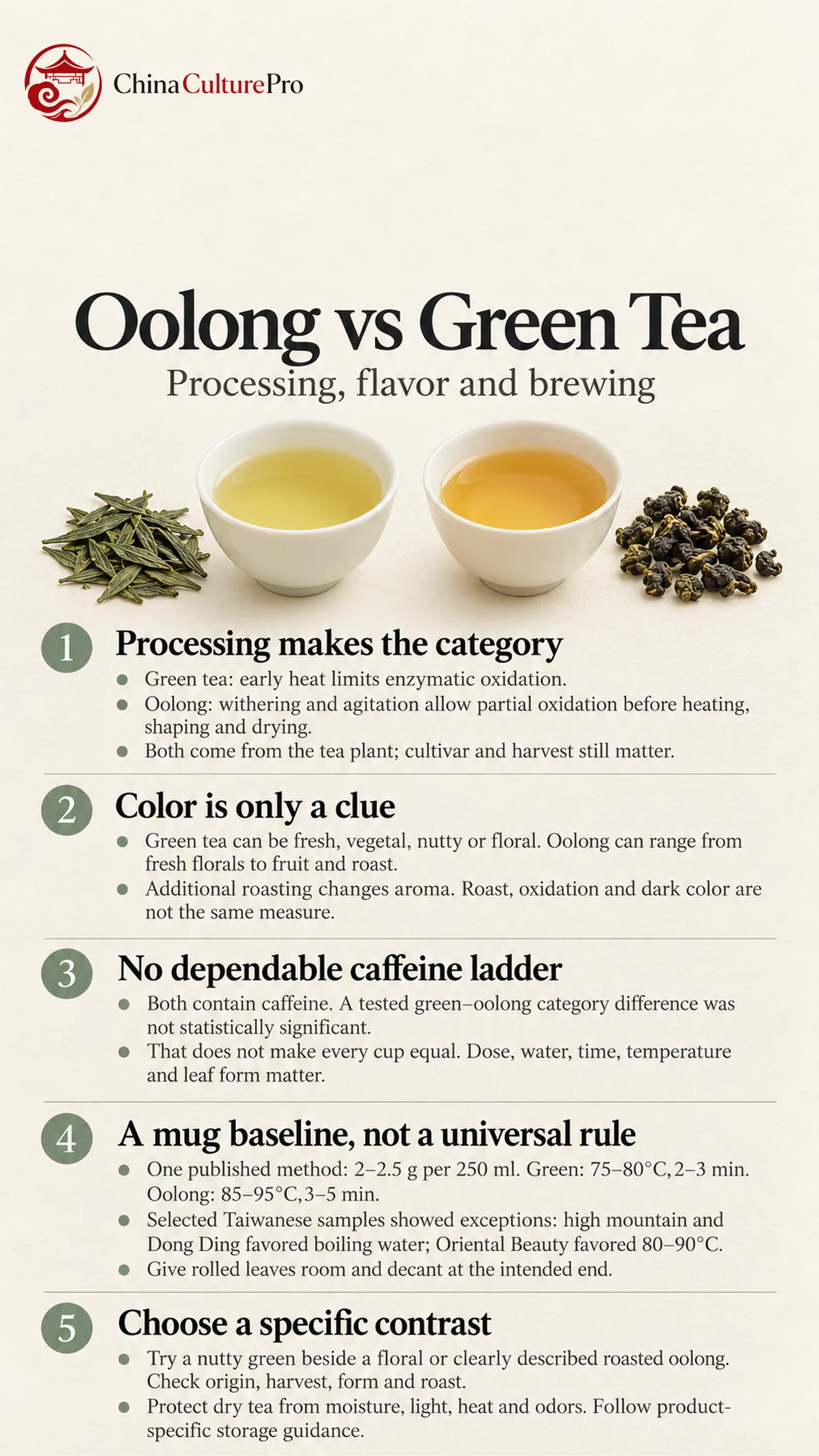
Two pale cups can come from different tea families, while two teas in the same family can taste strikingly different. For readers exploring Chinese tea and drinks, the useful comparison begins with processing, then follows through to roast, flavor and brewing choices.
Processing: When Oxidation Is Stopped
Fixation (杀青, shāqīng) is heat treatment that inactivates the enzymes driving much of tea’s oxidation. Green-tea manufacture places this early, using steaming or pan heating before later shaping and drying. Oolong manufacture first allows withering and controlled agitation, then fixes, shapes and dries the leaf.[1]
Oxidation changes leaf compounds and contributes to aroma, color and taste. The traditional trade word “fermentation” is often used for this stage, but it should not automatically be read as microbial fermentation. The tea oxidation and fermentation guide separates those mechanisms.
An experiment made six tea categories from one cultivar, showing how processing alone can produce different results from a shared leaf source. This does not mean all cultivars, plucking standards or regions are equally suited to every commercial tea style. Processing categories coexist with meaningful differences in raw material.[2]
Taste, Roast and Leaf Appearance
| Style | Possible sensory direction | Useful boundary |
|---|---|---|
| Thé vert | Often fresh, vegetal, chestnut-like or gently floral. | Leaves and liquor need not be vivid green. |
| Light-style oolong | Often floral and fresh, sometimes with a fuller texture. | A green-looking leaf can still have undergone partial oxidation. |
| More oxidized or roasted oolong | Can show fruit, honey, toast or deeper roast notes. | Oxidation and roast are separate influences; dark color cannot measure either alone. |
These are tendencies, not tasting requirements. An experimental comparison described chestnut and lightly floral notes in its green sample and floral-fruity notes in its oolong sample; it did not establish one flavor profile for every tea in either category.[2]
Additional roasting can change an oolong’s aroma without turning it into black tea.[6] The tea roasting guide explains that separate axis. Compare a fresh-style Taiwan high mountain oolong with an oolong from Wuyi for a useful contrast within oolong, while checking the actual roast of each product.
Caffeine: Why There Is No Reliable Category Ranking
Both families contain caffeine. A study of green and oolong teas from Chiang Rai found that the tested category difference was not statistically significant, while infusion conditions and leaf form affected the results. That is evidence against a simple category ladder, not proof that every green and oolong cup has the same caffeine content.[5]
Leaf quantity, water volume, temperature, steeping time and broken versus whole leaf all matter when comparing servings. A small high-leaf session and a large lightly dosed mug are not equivalent merely because each is called one cup. Taste intensity and roast color are also poor measuring tools. The tea caffeine guide considers the variables in more detail.
Brewing: Useful Starting Points and Exceptions
Start with instructions for the actual tea. One published mug method uses about 2–2.5 g per 250 ml, with green tea at 75–80°C for 2–3 minutes and oolong at 85–95°C for 3–5 minutes. These are that method’s starting ranges; they are not interchangeable with a high-leaf, short-infusion session.[4]
Research on selected Taiwanese samples provides useful exceptions. Its green tea favored 80–90°C over boiling water; high mountain and Dong Ding (冻顶乌龙茶, Dòngdǐng wūlóngchá) oolong favored boiling water, while Oriental Beauty (东方美人, Dōngfāng měirén) favored 80–90°C. The tested samples therefore did not follow a rule that every oolong needs hotter water than every green tea.[3]
Give rolled leaves room to expand and separate the liquor from the leaves when the intended steep ends. If the cup is too astringent, change one variable—such as infusion length—before changing several at once. A gaiwan ou théière can work for either family when its capacity and pouring method fit the tea and brewer.
Choosing a Tea and Keeping It Fresh
Choose a specific contrast instead of buying only by the category name: a fresh, nutty green against a lightly floral oolong, or a green against a clearly described roasted oolong. Ask for origin, harvest information, leaf form and roast description. Those details make the next comparison more informative.
Protect dry tea from moisture, light, excessive heat and strong odors. Fresh-style green and lightly oxidized oolong are usually bought for the character they already have, rather than for an assumption that storage must improve them. Roasted oolong may be handled differently by its producer, so follow the product’s instructions and the tea storage guide.
FAQs About Oolong and Green Tea
Is a green-looking oolong actually green tea?
No. The timing of heating and the preceding oxidation process determine the category. A lightly oxidized oolong can retain green-looking leaves and a pale liquor.
Which tea is less bitter?
Neither is guaranteed to be less bitter. Leaf quality, tea style, dose, temperature and infusion length affect the result. A pale-looking infusion can still taste harsh when over-extracted.
Can both teas be infused more than once?
Yes, many whole-leaf examples can be re-infused. Leaf form and brewing method affect how successive infusions develop; there is no guaranteed infusion count for every green or oolong tea.
Does oolong always have more caffeine than green tea?
No. Category labels do not reliably rank finished cups. Compare the actual leaf dose and brewing conditions, and use product-specific analytical information if a measured caffeine value is important.
Sources
[1] Taiwan Tea and Beverage Research Station. 臺灣特色茶分類及加工製程簡介
[2] Li et al., original experimental research. Study on taste quality formation and leaf conducting tissue changes in six types of tea during their manufacturing processes
[3] Taiwan Tea and Beverage Research Station. 水質及水溫對茶湯品質之影響
[4] Teabox, original brewing guide. How to Brew Oolong and Green Tea: Temperature and Time
[5] Food Chemistry, original caffeine research. Caffeine in Chiang Rai tea infusions: Effects of tea variety, type, leaf form, and infusion conditions
[6] Original roasted and unroasted oolong comparison. Comparative study of the volatile fingerprints of roasted and unroasted oolong tea by sensory profiling and HS-SPME-GC-MS