
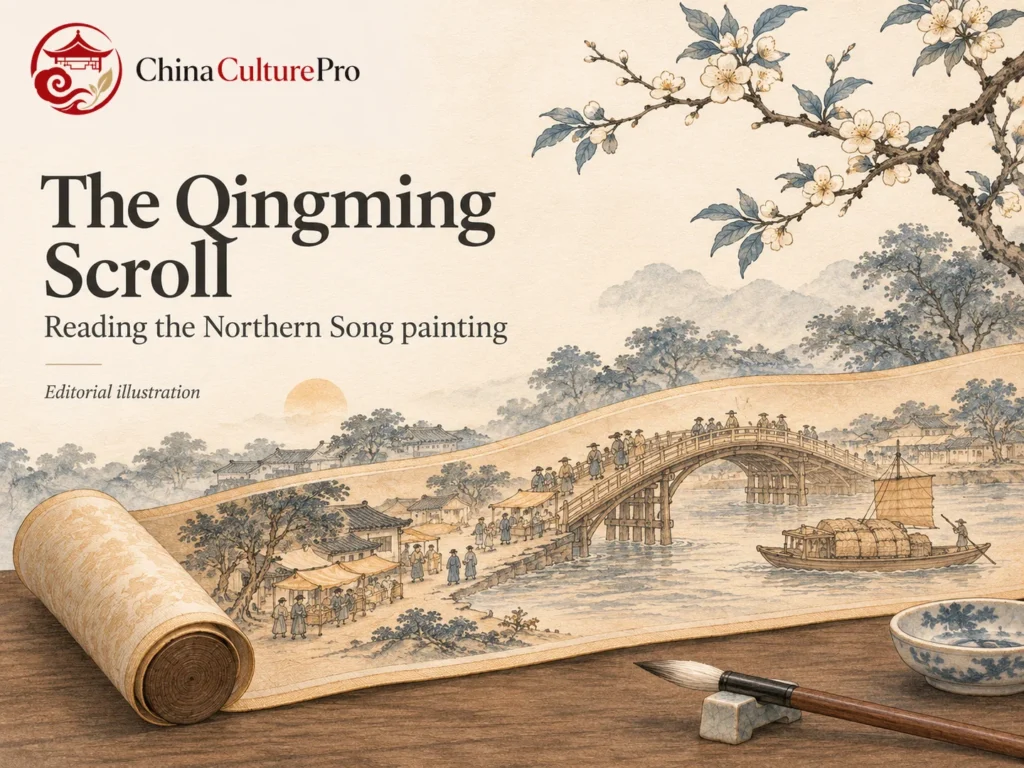

Quick Answer: What Is the Qingming Scroll?
The Qingming Scroll (清明上河图, Qīngmíng Shànghé Tú), commonly titled Along the River During Qingming, is a Northern Song (北宋, Běi Sòng) painting attributed to Zhang Zeduan (张择端, Zhāng Zéduān). The handscroll (手卷, shǒujuàn) uses ink and light color on silk to picture the outskirts, waterways and street life associated with Bianjing (汴京, Biànjīng), today’s Kaifeng. The Song scroll belongs to the Palace Museum in Beijing. [1][8]
The picture is only 24.8 centimeters high and about 5.3 meters long. Start at the right end of the painted image and follow the route into the city. A bright, much longer scroll with the same title may be a later court version held in Taipei. [1][3][6]

A crowd leans toward the rail of a wooden bridge as a boat approaches below. Earlier in the scroll, the riverbank is quiet. That change in pace is part of the painting’s design, and it comes into focus when you read the scene in sections. [2]
How the Handscroll Controls What You See
Among Chinese scroll painting formats, the handscroll opens horizontally on a surface. The viewer exposes a section roughly the width of the shoulders and rolls up the part already seen as the next stretch comes into view. This movement makes the viewer decide when to linger and when to continue. A full-width reproduction is helpful for locating the bridge and city gate, while a close digital view restores the scale at which small gestures become readable. [3]
The opening is on the right. On a digital viewer, locate the sparse countryside first and advance toward the crowded streets at the left. Look at the painted silk separately from the mounting and the inscriptions that follow it. A reproduction that shows only the famous bridge omits the buildup that gives the scene its impact. [2][3]
From the Countryside to the City
The opening follows paths through low houses and fields. The figures have room around them, and the landscape has a relatively open rhythm. Then the banks grow busier. Paths and the waterway begin to carry more traffic as the picture moves toward the bridge. [1]
The central Rainbow Bridge (虹桥, Hóngqiáo) brings river traffic and street traffic into a single scene. Find the boat just below the arch. Its crew lowers the mast for the passage as onlookers gather above. The gesture of leaning over the bridge draws your attention from the street to the water. The bridge matters as much for the moment of suspense as for the intricacy of its wooden structure. [2]
Farther left, the route passes a city gate and continues through streets lined with businesses. Compare the elaborate shop entrances with small stalls under simple shelters. Carts, pack animals and people share the road. Look at how little open space remains around them. [1]
Brushwork, Buildings and Everyday Life
Ruled-line painting (界画, jièhuà) is one of the Chinese painting techniques used to describe built forms with guided lines. Look at a roof edge or a beam, then compare it with the looser marks in a tree. Crisp architecture helps you read how buildings sit alongside lanes and how vessels fit into the river scene. The picture’s viewpoint changes as you travel through it, letting you look down into one area and then see another structure more frontally. [1][2]
The painting makes the movement of goods unusually tangible. A river vessel, a loaded animal and a shop entrance show different points in a commercial network. Such details can be compared with texts and surviving objects. Their density also reflects choices about what to include and where to place it. The scroll’s picture of the capital offers a selective view of a city shaped by a painter. [2][4]
Zhang Zeduan and the Meaning of Qingming
The painted section bears no surviving signature or seal of the artist. A colophon, an inscription attached after the image, gives the name Zhang Zeduan. Dated 1186, the note by Zhang Zhu identifies the painter and records his skill at portraying built structures and traffic. This is where inscriptions and seals help identify a work. The date belongs to the inscription. The year the picture was made and the circumstances of its commission remain uncertain. [4][8]
The common English title reads Qingming as a reference to the spring Fête de Qingming (清明节, Qīngmíng Jié). Another scholarly reading understands the words as a description of a clear, peaceful and orderly time. The choice shifts the emphasis from a time of year to a broader vision of thriving urban life. The title by itself cannot establish the exact day depicted. [4][5]
The Song Original and Later Qingming Scrolls
Artists revisited the subject for centuries. The Qing court version (清院本, Qīng yuànběn) of 1736 was made by five court painters. It follows the long river-to-city composition while adding details of urban life from much later periods. When a picture or animation uses the same English title, check the object label before treating a detail as Song evidence. [6][7]
| Version | Collection | Image size and visual clues |
|---|---|---|
| Northern Song scroll attributed to Zhang Zeduan | Palace Museum, Beijing | About 24.8 × 528 cm. Light color on silk, a wooden arch bridge and a compact stretch of city streets. [1][2] |
| Qing court scroll completed in 1736 | National Palace Museum, Taipei | 35.6 × 1152.8 cm. Brighter color and much more extensive urban scenery. [6][7] |
Compare the collection, artist and date first. Reproduction can change how the colors look, and the two scrolls give evidence for different periods. [6][7]
FAQs About the Qingming Scroll
Where Is the Original Qingming Scroll?
The Northern Song scroll attributed to Zhang Zeduan is in the Palace Museum in Beijing. The museum’s digital gallery lets you inspect the full painting and zoom into individual scenes. [1][2]
Does the Painting Show Tomb Sweeping?
Tomb sweeping is not the main action in the scroll. Its scenes follow travel, traffic and trade from the outskirts to the city streets. The festival translation is one reading of the title, alongside the interpretation of Qingming as peaceful order. [2][5]
How Long Is the Original Qingming Scroll?
The painted image is about 5.3 meters long and 24.8 centimeters high. The Beijing collection entry lists a width of 528 centimeters, while its exhibition record gives 528.7 centimeters. [1][8]
Sources
[1] Palace Museum, Beijing. Zhang Zeduan’s Along the River During Qingming
[2] Palace Museum, Beijing. Digital Gallery of the Qingming Scroll
[3] Metropolitan Museum of Art. Chinese Handscrolls
[4] Valerie Hansen. The Beijing Qingming Scroll and Its Significance for the Study of Chinese History
[5] Columbia University, Asia for Educators. Translations of Qingming Shanghe Tu
[6] National Palace Museum, Taipei. Painting Animation: Up the River During Qingming
[7] Columbia University, Asia for Educators. Two Versions of the Scroll
[8] Palace Museum, Beijing. Qingming Scroll in the Stone Moat Catalogue Exhibition