


Quick Answer: What Shapes a Chinese Brushstroke?
A Chinese brushstroke records how a loaded brush touches a particular surface. Changing the angle, pressure, water or ink strength can turn the same movement into a fine line, a broad wash or a rough texture. [1][3]
- Brush: The tip makes a narrow contact. Tilting the brush or adding pressure brings more of its hairs onto the surface. [1]
- Ink: Dilution changes the value, from dark to pale. Moisture changes how freely the brush releases ink. [1][3]
- Surface: Paper or silk affects how a stroke spreads, dries and keeps its edge. [2][7]
- Color: A pale tint can accompany an ink drawing. Strong mineral colors can organize an entire landscape. [2][5]
Several kinds of mark often appear in one painting. Look at each mark’s job before naming the style of the whole work. [1][4]
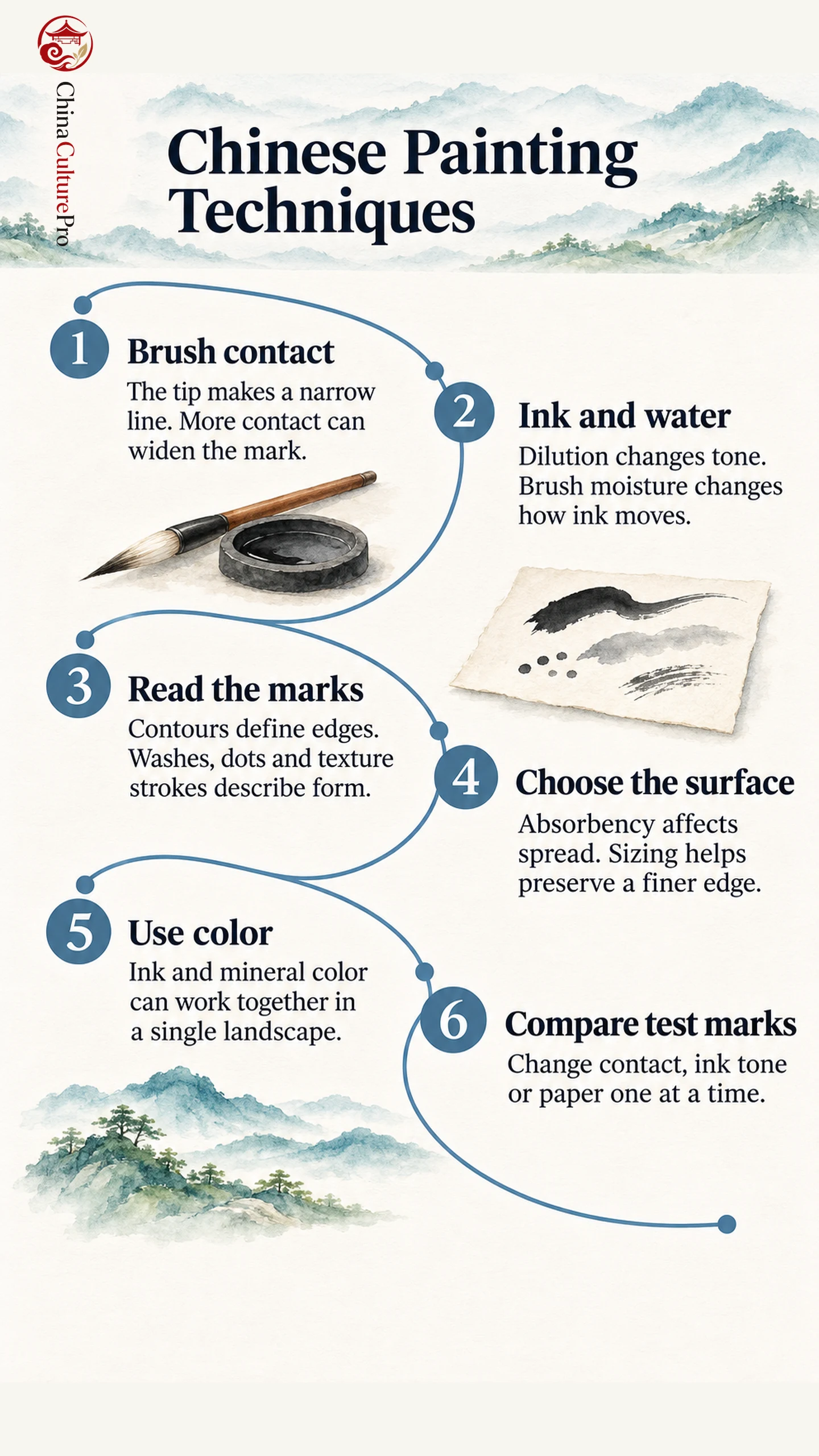
A mountain can emerge from an outline, a patch of pale ink and a handful of darker strokes. The outline gives it an edge. The wash places it in the atmosphere. Shorter marks suggest the shape of its rock face. Each effect starts with a different way of handling the brush. [4]
Brush Shape, Pressure and Contact
A pointed brush can make a line with its tip and a broad stroke with its side. Size matters, but so does the portion of the hairs that touches the sheet. A light beginning, firmer middle and lifted finish can make one mark move from narrow to broad and back again. Speed and angle affect the line’s shape even with the same brush. [1][3]
The Four Treasures of the Study include brush, ink, paper and inkstone. Consider them together. A lightly loaded brush may leave broken traces. With more liquid and a broader contact, it can release ink across a wider area. A line’s width or sharpness can reflect the pressure, the brush or the material beneath it. [1][2]
Ink Strength, Brush Moisture and Layering
Traditional solid ink is made from finely ground soot and a binder. Grinding the stick with water on an inkstone makes liquid ink. A small amount of strong ink can be diluted to make paler tones. Black ink can therefore give a landscape deep foreground marks and much lighter distance. [2][3][4]
Dilution and the amount of liquid in the brush are separate controls. A brush can hold a great deal of pale ink or a small amount of dark ink. With similar contact on the same paper, the first can leave a pale damp area and the second a dark, broken mark. If two wet marks meet, their tones can mix. A fresh mark over a dry wash can retain a clearer boundary. [1][3]
Five Marks to Recognize in a Painting
| Mark | Éléments à observer | Typical job |
|---|---|---|
| Contour | A line that follows the edge of a leaf, figure or mountain. [1][4] | Define a shape or show where forms overlap. |
| Wash | A broad area of diluted ink or color, sometimes with a gradual shift in tone. [1][3] | Suggest atmosphere, shadow or volume. |
| Texture strokes (皴法, cūnfǎ) | Short or extended marks inside a shape. [4][6] | Give a rock face or slope surface and direction. |
| Dots | Small touches repeated across a passage. [4] | Suggest foliage or group smaller details. |
| Broken ink (破墨, pòmò) | A second tone introduced into ink that is still wet. [1] | Interrupt an even wash with a softer, merging tonal edge. |
The Ming painter Tang Yin adapted axe-cut texture strokes into longer marks in his 1516 landscape Mountain Path and Whispering Pines. A stroke name can help you recognize a family of marks, and the painting shows how an individual artist changes the length and rhythm. [6]
Paper and Silk Change the Edge
Sizing partially seals the surface of a sheet and reduces how quickly liquid enters it. On more absorbent paper, a wet line can spread through the fibers. A less absorbent sheet can preserve a finer edge. Xuan paper (宣纸, xuānzhǐ) can be prepared for different effects. A test mark shows how the sheet takes the brush load you intend to use. [2]
Silk has its own weave and preparation. A smooth-looking cloth can still take ink readily. In Birds in a Lotus Pond, absorbent satin helps saturated ink marks spread. When comparing gongbi and xieyi, pay attention to the actual edges and handling instead of classifying the picture by its support. [1][7]
Color and Ink Can Share the Same Painting
In blue-green landscape (青绿山水, qīnglǜ shānshuǐ), mineral blues and greens can define the mountain masses. Wang Ximeng (王希孟, Wáng Xīmèng) used such colors in A Thousand Li of Rivers and Mountains (千里江山图, Qiānlǐ Jiāngshān Tú), a Northern Song silk handscroll. Look from the strong color of the peaks to the small lines describing the surface of the water. The broad and fine effects work at different viewing distances. [2][5]
In Mountain Market, Clearing Mist, Xia Gui (夏圭, Xià Guī) uses a more restricted ink palette. Dark dots, wedge-shaped strokes and washes describe a scene dissolving into mist. Compare the way one work sets apart masses of color and the other suggests space through the density and tone of its ink marks. [4][5]
Three Small Studies for Seeing the Difference
- Contact: Use one brush and ink mixture to make a tip line and a side stroke on the same sheet. Compare width and the shape of the end. [1]
- Tone: Keep the paper and brush pressure the same while testing pale and dark mixtures. Compare the values after the marks dry. [1][3]
- Absorbency: Repeat a damp stroke on two papers with different surface preparations. Look at the width of the final edge and how the ink spreads beyond the first contact. [1][2]
FAQs About Chinese Painting Techniques
Do Chinese Painters Use Only Black Ink?
Chinese painting includes monochrome ink, lightly tinted ink and works with pronounced color. Mineral blues and greens are prominent in Wang Ximeng’s Northern Song landscape. [2][5]
Is Xuan Paper Always Highly Absorbent?
Absorbency depends partly on preparation. Sizing reduces how quickly a sheet takes up water, so test the actual paper with the brush load you intend to use. [2]
What Is the Difference Between an Ink Wash and Dry Brush?
A wash distributes diluted ink over an area. Dry brush uses comparatively little moisture, so the hairs can leave separate traces and gaps. A painting can use a wash for distant mist and dry marks for a rough surface. [1][4]
Sources
[1] Asian Art Museum. A Visual Vocabulary of Brushstrokes
[2] Asian Art Museum. Brushstrokes: Styles and Techniques of Chinese Painting
[3] Asian Art Museum. An Introduction to Chinese Brushpainting Techniques
[4] The Metropolitan Museum of Art. Xia Gui: Mountain Market, Clearing Mist
[5] Palace Museum, Beijing. Wang Ximeng’s A Thousand Li of Rivers and Mountains
[6] National Palace Museum. Tang Yin: Mountain Path and Whispering Pines
[7] The Metropolitan Museum of Art. Bada Shanren: Birds in a Lotus Pond