

Quick Answer: What Does Chinese Art Include?
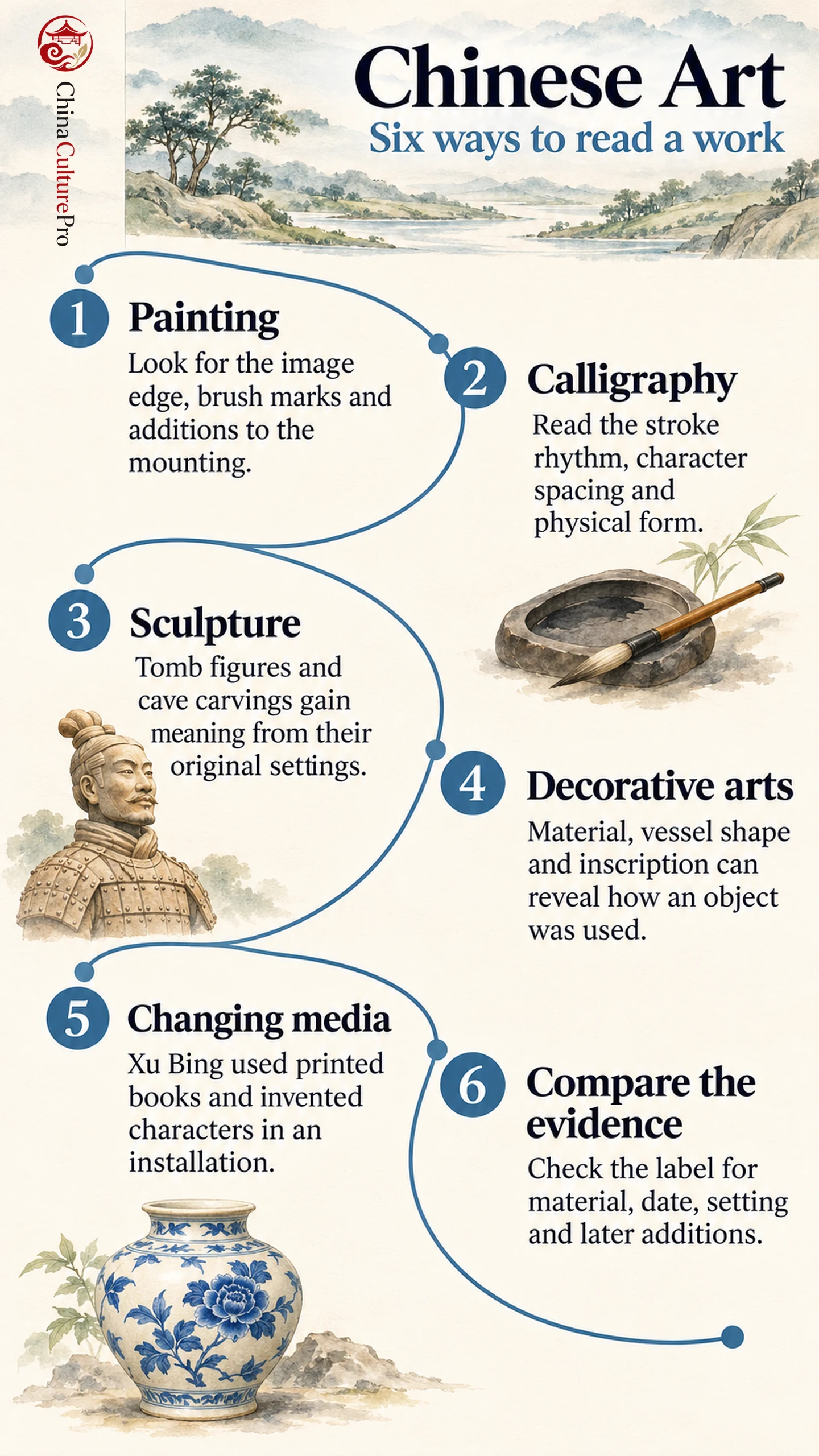
Chinese art spans the written character, the painted surface, the sculpted figure and objects made for use or display. Start with the material and the setting for which a work was made. [1]
- Painting: Ink and color on silk or paper can evoke a landscape, show a figure or trace the life of a city. [2][9]
- Calligraphy: Calligraphy (书法, shūfǎ) makes the movement and arrangement of written characters part of the work. [3]
- Sculpture: Clay, stone and wood carry very different meanings in tombs, temples and other settings. [1][4][5]
- Decorative arts: Bronze, jade, porcelain, lacquer and textiles take their forms from work in particular materials and from the uses for which they were made. [1][8]
The same motif can move across media. A work’s date, original setting and physical form help explain what the motif does there. [1][6]
A horse painted with a few brushstrokes, a clay soldier buried near an emperor and a pair of porcelain vases dedicated to a temple ask for different kinds of attention. The horse has a history of looking and collecting. The soldier belongs to an archaeological site. The vases carry a date and a record of their use. [2][4][6]
Painting: Formats, Brushwork and Subjects
A handscroll (手卷, shǒujuàn) is a horizontal work viewed in sections. Some handscrolls sustain a long visual sequence, as in Along the River During Qingming. Its painted silk takes a viewer from quiet fields to crowded streets. Others surround a much smaller image with writing. Check the dimensions of the image separately from those of the entire mounting. [2][9]
Night-Shining White (照夜白图, Zhàoyèbái Tú), a horse painting attributed to Han Gan (韩干, Hán Gàn) and dated to about 750, is ink on paper. The painting itself is about 31 by 34 centimeters. Over time, inscriptions and seals accumulated around it and on its surface. Read the brushwork of the horse first, then look for what later viewers added around it. [2][10]
Brush technique helps explain what each painting brings into focus. The horse attributed to Han Gan conveys energy through its contour and raised forelegs. In the city scroll, carefully described roofs, boats and lanes show how people and goods move through a built environment. One approach sharpens attention on an animal and the other distributes it across hundreds of details. [2][9]
Calligraphy: Writing as a Visual Art
In Chinese calligraphy, a familiar character can look different depending on the script and the writer’s hand. The more even lines of seal script make a useful comparison with running script, in which some strokes flow into one another. Start with the width of the lines, the gaps between characters and the way one form leads into the next. These features can be seen before the text can be translated. [3]
A brush-written model could circulate in several physical forms. Writing was also carved into stone and circulated through rubbings. A rubbing made centuries after a carving may preserve part of a much older text and form. A museum label can therefore supply separate dates for the composition, the carved version and the paper impression. Study the kind of object in front of you before comparing brushwork. [3]
Sculpture: Tombs, Temples and Workshops
The terracotta warriors near the mausoleum of the First Qin Emperor belong to a burial complex. The earthenware figures are grouped with horses and chariots in pits. Their arrangement matters because it shows how individual sculptures were designed to participate in a much larger formation. An isolated warrior in an exhibition can reveal armor or posture while losing this spatial relationship. [4]
Rock-cut Buddhist images at Yungang, made under Northern Wei patronage, belong to a different setting. Carved figures occupy cave interiors, where the scale and placement of each image shape how it is seen. Artistic models from the wider Buddhist world were adapted to new settings and visual conventions. The material and the site are part of the history of Chinese sculpture. [5]
Decorative Arts: Materials and Uses
Jade carving, bronze casting, lacquerwork and ceramics call for different materials and forms of expertise. A category like decorative arts can include objects used in ceremonies, at meals or as furnishings. A vessel’s shape and surface can help identify its function. Written evidence sometimes narrows the answer to a particular donor or purpose. [1][6]
The David Vases are a pair of Yuan dynasty altar vessels in blue-and-white porcelain (青花瓷, qīnghuācí). Their cobalt decoration lies beneath the glaze. An inscription dates their dedication to 1351 and records their presentation to a Daoist temple. The vessels borrow features from bronze forms, showing how a design can travel between materials. The dedication places blue-and-white production at Jingdezhen by 1351. [6]
The imagery on a vessel is another line of evidence. A dragon or flower has to be read together with the object’s shape, inscription and setting. The decoration on the neck of the David Vases, for example, frames a written dedication. A guide to Chinese porcelain patterns helps identify these recurring forms. [6]
How Patronage and New Media Changed Chinese Art
Court and scholar traditions developed alongside one another. Ming court painters adapted earlier figure and landscape subjects to suit the needs of the palace. Scholar painters used brushwork, poems and inscriptions to make associations with earlier artists and to address friends. The idea of literati painting (文人画, wénrénhuà) helps explain the importance of these relationships around a work. [2][8]
Earlier forms can become the material for a very different kind of work. In Book from the Sky (天书, Tiānshū), made from 1987 to 1991, Xu Bing (徐冰, Xú Bīng) printed books and long sheets from carved movable type. The invented forms resemble Chinese characters, which draws the viewer into trying to read them. The installation uses a bookmaking tradition to make reading itself the subject, one route into Chinese contemporary art. [7]
Four Objects and What to Look For
| Work or setting | Detail to check | Ce que cela permet de comprendre |
|---|---|---|
| Night-Shining White | The edge of the small horse image | The difference between the painting and additions to its mounting. [2][10] |
| Qin terracotta army | The figure’s position within a formation | The role of one sculpture in the burial complex. [4] |
| David Vases | The dedication on the neck | The date and religious purpose of the vessels. [6] |
| Book from the Sky | Repeated character-like forms | How a familiar print format can unsettle a reader’s expectations. [7] |
FAQs About Chinese Art
Is Chinese Art Mostly Ink Painting?
Ink painting is one prominent tradition. Chinese visual art also includes works made with color on silk, writing in ink or carved into stone, tomb and temple sculpture, bronze vessels, jade, lacquer and textiles. [1][3][8][9]
What Is the Difference Between Painting and Calligraphy?
Painting organizes images, while calligraphy gives written characters a visual form through structure, spacing and stroke movement. The two arts share brush techniques and can appear together on one work. [2][3]
Why Are Seals on Chinese Paintings?
Some seals identify an artist or collector. Collector seals can trace an artwork’s passage through different hands. On an old painting with several seals, compare their placement and read them alongside any inscriptions. [2]
Can Chinese Contemporary Art Use Traditional Techniques?
Yes. Book from the Sky uses hand-printed books and carved movable type as parts of an installation. The new setting changes how viewers encounter familiar book forms. [7]
Sources
[1] Asian Art Museum. In the Collection Galleries
[2] Maxwell K. Hearn. Peinture chinoise
[3] National Museum of Asian Art. China’s Calligraphic Arts
[4] UNESCO World Heritage Centre. Mausoleum of the First Qin Emperor
[5] The Metropolitan Museum of Art. Period of the Northern and Southern Dynasties
[6] British Museum. Large Print Guide to Chinese Ceramics, Room 95
[7] Xu Bing Studio. Book from the Sky
[8] The Metropolitan Museum of Art. Arts of the Ming Dynasty: China’s Age of Brilliance
[9] Palace Museum, Beijing. Zhang Zeduan’s Along the River During Qingming
[10] The Metropolitan Museum of Art. Night-Shining White