


Quick Answer: What Is Chinese Sculpture?
Chinese sculpture includes objects modeled, cast or carved for settings as different as an ancestral ceremony, an imperial tomb and a Buddhist temple. Its materials include bronze, fired clay, stone and wood. The Terracotta Army (兵马俑, bīngmǎyǒng) is one example of sculpture made for a burial complex. [1][3][6][8][9]
- Ritual: Shang and Zhou bronze vessels could combine an offering container with raised or projecting animal forms. [1][2]
- Burial: Fired clay figures ranged from the Qin emperor’s army to glazed animals in Tang tombs. [3][5]
- Devotion: Cliff carvings, gilded bronze figures and painted wooden images brought Buddhist subjects into different spaces. [6][7][8][9]
Look at the original setting and use as well as the material. Clay, for example, can carry paint on a soldier or a colored glaze on a camel. [4][5]
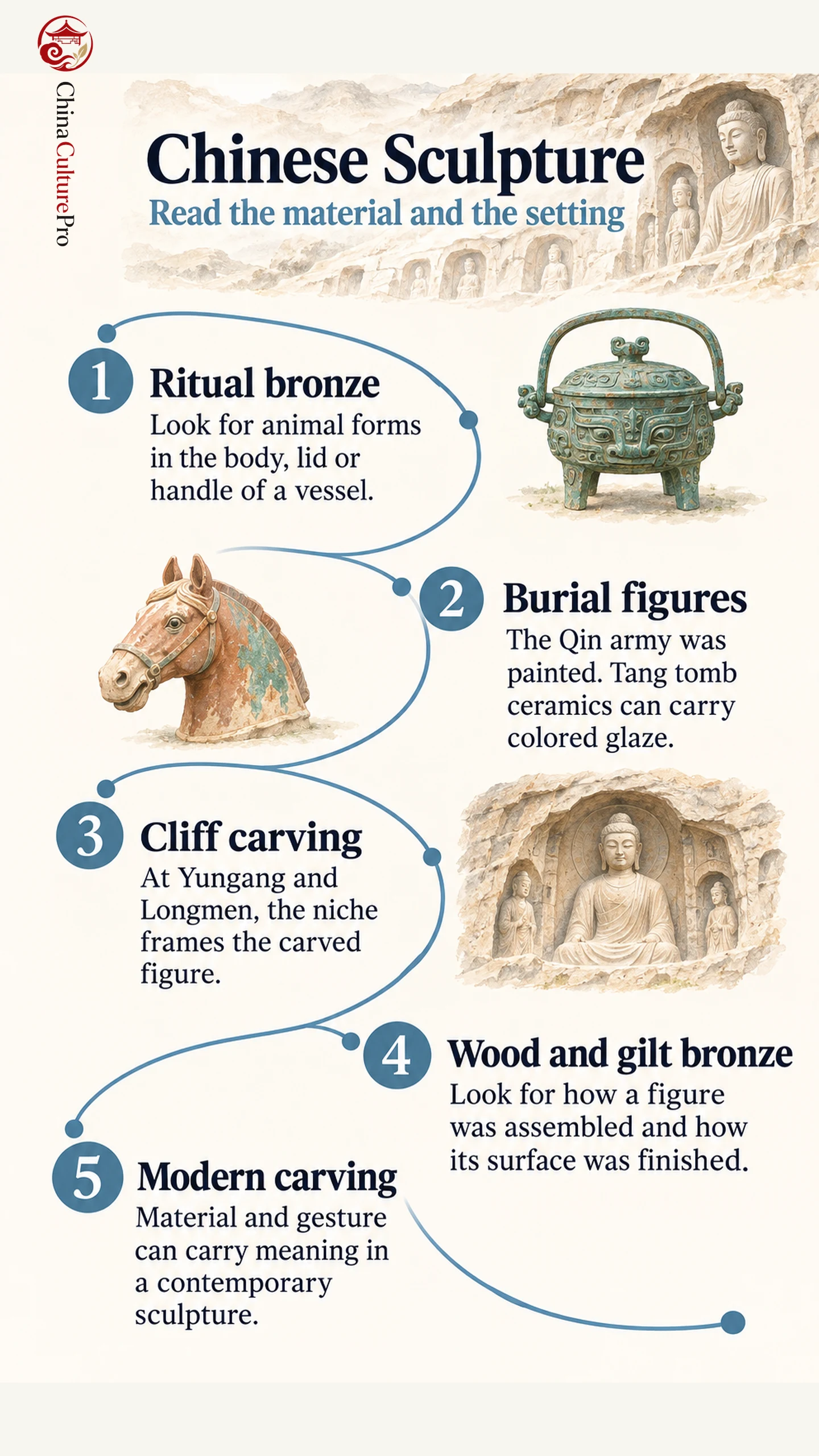
A carved Buddha still in its cliff niche and a bronze vessel in a museum case reward different kinds of looking. Start with what the object does in its setting. Then look at how the artist built its volume, shaped its surface and used color. Those clues help connect sculpture to other forms of Chinese art.
Ritual Bronze: When a Vessel Is Sculptural
Some of the most elaborate Shang and Zhou bronze vessels held food or wine for offerings to ancestors and other spirits. Some cast bodies and lids were shaped so that animal heads, tails or legs were also functional parts of a container. On a surviving Shang wine-pouring vessel, the owl’s head is below the spout and a bird with a hooked beak forms the handle. Follow the lid and the outline of the handle as well as the decoration on the body. [1][2]
Piece-mold casting begins with a model and a clay mold formed around it in sections. The sections can be reassembled for casting. For a vessel, a core leaves an interior cavity when metal fills the space between it and the outer mold. The result can be hollow and still have a sculpturally complex exterior. [1]
Burial Sculpture: The Qin Army and Tang Tomb Figures
The soldiers, horses and chariots near the First Qin Emperor’s mausoleum belong to a larger funerary landscape in Shaanxi. A single warrior can show armor and posture. Seen in groups, the figures make ranks and formations that matter just as much as the individual bodies. Traces of pigment also show that the fired clay was once the support for a painted surface. [3][4]
A late seventh- or early eighth-century Tang camel shows a different kind of burial furnishing. The roughly 69-centimeter tomb figure carries loads on its back and uses colored glaze. This earthenware is an example of sancai (三彩, sāncǎi), the glazed ceramic tradition often called three-color ware. The camel also brings long-distance trade into a funerary setting through the image of an animal that carried goods along Silk Road routes. [5]
Buddhist Sculpture in Caves and Temples
At Yungang, near Datong in Shanxi, the earliest major phase of carving began in the fifth century under the Northern Wei. The carvings form part of a cliff complex, where surrounding figures and the chamber frame the principal image. Longmen, on the Yi River near Luoyang in Henan, preserves late Northern Wei and Tang carving. Compare the large Buddhas in the early Binyang caves with the monumental Tang figures at Fengxiansi. The same limestone cliff complex records several phases of carving. At Mogao, modeled and painted figures appear in chambers alongside the Dunhuang murals. At Mogao, painted walls and modeled figures share one devotional space. [6][7][11]
Smaller images can carry signs of identity in their form. In an eighth-century gilt-bronze figure of Avalokiteshvara, a tiny Buddha in the headdress and a vessel in the figure’s right hand help identify the bodhisattva. An eleventh-century Water Moon Guanyin (水月观音, Shuǐyuè Guānyīn) uses a raised right knee and a low, crossed left leg to identify a particular manifestation. Its carver joined several pieces of wood with dowels and iron nails. Pose, attributes and construction reveal different things about an image used in Chinese Buddhism. [8][9]
Modern Sculpture and the Choice of Material
Wang Keping (王克平, Wáng Kèpíng), a founding member of the Stars Art Group, carved Chain in wood in 1979. Its compact fist relies on the mass of the block and the tension in a few forms. Compare that fist with the joined wooden figure of Guanyin. The compact carving and the articulated devotional image use the same broad material in different ways. Chain belongs to the experiments of late twentieth-century Chinese contemporary art. [10]
Five Examples of Chinese Sculpture
| Exemple | Material and setting | Éléments à observer |
|---|---|---|
| Shang wine-pouring vessel | Cast bronze, ritual service | See where an animal form becomes part of the vessel’s handle or spout. [1][2] |
| Qin terracotta soldiers | Fired clay with paint, imperial burial complex | Read the alignment of ranks as well as the modeled figures. [3][4] |
| Tang tomb camel | Glazed earthenware, burial furnishing | Look for the two humps and the load secured across the back. [5] |
| Longmen cave images | Carved rock, Buddhist cliff shrines | Consider the figures in relation to the niches cut for them. [7] |
| Liao Water Moon Guanyin | Joined wood, Buddhist image | Look for traces of the surface finish as well as the asymmetric pose. [9] |
FAQs About Chinese Sculpture
What Materials Were Used in Chinese Sculpture?
Founders cast bronze, potters fired modeled or molded clay, and carvers worked in stone and wood. Sculptors could finish those surfaces with glaze, pigment or gilding, depending on the object. [1][4][5][7][8][9]
Were the Terracotta Warriors Originally Painted?
Yes. Surviving pigment on some figures shows that the army’s current clay-colored appearance gives only part of the picture. Painted surfaces have required specialized conservation. [4]
What Is the Difference Between Relief and Sculpture in the Round?
A relief projects from a background that remains part of the work. Sculpture in the round has a body shaped on multiple sides. One cave can combine figures carved against a wall with figures that project much farther into the space. [6][7]
Sources
[1] British Museum. Chinese Art: A Guide for Teachers
[2] The Metropolitan Museum of Art. Wine Pouring Vessel (Gong)
[3] UNESCO World Heritage Centre. Mausoleum of the First Qin Emperor
[4] Emperor Qin Shihuang’s Terracotta Army Museum. Colors and Conservation of the Terracotta Army
[5] The Metropolitan Museum of Art. Camel
[6] UNESCO World Heritage Centre. Yungang Grottoes
[7] UNESCO World Heritage Centre. Longmen Grottoes
[8] The Metropolitan Museum of Art. Bodhisattva Avalokiteshvara (Guanyin)
[9] The Metropolitan Museum of Art. Bodhisattva Avalokiteshvara in Water Moon Form
[10] M+. Wang Keping: Chain
[11] UNESCO World Heritage Centre. Mogao Caves