


Quick Answer: Who Was Xu Beihong?
Xu Beihong (徐悲鸿, Xú Bēihóng, 1895–1953) was a Chinese painter and art educator. He brought close observation and academic drawing into his work with traditional brush and ink, and painted large historical subjects in oils. He became the first president of the merged academy named the Central Academy of Fine Arts in 1950. [1][2][7]
- Ink horses: Washes, blank paper and clear anatomy give his horses weight or movement. [3][4]
- Figures and stories: He used studies of human bodies and gestures to shape pictures of historical and literary subjects. [5][6]
- Teaching: He placed drawing from life and careful observation at the center of training. [1][2]
Look at the body in each work. A horse lowering its head, a group of workers and a figure in a large oil painting show different uses of the same attention to form. [3][5][6]
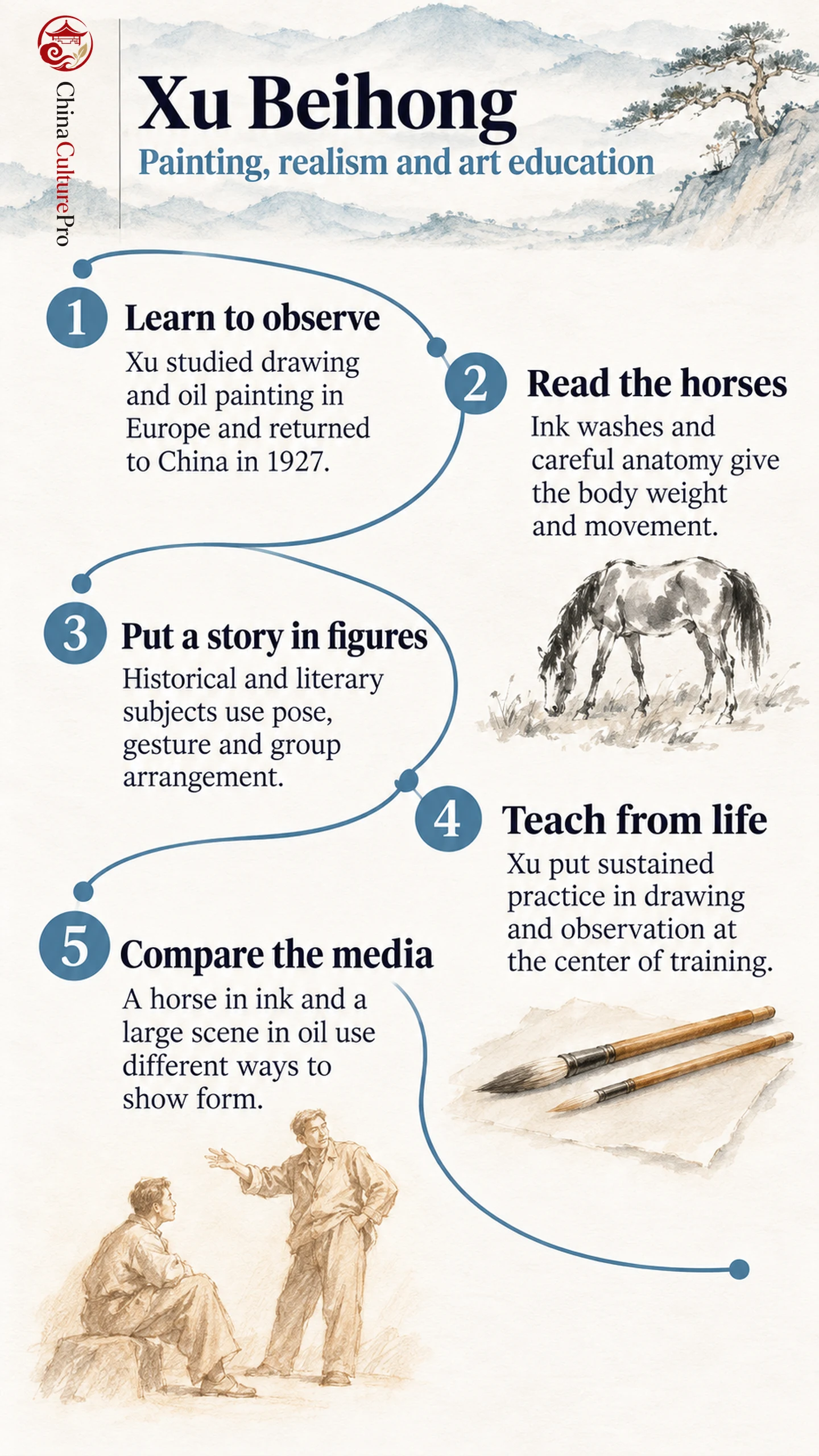
A horse lowers its head and turns its neck. A few changes in ink tone make the body appear solid, even though much of the paper remains open. That quiet pose helps explain what Xu Beihong brought to twentieth-century Chinese painting. [3]
From Yixing to Academic Training in Europe
Xu was born in Yixing, Jiangsu, in 1895 and learned painting from his father. He went to France in 1919 on a government scholarship. Drawing and oil painting were central to his studies in Europe. He returned to China in 1927 and taught at several institutions, including National Central University. [1][2]
Academic drawing trained the painter to observe how a body stands, turns or moves in depth. Xu used that knowledge across media. In brush painting he could preserve an open area of paper and let a wash describe a plane. In oil he could develop large groups of people within a sustained scene. [1][3][5]
How Xu Beihong Painted Horses
In Grazing Horse (马图, Mǎ Tú), dated 1932, Xu painted with ink on bark paper. The body recedes as the horse turns its neck, making the angle of the legs and back important. Dark and light washes help model the form. The placed legs and lowered head make the horse’s weight visible in a quiet pose. [3]
An inscription by Qi Baishi records the circumstances of the work. Xu made it for Qi’s son and did not have his seals with him. The absence of Xu’s own seal is part of this object’s story, and the inscription supplies evidence a viewer would otherwise miss. [3]
In the 1951 Galloping Horse (奔马, Bēnmǎ), the running pose directs attention toward the animal’s movement across the surface. Compare it with the grazing pose to see how a familiar subject lets Xu work on different problems of balance and motion. Other brush and ink techniques help explain how a dark mark or a thin wash can carry part of an animal’s form. [3][4]
History, Fable and the Modern Figure
Tian Heng and His Five Hundred Followers (田横五百士, Tián Héng Wǔbǎi Shì), made in 1928–30, is an oil painting based on an account in Records of the Grand Historian. Xu chose the farewell before Tian Heng’s departure. The gestures of the gathered figures show how figure painting can concentrate a longer story in one exchange. [1][5]
Xu made both a Chinese painting and an oil version of The Foolish Old Man Moves the Mountains (愚公移山, Yúgōng Yíshān) in 1940 while working in India. The fable tells of a family persisting with the task of clearing mountains. His studies for the painting examined how workers lift, lean and brace themselves. The oil version omits the figure carrying baskets and the loaded elephant found in the Chinese painting version. It also opens up the view into the distance. The wartime setting helps explain why the story of persistence mattered to viewers then. [6]
Drawing and the Reform of Art Education
Xu wanted students to draw from life and learn to understand how forms occupy space. The emphasis was on basic abilities that could travel across media: measuring proportions, observing light and shade, and understanding how a pose holds together. Those skills also helped artists construct more elaborate compositions from preparatory studies. [1][2][6]
He led the institution formed from a merger in 1949 and formally named the Central Academy of Fine Arts in 1950. Its early teaching drew on his concern for disciplined study of form. The curriculum gave sustained practice in drawing a central role, including for students working in other media. [1][7]
Four Xu Beihong Works to Compare
| Work | Date and medium | Éléments à observer |
|---|---|---|
| Tian Heng and His Five Hundred Followers | 1928–30, oil on canvas | Gestures and grouping at the moment of farewell. [1][5] |
| Grazing Horse | 1932, ink on bark paper | Light and dark washes around the turned body. [3] |
| The Foolish Old Man Moves the Mountains | 1940, Chinese painting and oil versions | Changes in the positions of the workers and the space beyond them. [6] |
| Galloping Horse | 1951, Chinese painting | The direction of movement in a running pose. [4] |
FAQs About Xu Beihong
Why Is Xu Beihong Known for Horses?
Horses were a recurring subject. His paintings use observed anatomy and ink to show poses ranging from a quiet grazing stance to rapid motion. [3][4]
Did Xu Beihong Paint in Oils?
Yes. Tian Heng and His Five Hundred Followers is an oil painting on canvas. He also made an oil version of The Foolish Old Man Moves the Mountains in 1940. [5][6]
What Did Xu Beihong Change in Art Education?
He promoted drawing from life and sustained practice in proportion and form. His teaching brought academic drawing and oil painting into contact with existing brush traditions. [1][2][7]
Sources
[1] Central Academy of Fine Arts. Xu Beihong
[2] Shanghai Maritime University. About Xu Beihong
[3] The Metropolitan Museum of Art. Xu Beihong: Grazing Horse
[4] National Art Museum of China. Gallery Collection: Galloping Horse
[5] CAFA Art Museum. Tian Heng and His Five Hundred Followers
[6] National Art Museum of China. Xu Beihong: Studies and Narrative Composition
[7] Central Academy of Fine Arts. Institutional History