
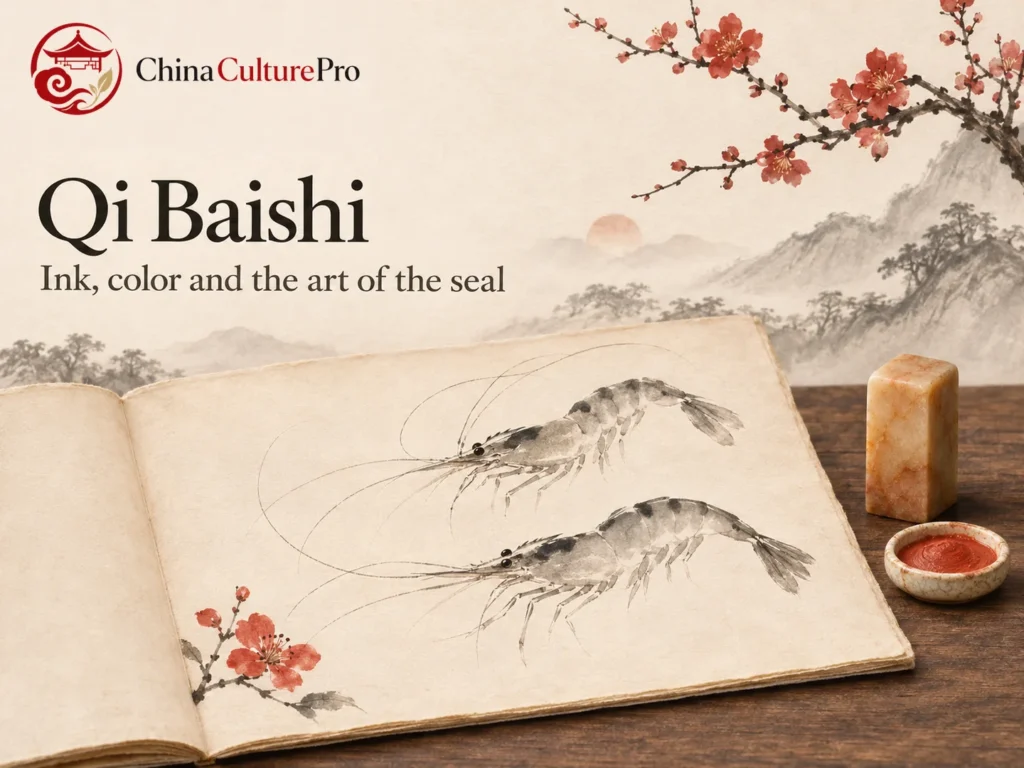

Quick Answer: Who Was Qi Baishi?
Qi Baishi (齐白石, Qí Báishí, 1864–1957) was a Chinese painter, calligrapher and seal carver. He trained as a woodworker in Hunan and became a major figure in twentieth-century painting in Beijing. Small creatures and familiar plants gave him subjects for experiments with ink, color and line. [1][2][3][4]
- Brush marks: A few related strokes can give an animal its body and movement. [3]
- Detail and color: Delicate insects can appear beside freely brushed flowers on the same album leaf. [4]
- Writing and seals: Names, titles and carved marks have their own place in the composition. [5][6]
His work includes landscapes and other subjects alongside the natural forms for which he is widely known. [2]

In one album leaf, a small insect has carefully drawn legs while the plant beside it appears in broad touches of color. Qi Baishi could shift the degree of detail within a single image. The result gives you a way into the work of one of the best-known Chinese painters. [4]
From Xiangtan Woodworking to Beijing Painting
Qi grew up in Xiangtan County, Hunan, and worked as a carpenter and furniture maker. He went on to study portrait painting, calligraphy and carving seals. From 1902 he made five journeys at the invitation of friends. Back in Xiangtan, he drew on those experiences in his painting. He settled in Beijing in 1919. [1][2]
The painter Chen Shizeng (陈师曾, Chén Shīzēng), also known as Chen Hengke, encouraged him to develop a more personal way of using the brush. The change came after years of training and work. By 1927 Qi was teaching traditional painting in Beijing. He brought that freedom to landscapes as well. In the 1931 album leaf Viewing Antiquities at the Studio of Humility, blue and red hills surround a small study where a seated figure looks at a tray. Color and a few abbreviated trees make the scene readable at a small scale. [1][2][3][8]
How Qi Baishi Painted Shrimp
The 1927 hanging scroll Shrimp (虾柳图, Xiāliǔ Tú) uses ink on paper. Begin with the groups of marks forming the bodies. Related strokes recur from one creature to the next, while small changes in ink strength, angle and placement give each animal its position. Long thin lines spread around the bodies and make the water seem occupied even where the paper is bare. [3]
Compare the eight-years-earlier Scuttling Crab, an ink hanging scroll dated 1919. Each mark describing a leg or the shell is shaped for that part of the animal. In the later picture, the sequence of marks repeats across several bodies. The contrast makes his change in method visible. A brushstroke could describe a part and also act as a repeated unit in the picture’s design. [3][9]
The repetition helps the group hold together. Each stroke has to describe something recognizable about the animal and contribute to the rhythm of the picture. The painting also shows how Chinese bird and flower painting can take small aquatic creatures as its subject. [3][4]
Insects, Flowers and Different Kinds of Detail
The twelve-leaf album Insects and Plants (草虫图, Cǎochóng Tú), dated 1943, shows how Qi changed methods within one composition. A cicada’s fine contours appear beside broader strokes of foliage. In another leaf, a dragonfly and a lotus are described at different levels of detail. The plants can establish season and setting while the smaller creatures reward close looking. [2][4]
Qi also used strong contrasts between red flowers and leaves handled in dark ink. His flower pictures give color an active role in how the eye moves between forms. A comparison of gongbi and xieyi helps describe the difference between close linework and expressive marks in the same artist’s work. [4][7]
Calligraphy, Poetry and Seal Cutting
Seal cutting (篆刻, zhuànkè) was an art Qi practiced in its own right. He carved seals for himself and for other people. The texts could include names or phrases with a personal or literary association. On the page, the impression can balance an inscription or identify a name the artist used. [5][6]
The Three Symbols of Autumn, dated 1934, carries an inscription identifying the subject and a seal reading Baishi, or White Stone. The title draws attention to the season. The dry outlines of chrysanthemums and the broader, wetter treatment of begonia leaves show how he varied his brush across a single hanging scroll. Compare the mark on the work with the inscription when reading painting inscriptions and seals. [5]
Three Qi Baishi Works to Compare
| Work | Date and format | Detail to look for |
|---|---|---|
| Crevettes | 1927 hanging scroll | Repeated ink marks at different strengths make the creatures read as a group. [3] |
| The Three Symbols of Autumn | 1934 hanging scroll | Compare dry chrysanthemum outlines with broad colored begonia leaves. [5] |
| Insects and Plants | 1943 album of twelve leaves | Examine the change from fine insect contours to freer treatment of plants. [4] |
FAQs About Qi Baishi
What Is Qi Baishi Most Famous for Painting?
He is especially associated with ink paintings of shrimp, including a dated hanging scroll from 1927. Flowers, insects and landscapes also form important parts of his work. [2][3][4]
Did Qi Baishi Always Paint in a Freehand Style?
He used both expressive and closely controlled brushwork. The 1943 Insects and Plants album places finely drawn insects next to broader touches of ink and color. [4]
What Does Baishi Mean?
Baishi means “White Stone.” It is one of the artist’s names, associated with a place in his home region. It appears on a seal in The Three Symbols of Autumn. [5]
Sources
[1] Beijing Fine Art Academy. Memorial Hall of Qi Baishi’s Former Residence: Life
[2] The Metropolitan Museum of Art. Modern Chinese Painting, 1860–1980
[3] The Metropolitan Museum of Art. Qi Baishi: Shrimp
[4] The Metropolitan Museum of Art. Qi Baishi: Insects and Plants
[5] National Museum of Asian Art. The Three Symbols of Autumn
[6] Beijing Fine Art Academy. Three Hundred Seals: Qi Baishi’s Seal Carving Development
[7] Beijing Fine Art Academy. Interpretation of Flowers
[8] The Metropolitan Museum of Art. Qi Baishi: Viewing Antiquities at the Studio of Humility
[9] The Metropolitan Museum of Art. Qi Baishi: Scuttling Crab