

Quick Answer: What Is Yue Opera?
Yue opera(越剧,Yuèjù) is a form of Chinese theatre that grew out of singing traditions in the Shengzhou area of Zhejiang, part of the wider Shaoxing region. It developed a major urban audience in Shanghai. Its stage style is known for lyrical singing and close attention to relationships and character.
Women’s companies became important in its development. In many productions, women play male and female parts. *The Butterfly Lovers*, *Dream of Red Mansions* and *Xianglin’s Wife* are among its best-known works. Look for the characters 越剧 when a programme also uses the English name Yueju.

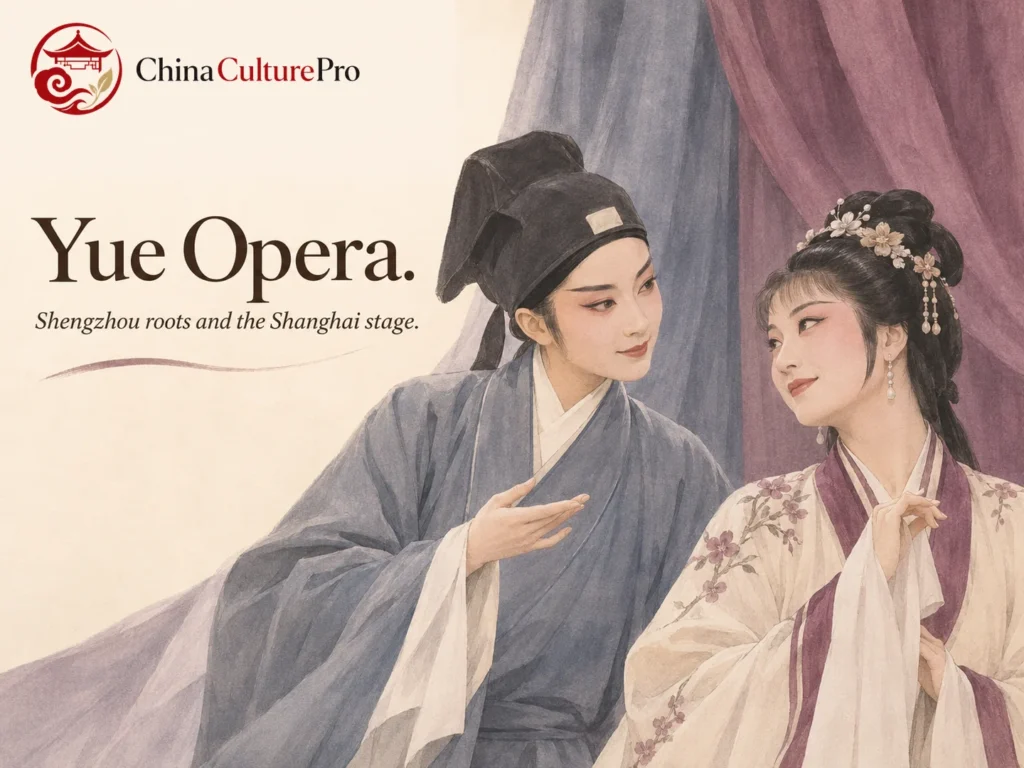
A young scholar onstage may be played by a woman whose singing and movement make the role recognizable. That is one way to see how Yue opera developed its own stage practice while drawing on older local singing and other kinds of theatre.
From Shengzhou to Shanghai
Yue opera grew out of local sung storytelling around Shengzhou, formerly Sheng County. Performers drew on other regional forms as they developed plays and took the work beyond its early audiences. Companies reached Shanghai in 1916, then performed under a name that identified the form with Shaoxing. There, the form developed within a city theatre culture alongside other kinds of performance. [1]
Shanghai became a major center for production, without replacing the genre’s Zhejiang roots. That movement from local settings to an urban stage helps explain why both locations are named in accounts of Yue opera. The repertory reflects new opportunities for writing, directing and staging as well as continuity with regional singing. [1]
Women’s Companies and Stage Reform
Early troupes included men. Women’s companies gained prominence in the twentieth century, especially from the 1930s. Their casting made female performers of male roles a familiar part of the stage tradition. The performer’s gender and the character’s role are separate things to look for in a cast list. [1]
Yuan Xuefen was one of the artists who pushed for changes in Shanghai in 1942. She and her colleagues worked toward a more formal approach to writing and directing. Their productions drew on realistic acting from drama and film and stylized movement from forms such as Kunqu. These changes gave performers ways to develop a character’s thoughts through voice, posture and action. [2]
How the Singing Carries a Scene
Yue opera uses several melodic families. One is chediao(尺调,chědiào), which can be sung in different rhythmic forms. A performer can dwell on a phrase or move rapidly through a line as a situation changes. The words, role and rhythm shape the effect of each line. [3]
Yue opera has role families for young leads, older characters and comic figures, among others. Listen to how a singer shapes the end of a line while another actor reacts. A held syllable can prolong an emotion that spoken dialogue has already introduced. The role shapes how the actor uses that musical space. [3]
Stories, Roles and Works to Start With
The repertoire includes stories of lovers, family relationships and social exclusion. A familiar story may appear in several operatic forms or on film. Check the credits to identify the version.
| Work | What the story centers on | What to follow |
|---|---|---|
| *The Butterfly Lovers* | Liang Shanbo and Zhu Yingtai’s bond and separation | How the performance changes when the two characters’ hopes diverge. |
| *Dream of Red Mansions* | Relationships inside a prominent family | How the adaptation selects characters and scenes from the novel. |
| *Xianglin’s Wife* | A woman’s struggle to survive and find a place in her community | How singing and acting convey the pressure around one character. |
An opera film helped bring the Yue version of The Butterfly Lovers to a wider audience. Comparing a filmed scene with stage footage can reveal how camera framing changes what you notice about voice, expression and movement. [4]
How to Identify a Yue Opera Performance
Look for the name 越剧 in the credits. The same pinyin spelling can also refer to 粤剧, or Cantonese opera. Zhejiang and Shanghai are clues to the former, and Cantonese language and repertoire to the latter. The Chinese title and stated language give firmer clues than the romanized spelling or the costume.
Once you have identified a Yue production, use a synopsis to find a scene with a clear decision or change in a relationship. Watch how an actor prepares for the first sung phrase. Then hear how it ends and see when the other performer responds.
FAQs About Yue Opera
Are Yue opera and Cantonese opera the same?
They are distinct forms. Zhejiang and Shanghai Yue opera is 越剧. Cantonese opera is 粤剧.
Were Yue opera performers always women?
Early groups included male performers. Women’s companies gained prominence later, and women became well known for performing male and female roles.
What is a good first Yue opera to watch?
An excerpt of *The Butterfly Lovers* with a synopsis offers a clear entry point into the singing and the relationships onstage.
資料來源
[1] China Intangible Cultural Heritage Digital Museum. Yue Opera, Zhejiang Project
[2] China Intangible Cultural Heritage Digital Museum. Yuan Xuefen
[3] China Intangible Cultural Heritage Digital Museum. Yue Opera, Shanghai Project
[4] Shanghai Municipal Administration of Culture and Tourism. Yueju Opera