
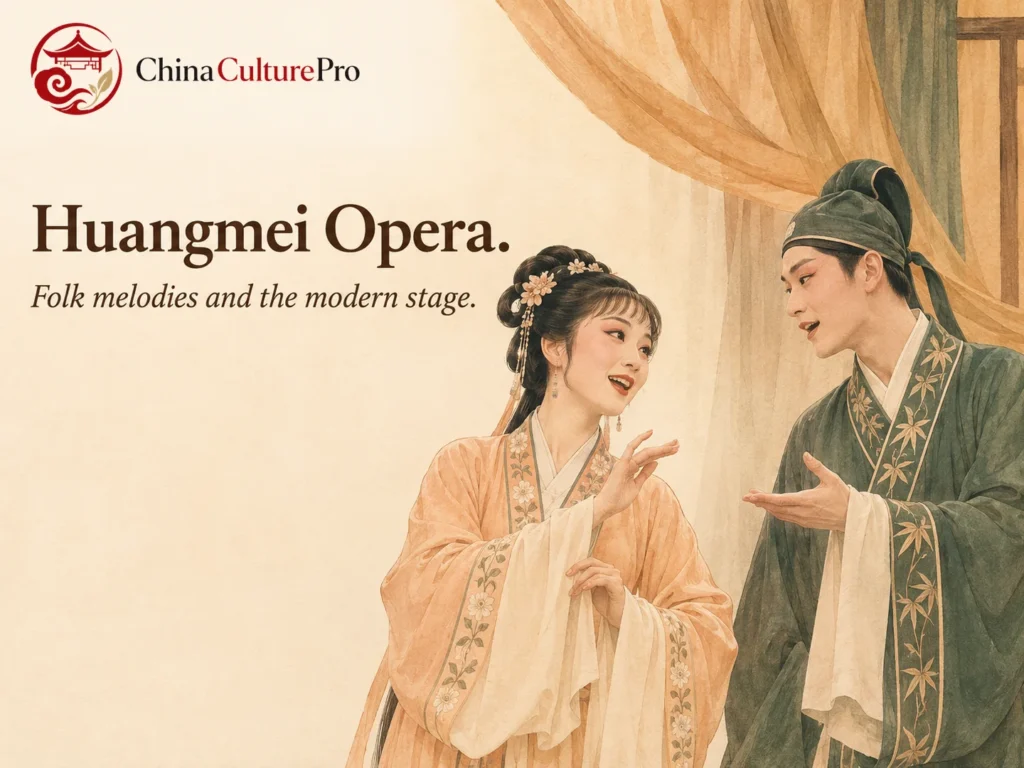

Quick Answer: What Is Huangmei Opera?
Huangmei opera(黄梅戏,Huángméixì) is a form of Chinese theatre associated with Hubei and Anhui, especially the area around Anqing. Its repertoire developed from regional singing and performance. It is known for flowing melodies that can carry both everyday dialogue and a more extended expression of feeling.
A performance can range from a short scene between two characters to a longer story. *The Fairy Couple* and *The Female Imperial Son-in-Law* are familiar examples. An excerpt with a synopsis is a useful way to hear how a melody responds to the action.
Two characters can settle a disagreement by taking turns singing. In a short Huangmei opera scene, the way one line answers another helps carry the scene. Longer works use that same attention to song and character to carry more complicated stories.
From Folk Singing to the Anqing Stage
The Anqing heritage account traces part of the genre’s development to tea-picking tunes from the area around Huangmei County in Hubei. In the late Qing these tunes circulated into neighboring parts of Anhui, where they combined with local forms. Anqing speech and singing became part of the developing theatre tradition. [1]
The form also absorbed elements from other kinds of music and 中國戲曲. It developed from shorter local performances into a repertoire that included full plays. The name points back to Huangmei, while Anqing became a major center for the developed theatre form. [1]
What Huangmei Opera Sounds Like
The repertoire uses several families of tunes. Short songs can move lightly between speakers, and a principal melody can sustain a longer stretch of drama. Follow where a singer extends a syllable or shifts pace. Those changes can tell you where a character pauses to think, asks for an answer or makes a decision. [2]
Modern accompaniment often features the gaohu(高胡,gāohú), a high-register bowed fiddle. The Hubei heritage record describes earlier uses of voices and percussion and the development of a system with the gaohu in a leading role. The leading fiddle is one feature of modern accompaniment. Listen for how it follows a sung phrase and where it continues as the singer takes a breath. [2]
Three Plays to Start With
The repertoire includes mythic plots, stories of disguise and everyday disagreements. These examples are documented in CCTV’s opera archive. Choose by the kind of scene you want to hear. [3]
| Work | 會做甚麼 | What to listen for |
|---|---|---|
| *Picking Pigweed* | Two young people quarrel after crops are damaged and resolve the conflict through singing. | Hear how answering lines turn a dispute into a shared song. |
| *The Fairy Couple* | A celestial woman leaves heaven and marries Dong Yong, a man living on earth. | Hear how song expresses the couple’s choices and what they stand to lose. |
| *The Female Imperial Son-in-Law* | Feng Suzhen disguises herself as a man and succeeds in the imperial examinations. | Listen for changes between public speech and the character’s private predicament. |
A short exchange in *Picking Pigweed* can be easier to follow as a first example. A longer work gives the songs a broader dramatic arc. A named cast or archival credit makes it possible to compare different performances of the same passage.
Stage Companies, Film and Heritage
A professional provincial troupe was formed in Hefei in 1952. Companies built up stage repertoires and helped bring Huangmei opera to audiences beyond its early centers. The Anhui company’s project record names performers including Yan Fengying and Wang Shaofang, along with works such as *The Fairy Couple*. [4]
In the film version of *The Fairy Couple*, Yan Fengying plays the celestial woman and Wang Shaofang plays Dong Yong. The film gives viewers a way to see those performers’ expressions and gestures close up. [5] China’s first national inventory in 2006 included the Anqing project. That dated record is one part of the genre’s intangible heritage history. [1]
How to Listen to a Huangmei Opera Scene
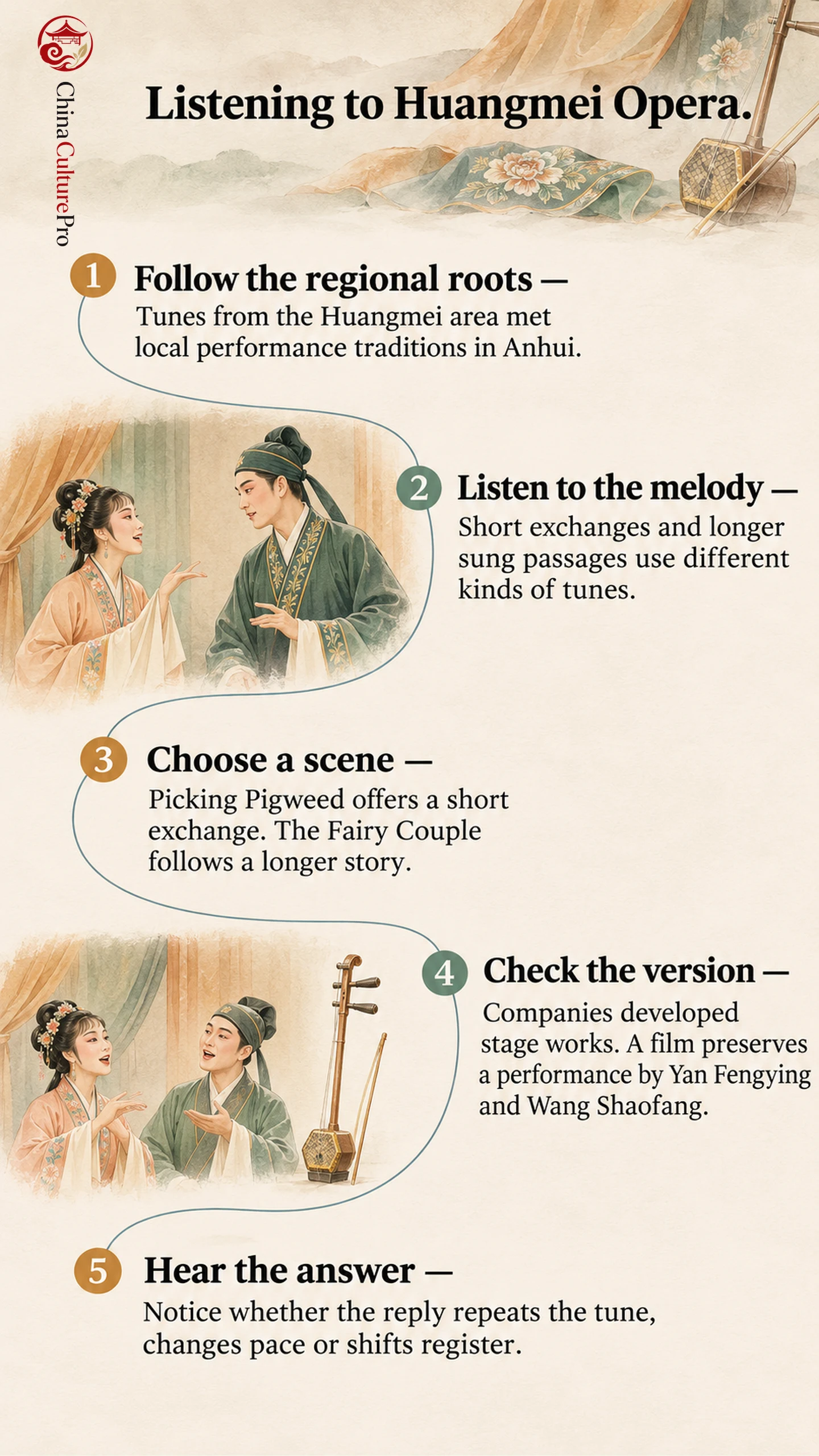
Start with the situation. In an exchange, identify who asks the first question or makes the first complaint. Then notice whether the reply repeats the melody, changes its pace or moves into a different register. The relationship between phrases can make the scene understandable before you know all the words.
For comparison with 越劇, choose two works with clear credits. Compare how the actors move from dialogue into song and how the bowed instrument accompanies them. The individual scene and performer matter alongside the genre’s overall sound.
FAQs About Huangmei Opera
Is Huangmei opera from Hubei or Anhui?
Both are part of its history. The Anqing tradition traces early tunes to the Huangmei area of Hubei and later theatrical development to neighboring Anhui.
Is Huangmei opera the same as Peking opera?
Huangmei opera is a separate form with its own regional singing, stage history and repertoire.
What is a good first Huangmei opera excerpt?
An exchange from *Picking Pigweed* offers a short example of how melody and dialogue work together.
資料來源
[1] China Intangible Cultural Heritage Digital Museum. Huangmei Opera, Anqing Project
[2] China Intangible Cultural Heritage Digital Museum. Huangmei Opera, Hubei Project
[3] CCTV Opera Channel. Huangmei Opera Video Archive
[4] China Intangible Cultural Heritage Digital Museum. Huangmei Opera, Anhui Theatre Project
[5] CCTV Opera Channel. The Fairy Couple, Huangmei Opera Film