
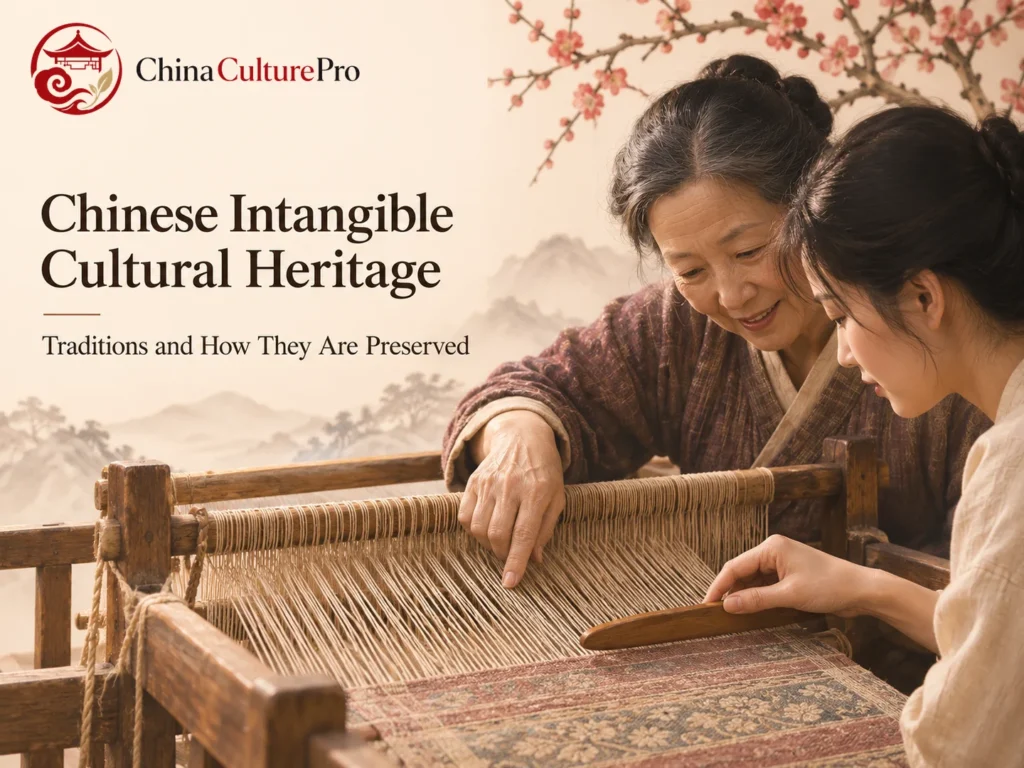

Quick Answer: What Is Chinese Intangible Cultural Heritage?
Chinese intangible cultural heritage (非物质文化遗产, fēiwùzhì wénhuà yíchǎn) includes practices and knowledge that communities recognize as part of their heritage. Examples include craft skills, storytelling and celebrations. People transmit and adapt them through practice.[1]
- What continues: Knowledge, skills and social practices, along with their associated objects and spaces.
- Who carries it: The communities, groups and practitioners who make, perform or teach it.
- What safeguarding does: It supports the conditions that let the practice continue.
China’s inventories and the UNESCO lists record different kinds of recognition.
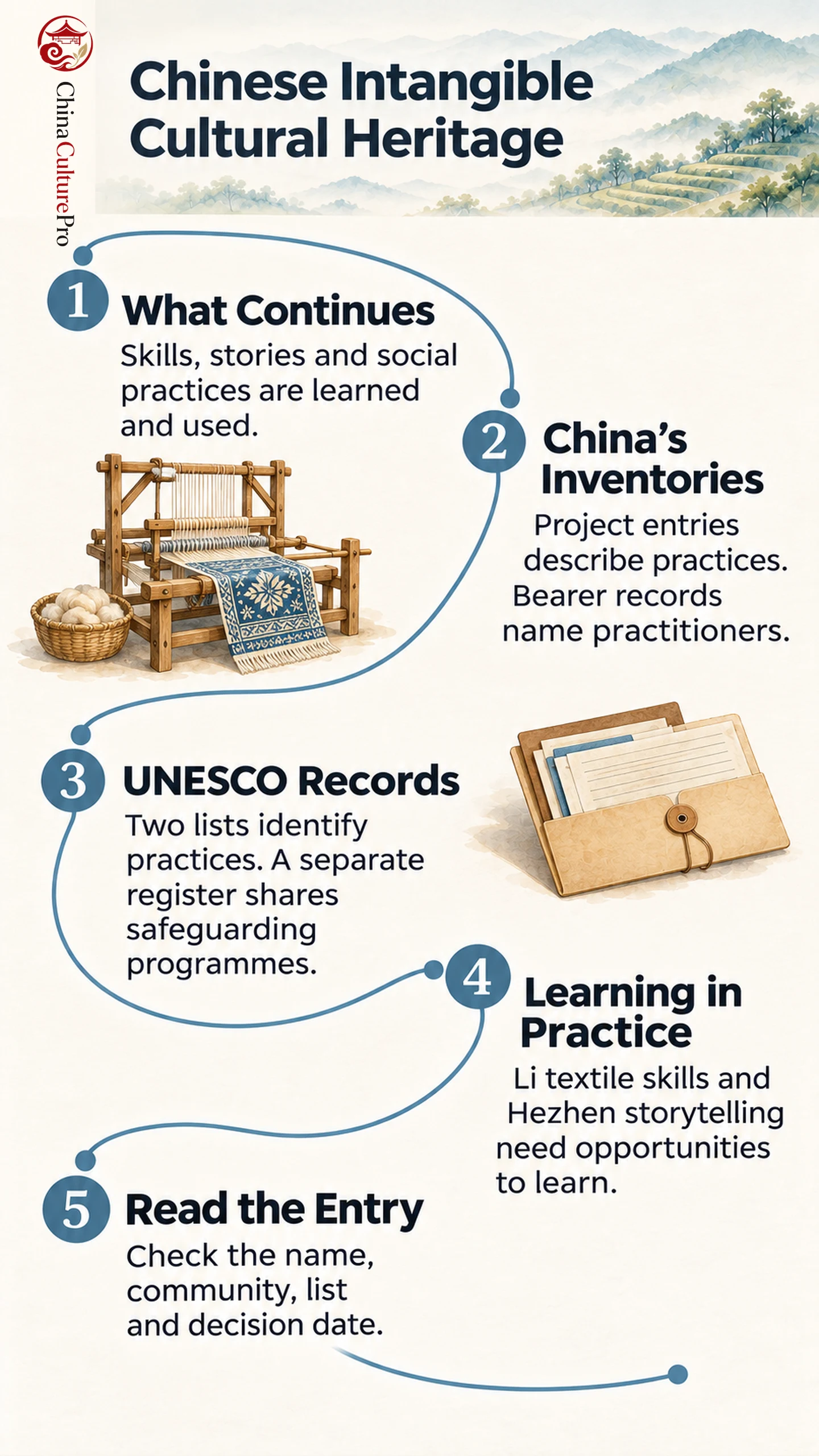
A museum can keep a woven garment, but the skill of planning and weaving it has to be learned. The same distinction helps explain why heritage records describe people, places and teaching alongside objects, festivals and performances.
What Can Count as Living Heritage?
The 2003 UNESCO Convention describes living heritage through five broad areas. They cover oral expression, performance, social practices and festivities, knowledge concerning nature, and craftsmanship. A single practice can draw on several areas. The objects and spaces people use can form part of the practice.[1]
A loom and a textile help explain traditional craftsmanship when viewed alongside the people who use them. Likewise, Chinese New Year traditions can involve preparations in the home, family gatherings and public activities. The Spring Festival entry records a group of social practices rather than a single performance or object.[1][9]
Associated objects can carry evidence of earlier work. Keeping the practice viable also requires people to be able to make decisions about it. Article 15 of the Convention calls for States Parties to involve the communities and practitioners who create, maintain and transmit heritage in its management.[1]
China’s Inventories and Representative Bearers
China’s representative project lists give domestic recognition to named practices. An entry can include a place, project number and safeguarding organization. The same general craft can have distinct local entries. Yuxian and Yangzhou, for example, both appear under the project code VII-16 for paper cutting, while their entries describe different skills and local uses.[2][3][4]
A representative bearer is a person recognized under a separate process for their knowledge and role in transmission. Read the two records together when they are available. The project record gives the practice’s scope and the bearer record identifies a practitioner recognized for transmission. Community members can continue to practice and teach alongside formally recognized bearers.[2]
Recognition can help direct support toward activities such as teaching, documentation or transmission spaces. To understand what has been supported in a specific place, look for a safeguarding plan or account of the work alongside the inventory entry.[2]
What the UNESCO Lists and Register Mean
UNESCO uses different mechanisms under the 2003 Convention. Read the heading on an entry before interpreting the date or decision number.[1][5]
| 機制 | 用途 |
|---|---|
| Representative List | Makes living heritage visible and encourages dialogue about its diversity. |
| Urgent Safeguarding List | Identifies practices whose continued transmission requires urgent measures. |
| Register of Good Safeguarding Practices | Shares examples of programmes, projects and activities that help keep heritage viable. |
A practice can appear on a domestic inventory without appearing on an international list. A safeguarding programme can also have an entry of its own, separate from the practice that it supports.[1][5][7]
Safeguarding in Practice: Li Textiles and Hezhen Storytelling
In Hainan, Li (黎族, Lízú) women have taught traditional textile skills through instruction and demonstration. These skills include spinning, dyeing, weaving and embroidering. UNESCO first placed the techniques on the Urgent Safeguarding List in 2009 and transferred them to the Representative List in 2024. The 2009 and 2024 dates describe changes in listing status. The skills and the relationships through which people learn them have a longer history.[6][8]
The safeguarding programme for Hezhen (赫哲族, Hèzhézú) Yimakan (伊玛堪, Yīmǎkān) storytelling was selected for the good-practice register in 2025. UNESCO describes work involving families, schools, communities and public authorities. The programme brought the storytelling into schools, where it helped engage younger people and supported transmission of the Hezhen language. The storytelling and the programme that supports it have separate UNESCO records.[7]
Textile learners need chances to see how a maker handles the material and to try the steps. Storytelling learners need chances to hear and use the language. The guide to protecting living heritage looks more closely at what supports that kind of learning.[7][8]
How to Read a Heritage Entry
Start with the exact element name and the listed communities or places. Then read the decision, the list or register, and the date. In a UNESCO entry, the nomination and community materials can provide more context than the short summary. Check whether the entry describes a practice, a recent transfer or a programme.[5][6][7][9]
Finally, look for what people do to keep the practice viable. A public demonstration can make a tradition visible. Regular opportunities to learn, practice and teach address a different need. Follow a public inscription label to the underlying entry. If it gives a decision number, you can use that number to find what the committee actually decided.[1][7]
The Spring Festival entry, for instance, includes a decision number, nomination materials and statements of consent. The date of that decision identifies an inscription event. Accounts of how people observe the festival are in the description and supporting materials.[9]
FAQs About Chinese Intangible Cultural Heritage
Is intangible cultural heritage the same as a World Heritage Site?
World Heritage sites are designated places. The 2003 Convention addresses practices, knowledge and skills, which may use particular places and objects.
Does every Chinese intangible cultural heritage practice have UNESCO recognition?
Many practices are recorded in domestic inventories or recognized by their communities. UNESCO inscription has its own nomination and decision process.
What is a representative bearer?
In China’s domestic system, it is a recognized practitioner with expertise and a role in passing on a representative practice.
Can a heritage tradition change after it is listed?
Yes. The Convention describes living heritage as recreated by communities over time. Records and decisions can reflect later changes in practice or safeguarding.
資料來源
[1] UNESCO. Basic Texts of the 2003 Convention
[2] Ministry of Culture and Tourism of the People’s Republic of China. Intangible Cultural Heritage Law of the People’s Republic of China
[3] China Intangible Cultural Heritage Digital Museum. Yuxian Paper Cutting
[4] China Intangible Cultural Heritage Digital Museum. Yangzhou Paper Cutting
[5] UNESCO. Procedure of Inscription and Selection of Good Safeguarding Practices
[6] UNESCO. Decision 19.COM 7.c.1
[7] UNESCO. Safeguarding Programme for Hezhen Yimakan Storytelling
[8] UNESCO. Traditional Li Textile Techniques
[9] UNESCO. Spring Festival, Social Practices of the Chinese People in Celebration of Traditional New Year