
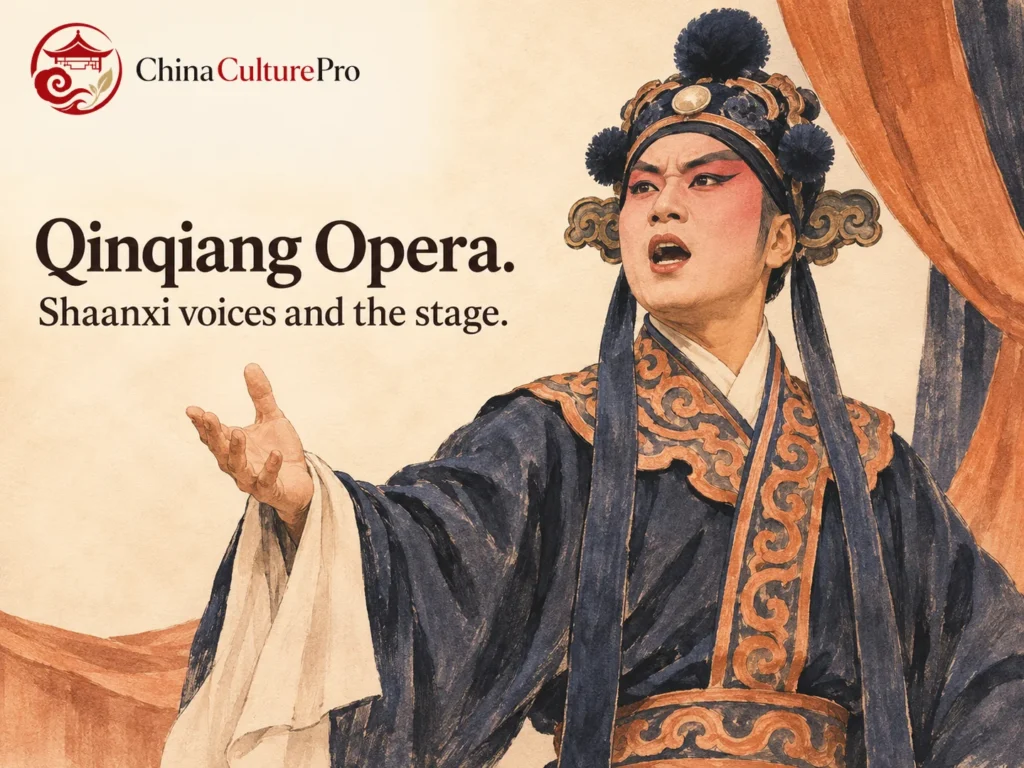

Quick Answer: What Is Qinqiang?
Qinqiang(秦腔,Qínqiāng) is a regional opera associated with Shaanxi and other parts of northwestern China. A high, forceful line can be striking, and the repertoire also includes finely shaped, quieter passages. Fiddle and percussion help the singers and actors set the pace of a scene.
It belongs to the wider family of clapper-associated opera traditions. Local speech, melodic patterns and a repertoire of historical, legendary and everyday stories help distinguish it. Compare identified scenes to hear the range.
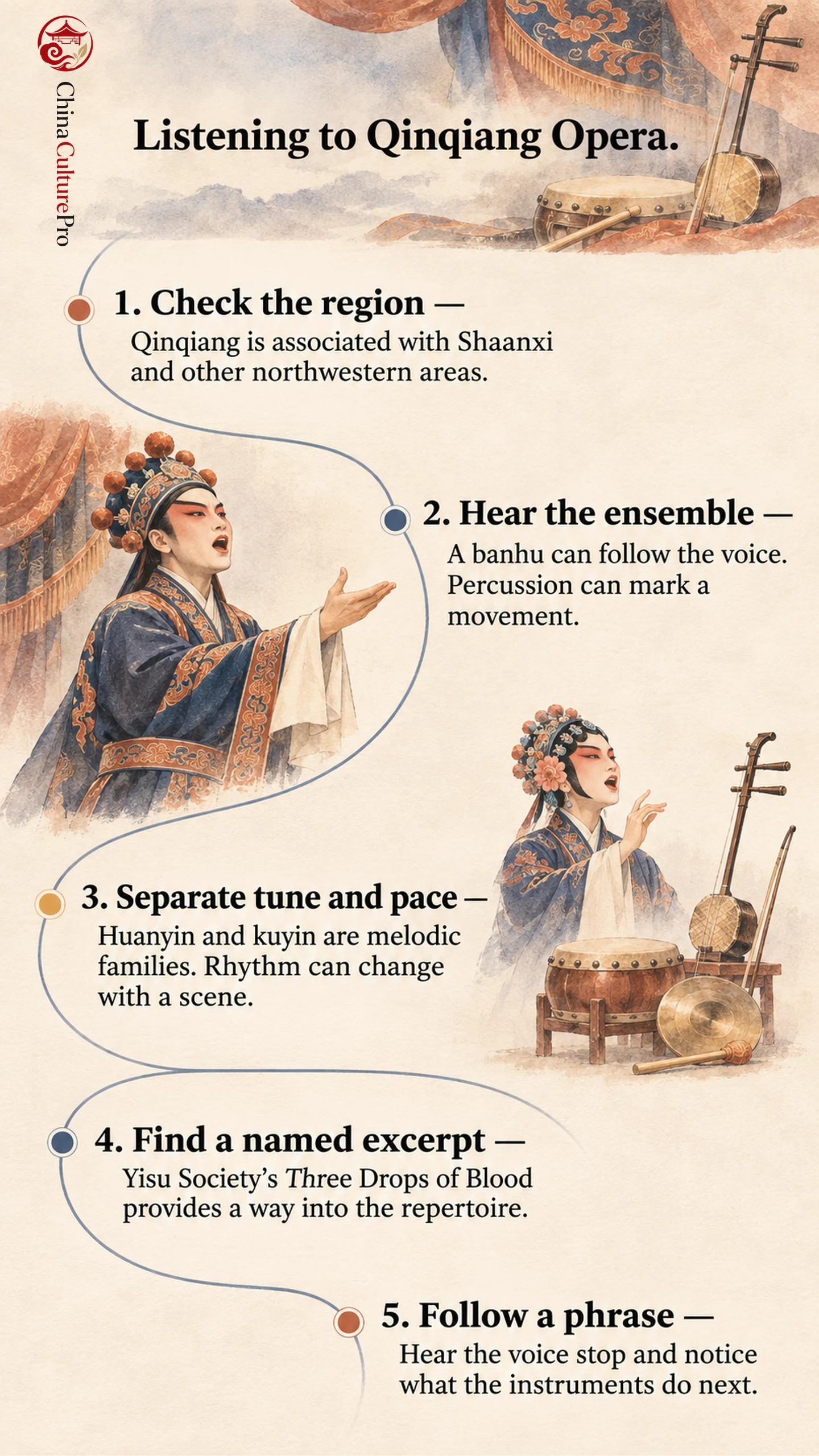
A Qinqiang voice can rise sharply and then settle into a measured phrase. Listen to the change in pace and hear what the instruments do around it. That gives you a better introduction to the sound than the loudest moment alone.
Guanzhong Roots and Northwestern Stages
Qinqiang is associated with the Guanzhong area of Shaanxi. Its documented development brought local music, speech and theatrical practice together. The national heritage entry records circulation through Gansu, Ningxia, Qinghai and Xinjiang as well as Shaanxi. A troupe credit gives more local context than the regional name alone. [1]
It belongs to the wider bangzi(梆子,bāngzi) group of 中國戲曲, named for a wooden percussion instrument. The shared label points to musical and rhythmic relationships. Yu opera is another branch with its own regional singing and repertoire. China included the Shaanxi Qinqiang project in its first national heritage list in 2006. [1]
The Fiddle, Percussion and Vocal Line
The banhu(板胡,bǎnhú), a bowed fiddle, is a leading melodic instrument in the documented Shaanxi ensemble. Winds and plucked strings can also accompany the voice. A percussion section uses drums, gongs and other struck instruments. Listen for when the fiddle follows a phrase and when percussion marks the start or end of a movement. [1]
Vocal sound varies with the part. A forceful older or painted-face role can use a different attack from a quieter or more finely shaped line in another role. The tempo can also change. Use a role credit and the particular scene to help explain the difference you hear. [1]
Two Melodic Families and Changing Pace
Two central musical families are huanyin(欢音,huānyīn) and kuyin(苦音,kǔyīn). Their names are often explained through associations with brighter and more plaintive expression. The contrast is a way of organizing musical material. It also gives listeners a way to notice how a phrase takes shape. [1]
A singer can use different rhythmic patterns within the genre. A measured passage may dwell on the character’s thought. A tighter pattern can make the action feel more urgent. Listen to the melodic contour and the rhythmic pace separately. A plaintive melody can still change pace as the character moves from one thought to another. [1]
Yisu Society and the Repertoire
Xi’an’s Yisu Society(易俗社,Yìsúshè) was founded in 1912. Its founding gives a dated example of a company’s work in developing and staging repertoire. [2] One of its productions, *Three Drops of Blood*, premiered in 1919. CCTV’s archive credits the company in several recorded scenes. [3]
| Work or excerpt | 有文物記錄的版本 | What to follow |
|---|---|---|
| *Three Drops of Blood* | Yisu Society scenes in CCTV’s Qinqiang archive | Notice how several kinds of characters move the complicated story forward. [3] |
| *The Flaming Horse*, flower-naming scene | Zhang Lu and Wang Mina in a 2026 CCTV programme | Listen to the exchange between the two performers. [4] |
| *The White Snake*, Broken Bridge scene | Gao Ningning, Liu Zhi and Wang Fengyun in the same programme | Watch how the performers combine singing and reaction within the encounter. [4] |
The appearance of the White Snake story in this repertoire also gives you a way to compare how different opera genres stage the same narrative. Compare the scenes rather than assuming they share the same music or dialogue.
How to Listen to a Qinqiang Scene
Pick a passage whose performers and work are identified. First, listen for where the voice stops and the instruments carry the sound onward. Then watch the actor’s movement through that transition. You can often hear and see the same pause doing two jobs.
In a second excerpt, notice the pace and size of the gesture. Compare an extended phrase with a brisk exchange. The effect may come from the role, the scene or the singer’s approach. These details give you firmer evidence than one broad description of the genre’s sound.
FAQs About Qinqiang
Is Qinqiang the same as Yu opera?
They are separate regional traditions within the wider bangzi family. Qinqiang is associated with Shaanxi and the northwest, and Yu opera with Henan.
Is every Qinqiang role sung loudly?
Vocal weight and pace vary. Compare different role types and scenes to hear the range from forceful to restrained passages.
What is a good first Qinqiang excerpt?
An identified scene from *Three Drops of Blood* offers a way to follow character work and see how the story advances.
資料來源
[1] China Intangible Cultural Heritage Digital Museum. Qinqiang Opera
[2] Shaanxi Provincial Archives. Qinqiang and Yisu Society
[3] CCTV Opera Channel. Qinqiang Video Archive
[4] CCTV Opera Channel. Qinqiang Excerpts Programme, February 2026