


Quick Answer: What Is Chinese Ribbon Dance?
Chinese ribbon dance is a broad description of performances in which long cloth traces the dancer’s movement. A held strip of silk can sweep into an arc or continue moving after the hand slows. Its path lets a viewer see the size of a gesture and the moment its direction changes.
Some modern Chinese classical dance works take inspiration from the flowing cloth and airborne figures in Dunhuang murals. Other performances use cloth for different effects. Long silk held as a prop and sleeve extensions attached to an opera costume give the performer different ways to move the fabric.
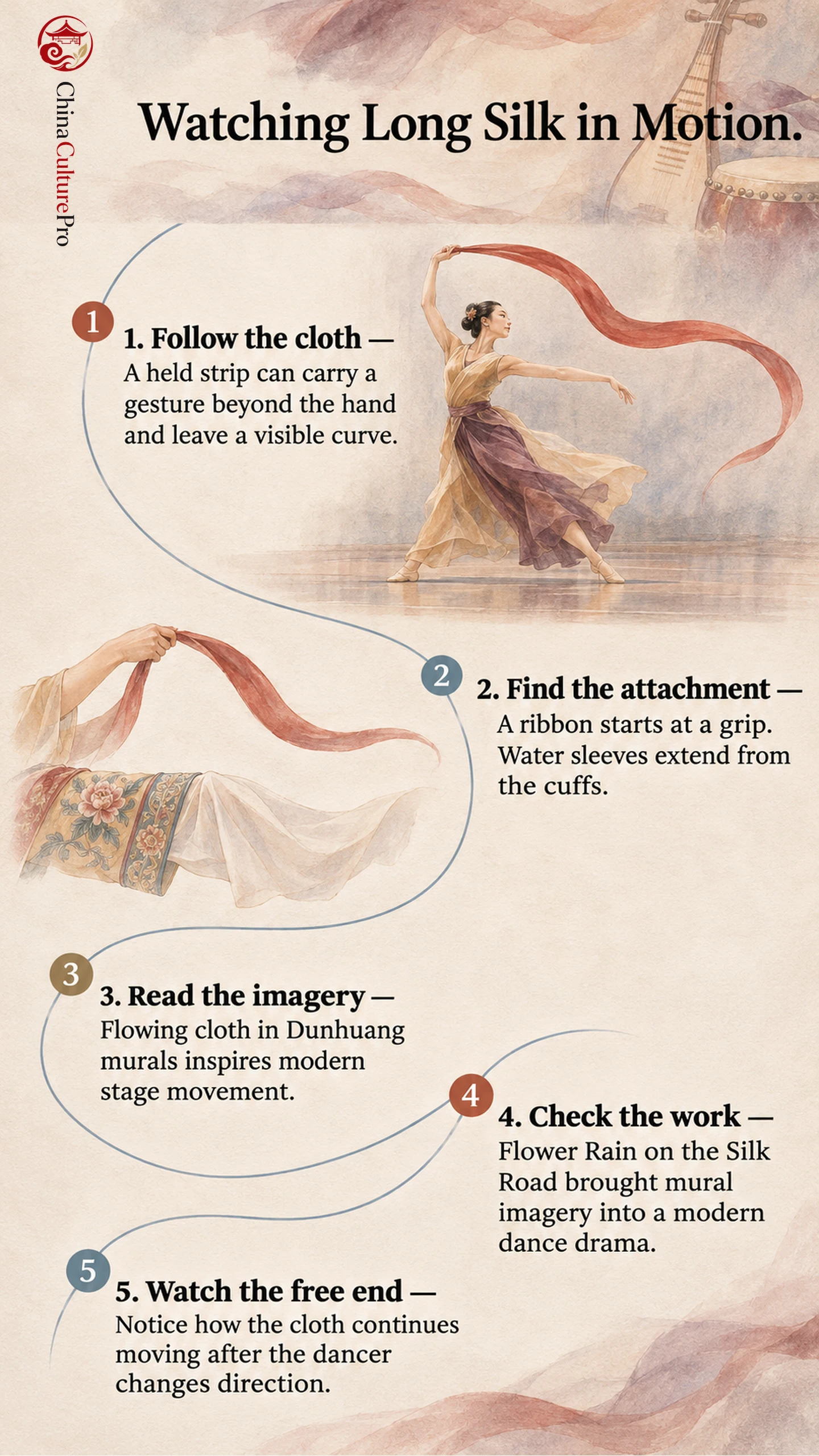
The hand can stop while the cloth continues moving. For a moment the audience sees the direction of a gesture in the air. Looking at that delay helps explain what a ribbon adds to a dancer’s movement.
How Long Silk Moves on Stage
Long silk, or changchou(长绸,chángchóu), is a prop in some Chinese classical dance works and training. A turn of the body can send the cloth around the dancer, and a change in the hand’s direction can make the fabric follow a new path. The cloth’s length and the speed of the movement affect the visible shape. [1]
A ribbon gives the eye a moving line, while a folding fan can give it a surface that opens or closes. The two props can appear in different works. Watch what each adds to the dancer’s movement before deciding what tradition the performance belongs to.
Handheld Silk, Costume Scarves and Water Sleeves
A strip of cloth can be held, draped or sewn to a garment. Where the cloth starts helps identify the prop. Water sleeves, or shuixiu(水袖,shuǐxiù), extend from costume cuffs. A nineteenth-century theatrical jacket in the Metropolitan Museum of Art preserves its sleeve extensions. It is one example of how the cloth can form part of an actor’s opera costume. [2]
| 形式 | Where the cloth begins | What the viewer sees |
|---|---|---|
| Handheld long silk | At the hand or a held support | A free length of fabric can trace a wide loop or trail behind a change of direction. |
| Draped scarf or sash | At the shoulder, waist or another point on the costume | Cloth extends the body’s outline, and a loose end can move with the dancer. |
| Water sleeves | At the ends of the costume sleeves | The sleeve extensions carry the arm’s motion into the surrounding space. |
The shape alone may be ambiguous in a close shot. Look at the performer’s hand and cuff to see where the fabric is supported. A sleeve can be gathered and released in a gesture, while a separate ribbon can move as an independent prop.
Dunhuang Imagery and Modern Choreography
Dunhuang murals portray celestial figures known in Chinese as feitian(飞天,fēitiān), often called flying apsaras in English. Flowing scarves and ribbons can suggest movement through the air. The shapes and poses differ across paintings and periods. They give artists a collection of visual forms to interpret. [3]
Modern long-silk dance has drawn on those forms. In contemporary training for flying-apsara dance, performers use long silk to translate shapes and motion suggested by Dunhuang imagery into dance phrases. A mural can show cloth in a curve and suggest a sense of motion. Choreography has to decide how the dancer arrives at that shape, leaves it and joins it to the next one. [1]
A Stage Example from Gansu
*Flower Rain on the Silk Road* is a dance drama created in 1979 by the Gansu company. The work draws on the Mogao Cave murals and stages a story about a painter, his daughter and a Persian merchant. It combines different styles of movement within one theatrical production. The company prepared a revised production in 2008. The two dates refer to stages in the modern work’s history. [4]
Use the production as an example of how mural imagery can enter a stage work. A short ribbon solo and a full dance drama can share a visual reference while asking different things from the audience. The synopsis and company credit help you distinguish a particular staging from the broader traditions of Chinese dance.
How to Watch the Cloth in Motion
Pick one movement and watch where the cloth starts. See whether the hand, arm or torso leads it. Then follow the free end after the dancer turns or slows. The interval between the body’s action and the fabric’s response can carry a small gesture across more space.
When comparing recordings, look for the title, company and type of prop. A wide view helps show the full shape the cloth makes. A closer view helps you see how the performer is holding or wearing it. Together they give a clearer picture of the choreography.
FAQs About Chinese Ribbon Dance
Is Chinese ribbon dance an unchanged ancient dance?
Older paintings and costume traditions can inspire modern work. A particular performance has its own choreography and production history.
Are water sleeves the same as handheld ribbons?
Water sleeves are costume extensions. Handheld ribbons move from a grip or another support held by the performer.
Does every Chinese ribbon dance depict a flying apsara?
Dunhuang’s flying figures inspire some works. Look at the programme to see what imagery a particular dance draws on.
資料來源
[1] Shi Min and Wang Xue, Journal of Beijing Dance Academy. Flying Apsaras Long-Silk Technique and Aesthetics
[2] Metropolitan Museum of Art. Woman’s Theatrical Jacket, Object 62.27.2
[3] China Culture. Dunhuang Flying Apsaras
[4] Gansu Provincial Department of Culture and Tourism. Flower Rain on the Silk Road at the National Centre for the Performing Arts