
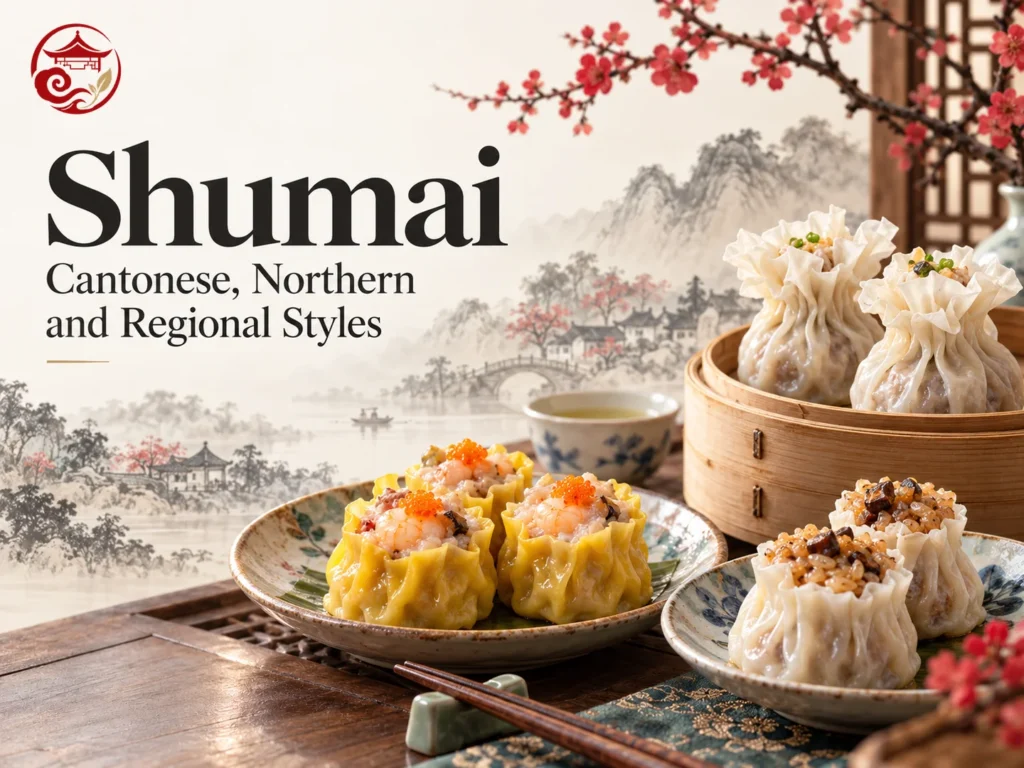

Quick Answer: What Is Shumai?
Shumai (烧卖, shāomài; also written 烧麦) are Chinese filled dumplings, usually steamed with their tops left open.[1]
- Shape: A thin wrapper gathers around the filling, often forming a small cup or a parcel with a ruffled neck.
- Filling: Meat, seafood, sticky rice, mushrooms and vegetables appear in different regional combinations.
- Cooking: Steaming is the most familiar preparation, though some local versions are pan-fried.
They belong to the wider Chinese dumpling family. The Cantonese pork-and-shrimp version is one style, rather than a definition of every shumai. Size, pleats and pieces per basket vary.
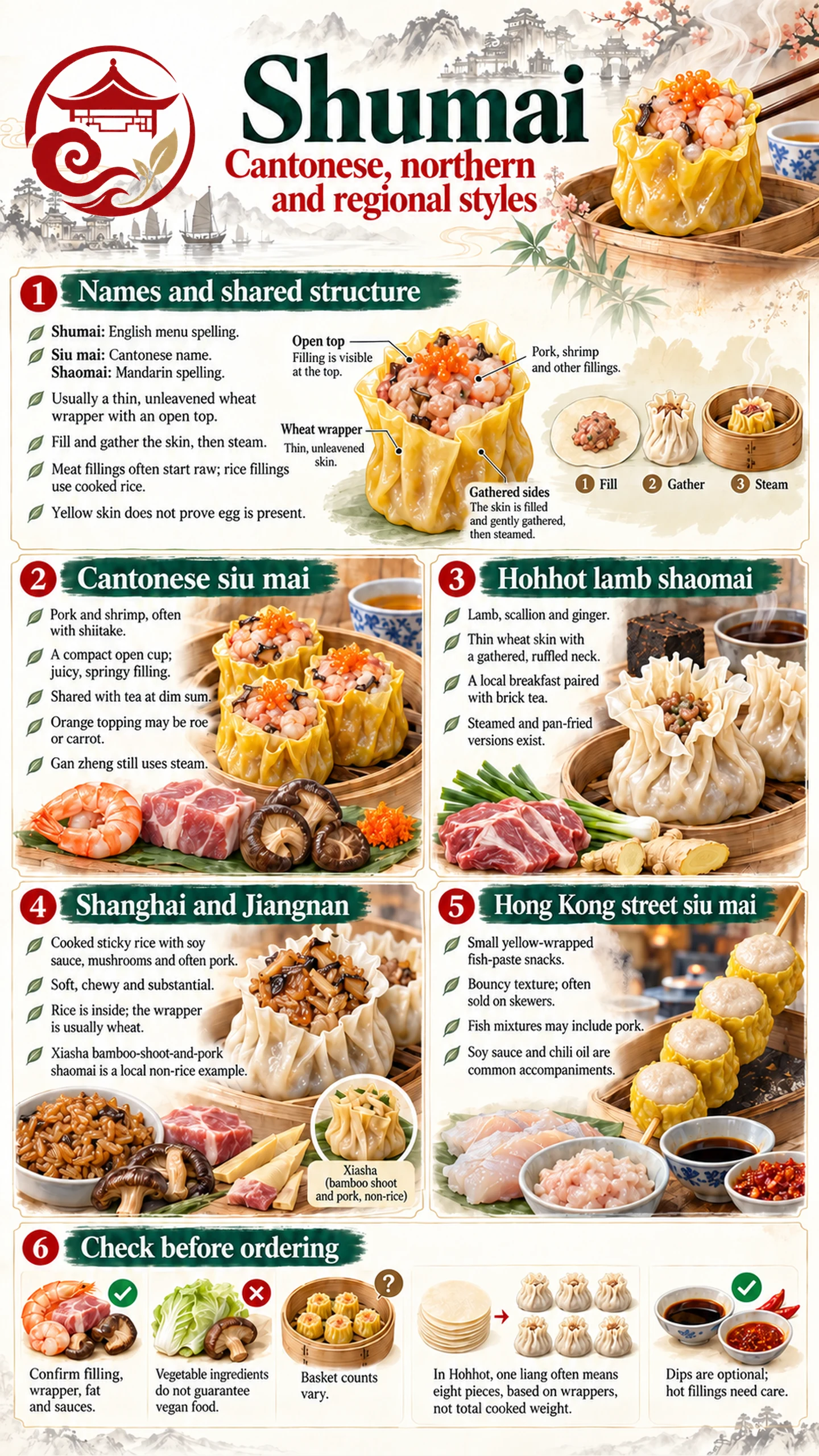
A familiar menu name can lead to very different food: a pork-and-shrimp bite at a Cantonese teahouse, a lamb-filled breakfast in Hohhot, or a generous parcel of sticky rice in Jiangnan. Recognizing the regional style helps you know what is inside before you order.
Shumai, Siu Mai and Shaomai: Understanding the Names
Shumai is a common English menu spelling. Siu mai reflects the Cantonese name, while shaomai represents the Mandarin pronunciation without tone marks. The Chinese spellings 烧卖 and 烧麦 also occur across regions. These names belong to the same food family; they do not identify three fixed recipes.[2]
A Cantonese menu will often use siu mai for its familiar pork-and-shrimp version, but the spelling alone cannot establish the filling. Read the ingredient description alongside it. The same habit helps with other Chinese food names: a familiar English label may conceal a specific local preparation.
Thin Wrappers, Open Tops and Steaming
The usual wrapper is thin, unleavened wheat dough. It supports the filling without the thick, risen bread of a fluffy bun. Some preparations use round skins; others adapt thin square wrappers. The dough is gathered around the filling, leaving an exposed top or a narrow opening rather than sealing the whole parcel shut.[3]
Preparation depends on what goes inside. In common pork-and-shrimp recipes, seasoned raw ingredients are mixed until cohesive, shaped inside the wrapper and cooked together. That mixing helps produce a filling that holds its shape with a firm, springy bite. Rice-filled versions take a different route: the sticky rice is cooked first, combined with seasonings and other ingredients, then wrapped and steamed.[4][5]
In a steamer, hot vapor heats the dumplings above the water; they are not submerged as boiled dumplings are. Bamboo is familiar, but other steaming equipment can serve the same purpose. Our Chinese cooking methods guide explains steaming in its wider cooking context.[3]
Resting dough is not the same as yeast fermentation. Likewise, a yellow wrapper does not by itself confirm whether egg is present; check the actual ingredients.
Regional Shumai Styles Across China
The following examples distinguish ingredients, texture and eating occasions. They are regional reference points, not an exhaustive classification.
Cantonese Siu Mai: Pork, Shrimp and Dim Sum
The version familiar from many Cantonese teahouses combines pork and shrimp, often with chopped shiitake mushrooms. A thin skin wraps the lower part of the filling, leaving a broad exposed top. The compact cup shape and cohesive filling distinguish it on a mixed dim sum (点心, diǎnxin) table; pork brings richness while shrimp adds a springy bite.[4]
This is a classic part of Cantonese cuisine. Dim sum includes small sweet and savory dishes shared at the table. Yum cha (饮茶, yǐnchá in Mandarin), the Cantonese name for drinking tea, describes the associated dining occasion. A basket of siu mai may sit alongside other dishes during a leisurely dim sum meal; it does not need to be an entire meal by itself.[2]
The orange topping may be fish roe or finely chopped carrot, so appearance alone cannot identify it. Menus may also use gan zheng (干蒸, gānzhēng), often translated as “dry-steamed.” This is still a steamed preparation; the name does not mean cooking without steam.[4][6]
Hohhot Shaomai: Lamb and Ruffled Wrappers
In Hohhot, Inner Mongolia, lamb with scallion and ginger is a distinctive local combination. Its pronounced meat flavor and aromatic seasoning differ from the pork-and-shrimp filling above. The wrapper is especially important visually: thin dough rises above the filling in a finely ruffled edge, gathered at the neck so the parcel resembles a small pomegranate or flower.[7][8]
Making that edge involves a specialized rolling tool that works the dough thin around the outside. The result is a flexible wheat wrapper, not a risen bun. Thinness and the gathered upper edge give this style its recognizable silhouette without requiring one universal pleat count.[8]
Locally, shaomai is established breakfast food, traditionally paired with brick tea. That combination shows how a dumpling can belong to a substantial morning meal rather than only to a Cantonese small-plate setting. It is one example within China’s varied regional breakfasts. Steamed versions are familiar, and pan-fried preparations also exist. Hohhot is a specific northern example; other northern cities have their own fillings and practices.[7][9]
Shanghai and Jiangnan: Sticky Rice Shaomai
In Shanghai and parts of Jiangnan, nuomi shaomai (糯米烧卖, nuòmǐ shāomài) puts sticky rice at the center. Soy sauce, shiitake mushrooms and pork are familiar additions, with bamboo shoots or other ingredients appearing in particular versions. The rice is cooked and seasoned before wrapping; the finished filling is soft, chewy and substantial rather than a compact meat-and-shrimp mixture.[10][5]
Here, the cooked rice forms the filling and the wheat skin holds the parcel together. Our Chinese sticky rice guide explains the ingredient across other preparations. At a breakfast shop, these filled parcels can provide a filling morning option; they also appear as snacks and ready-made steamed foods.
Even within Shanghai, rice does not define every version. Xiasha shaomai (下沙烧卖, Xiàshā shāomài), associated with Pudong’s Xiasha area, includes a well-known savory bamboo-shoot-and-pork filling. That local exception is a useful reminder to read the menu beyond the regional label. A Jiangnan address alone does not tell you whether the filling is rice, meat or another mixture.[10]
Hong Kong Street Siu Mai: Fish-Paste Snacks
Hong Kong street siu mai offers another interpretation. These small, often yellow-wrapped snacks commonly use fish paste; some mixtures also include pork. Their bouncy texture differs from the more visibly textured pork-and-shrimp teahouse filling. They are often sold in small portions on skewers, ready to eat with soy sauce and chili oil.[11]
These portions suit a quick street snack, eaten while standing or walking, alongside the city’s seated teahouse tradition. Both belong to Hong Kong’s food culture, and neither represents every siu mai available in the city. Most importantly, a fish-based name does not guarantee a pork-free product. Ask about the actual mixture if that distinction affects your order.
Ordering and Eating Shumai
Confirm three things before choosing a portion:
- Style and ingredients: Ask what is in the wrapper and filling, including stock, fat and sauces. A meat name alone does not establish halal suitability. For Chinese vegetarian food, confirm animal-derived additions as well as visible ingredients; egg, shellfish, fish, wheat and soy may matter depending on the preparation.
- Portion and measure: Cantonese teahouses commonly sell by the basket, with the number of pieces set by the restaurant. Hohhot uses a traditional liang (两, liǎng) measure based on wrappers rather than the total finished dumpling weight. One liang commonly corresponds to eight pieces there, but nearby cities and individual shops can use different counts. Confirm the number before applying assumptions from another food or place.[9]
- Dips and eating: Taste a piece before adding sauce. Chinese soy sauce, vinegar and chili oil are options, not a compulsory formula. Freshly steamed filling can be very hot, so take a small bite and let it cool rather than assuming a small dumpling is ready to swallow whole.[12]
Sharing a basket does not require everyone to choose the same dip. For dietary restrictions, a clear answer from the kitchen is more useful than an inference from color or a familiar name.
FAQs About Shumai
Does shumai always contain rice?
No. Sticky rice shumai is a regional style, particularly familiar in Shanghai and Jiangnan. Cantonese pork-and-shrimp siu mai and Hohhot lamb shaomai typically have meat-based fillings. The name alone does not tell you whether rice is included.
What is the difference between shumai and har gow?
Shumai usually has an open top and a thin wheat-flour wrapper. Har gow (虾饺, xiājiǎo in Mandarin) is a sealed shrimp dumpling with a translucent starch-based skin. See har gow for details; translucency does not establish gluten-free suitability.[13]
Can shumai be vegetarian?
Yes, including specially made vegan versions. Rice or mushrooms in the name are not enough: meat stock, lard or oyster sauce may still be present. Check the wrapper for egg and confirm the whole preparation, rather than only its main filling.[5]
Can frozen shumai be steamed without thawing?
Many products and recipes allow steaming directly from frozen. Check the package instructions, including whether the dumplings are raw or precooked. Follow the specified method; no single steaming time suits every size, filling or product.[12][14]
資料來源
[1] Taiwan Ministry of Education. 燒賣 — Concised Mandarin Chinese Dictionary
[2] Sarah / The Woks of Life. Siu Mai with Pork and Shrimp
[3] Made With Lau. Dad’s Siu Mai: The Chinese Restaurant Way
[4] Lisa Lin / Healthy Nibbles. Cantonese Shumai (Siu Mai, 燒賣)
[5] Judy / The Woks of Life. Sticky Rice Mushroom Shumai with Homemade Wrappers (Vegan)
[6] Guangzhou Daily. 怀旧点心“出道” 传统饮食焕新机
[7] 张亚楠、王赵薇、陈家兴 / 中国甘肃网. 从“捎卖”到烧麦:一笼蒸食里的三百年呼和浩特烟火
[8] 杨亚东、李茂林 / 央广网. 呼和浩特烧麦:一座城的味觉记忆和文化密码
[9] 高雁萍 / 呼和浩特日报. 烧麦如花
[10] 上海老底子 / 澎湃号. 上海烧卖
[11] Hong Kong Tourism Board. Must-Try Street Food in Hong Kong
[12] Nagi Maehashi / RecipeTin Eats. Siu Mai (Shumai) – Chinese steamed dumplings
[13] Judy / The Woks of Life. Har Gow (Dim Sum Shrimp Dumplings)
[14] Hong Kong Centre for Food Safety. Prepared dishes – Food Safety Advice for Food Businesses and Consumers