


Quick Answer: What Is a Minnan Swallowtail Ridge?
In Minnan (闽南, Mǐnnán), or southern Fujian, a swallowtail ridge, or yanwei ji (燕尾脊, yànwěi jǐ), is a roof crest whose ends sweep upward and fork. The name comes from the resemblance to a swallow’s split tail. The feature appears on some large houses as well as religious buildings.[1][2]
- Position: The fork is at the ends of the main ridge, along the highest line of the roof.[1]
- Shape: Look for an upturned end divided into two tips.[1]
- Decoration: Ceramic flowers, birds or figures can sit along the roofline. The decorations are a separate feature from the fork.[4]
The swallowtail is one of several profiles in the wider tradition of Chinese roofs. The distinction is easiest to see on roofs with a clear view of the crest.
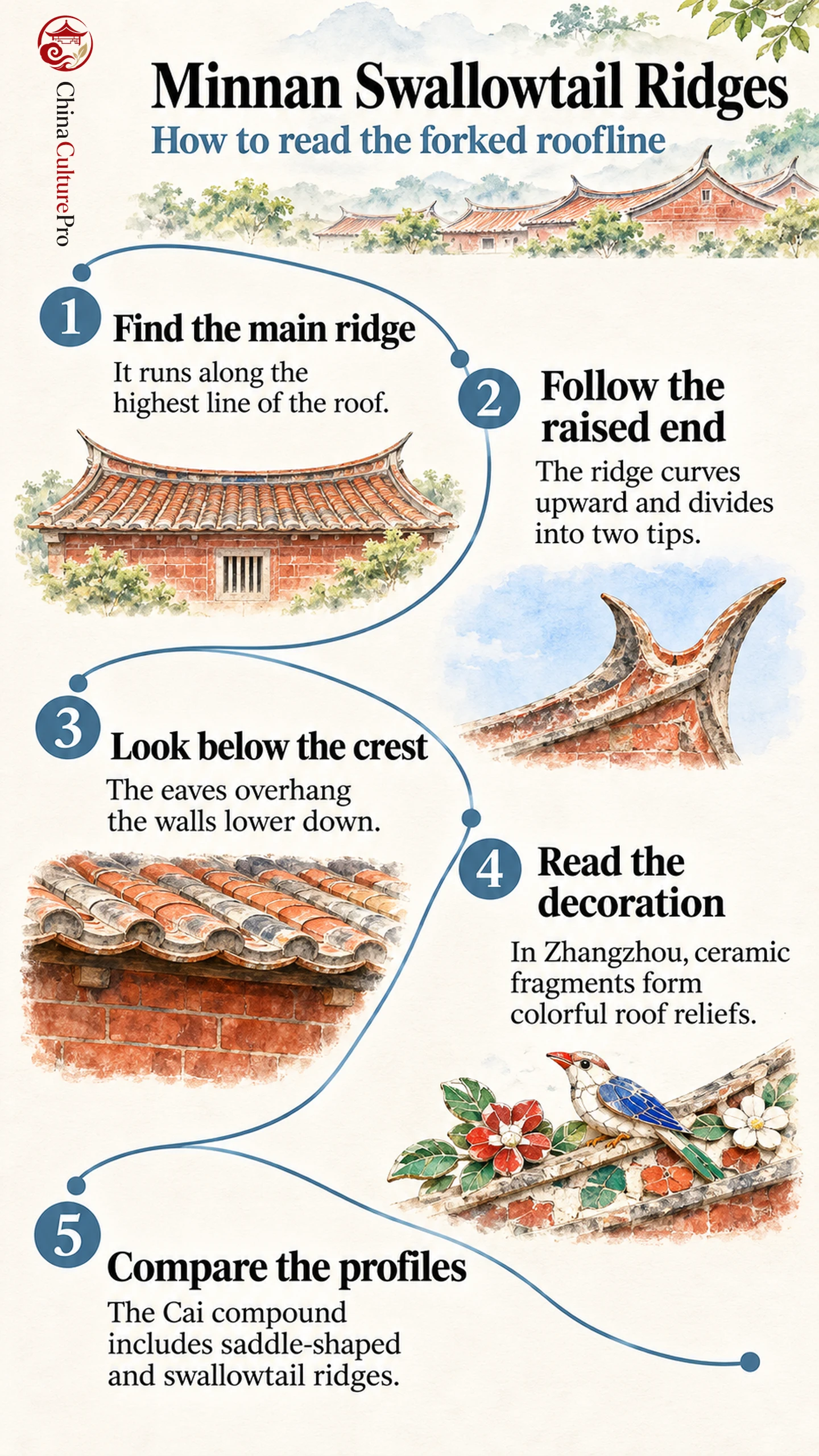
A front view often shows the crest in outline against the sky. From a corner of the building, the eaves may overlap it in your line of sight. Start with the highest line, then follow it out toward either end.
How to Recognize the Forked Ridge
The main ridge, or zhengji (正脊, zhèngjǐ), runs along the top of the roof. Its ends are above the gables. The eaves sit lower, where the tiled roof overhangs the walls. You can read the ridge ends and the eave corners as separate lines, even where both curve upward.[1]
A roof with a saddle-shaped crest has a different silhouette. The account of the Cai family compound in Nan’an (南安, Nán’ān) describes both saddle-shaped and swallowtail crests. The fork makes the swallowtail recognizable even when the curve is modest.[3]
Where the Shape Appears
Quanzhou’s architectural overview identifies the swallowtail as characteristic of a large regional dwelling with red brick and pale stone. The Cai family compound is one place to read the crest in relation to the tiled roof and walls of Minnan red-brick houses.[2][3]
The profile also appears in temple architecture. Its presence alone gives limited evidence about a building’s use or the household that occupied it.[1][2]
Ceramic Decoration and Roof Preservation
In Zhangzhou (漳州, Zhāngzhōu), decorative roof sculptures in the technique known as jian ci diao (剪瓷雕, jiǎn cí diāo) use cut fragments of colored ceramic to form details such as birds, flowers or figures. Such relief can sit along the ridge of a house or ancestral hall. Read the silhouette first. Then look at the colored ceramic pieces that give the relief its surface.[4] Fujian’s provincial heritage list includes the cut-ceramic craft of Dongshan (东山, Dōngshān) County.[6]
FAQs About Minnan Swallowtail Ridges
Does Every Curved Roof Have a Swallowtail Ridge?
The identifying detail is a fork at the raised end of the main ridge. The eaves can curve as well, and a roof crest can have a rounded end.[1][3]
Were Swallowtail Ridges Only for Temples?
Documented examples include temples and large residences. Quanzhou describes the ridge on one prominent type of traditional house.[1][2]
Can the Ridge Tell You How Old a House Is?
The profile helps identify a style. Construction and conservation records give firmer evidence about its age. In 2024, Nan’an reviewed how the Cai compound was being conserved and used.[3][5]
資料來源
[1] Taoyuan Local Curriculum. Changxiang Temple and the Swallowtail Ridge
[2] Quanzhou Municipal People’s Government. Southern Fujian Residential Architecture
[3] Fujian Department of Civil Affairs. The Cai Family Residences in Nan’an
[4] China Discipline Inspection and Supervision News. Cut-Ceramic Sculpture in Zhangzhou
[5] Nan’an Municipal People’s Government. Audit of Historic Building Conservation and Use
[6] Fujian Department of Culture and Tourism. Second Fujian Provincial Intangible Heritage List