


Quick Answer: What Is a Shanxi Courtyard Mansion?
A Shanxi (山西, Shānxī) courtyard mansion is a large family compound made up of connected courts, halls and passageways. The Qiao family compound (乔家大院, Qiáojiā Dàyuàn) and Wang family compound (王家大院, Wángjiā Dàyuàn) show two ways of arranging a large property, around a straight lane or in groups that follow a slope.[3][6]
- Courtyards: Rooms face into open spaces that can be reached through a sequence of gates.[4]
- Connections: A passage may link several courts.[6]
- Materials: Carved brick, wood and stone mark architectural details in the compounds.[1][3]
Large compounds are one part of Shanxi’s residential history and the wider history of Chinese merchant families.
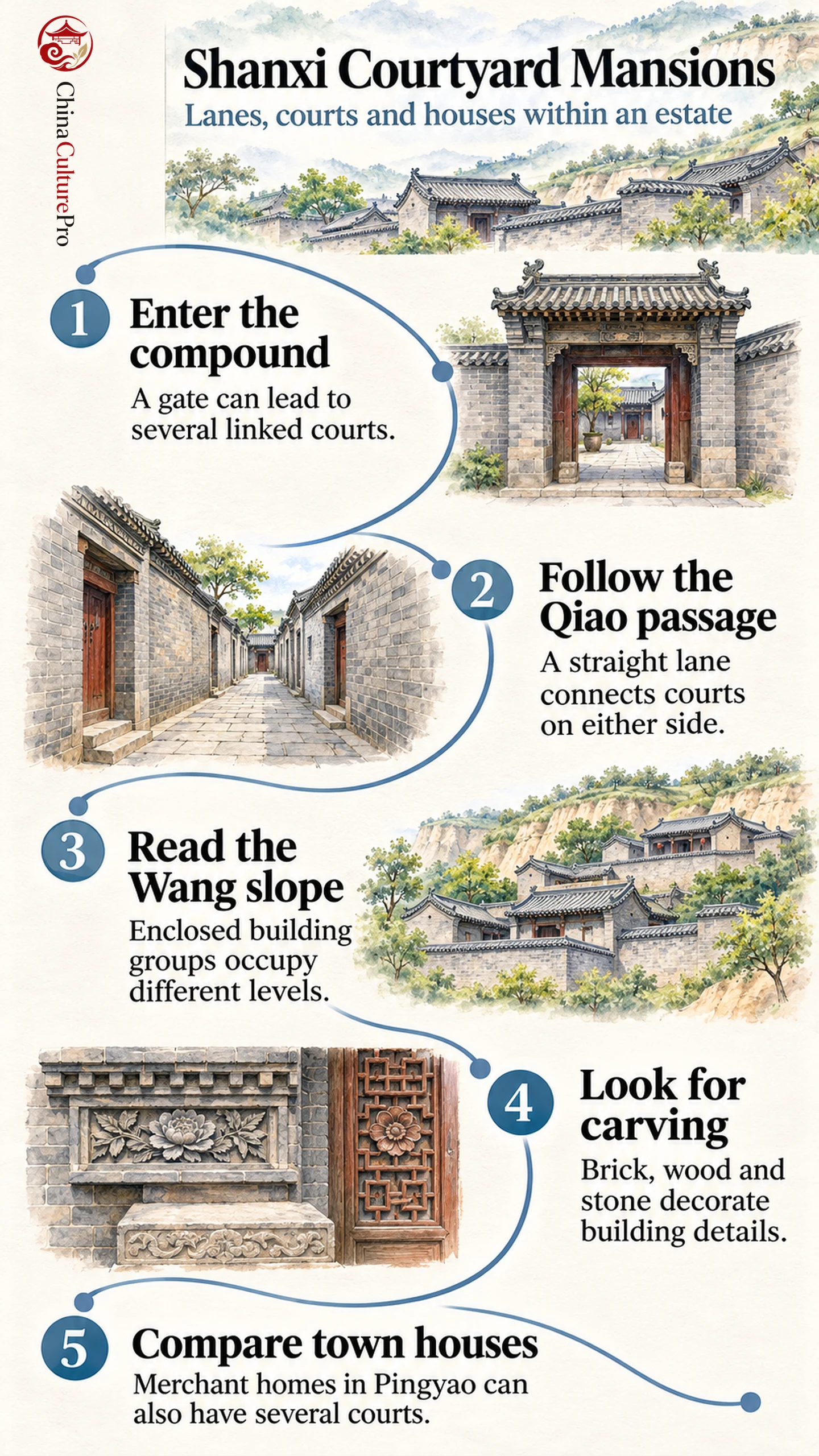
From outside, a long brick wall can make a compound look like one building. The gate leads to a different view. Inside, passageways connect smaller courts, each with rooms of its own. Follow one passage to see how a larger estate could be divided into smaller building groups.
The Lane Through the Qiao Family Compound
In Qi County (祁县, Qí Xiàn), the historic Zaizhong Hall (在中堂, Zàizhōng Táng) section of the Qiao estate has a straight central passage with large courts on either side. Some contain smaller courts within them. The ancestral hall stands at the far end, opposite the entrance.[6]
The section was begun in the Qing dynasty and enlarged in later phases, including in the early Republic. In 1986 it was put to use as a folk museum.[1] The wider Qiao site includes several named halls and a garden.[2]
The Wang Family Compound on the Slope
The Wang compound in Jingsheng (静升, Jìngshēng), Lingshi (灵石, Língshí), developed over the Ming and Qing periods. Several enclosed building groups occupy a slope. Their courts sit at different levels and contain both vaulted rooms and tiled houses.[3] For another regional use of arched dwellings in large properties, see northern Shaanxi cave dwellings.
How to Read Gates, Courts and Carvings
Look for decorated lintels and stone steps where a passage enters a court, and for carved brick along screens and walls. Such details can distinguish entrances and enclosed spaces. The arrangement can extend a four-sided courtyard form across many connected parts of a property.[1][4]
A study of merchant homes in Pingyao (平遥, Píngyáo) also documents compounds with several courts. The urban examples show connected courts at a different scale within Shanxi’s regional building traditions.[4]
FAQs About Shanxi Courtyard Mansions
Is a Mansion Just One Courtyard?
A large compound can contain a series of courts with different room groups. The Qiao passage provides access to several such groups.[6]
What Did a Large Family Estate Contain?
Alongside houses and courts, some estates contained gardens or spaces for family rites. The Wang compound includes an ancestral hall, and the Qiao site includes a family garden.[2][3]
Are the Qiao and Wang Compounds Part of Pingyao’s World Heritage Site?
The inscribed property includes the walled town of Pingyao and two outlying temples. Qiao and Wang are estates in Qi County and Lingshi respectively.[2][3][5]
資料來源
[1] CCTV, from Shanxi Tourism. The Qiao Family Compound
[2] Ministry of Culture and Tourism of China. Qiao Family Compound Cultural Area
[3] Central Commission for Discipline Inspection. The Wang Family Compound in Lingshi
[4] Buildings. The Spatial Form of Traditional Shanxi Merchant Residences in Pingyao
[5] UNESCO World Heritage Centre. Ancient City of Ping Yao
[6] Liaocheng University, School of History and Culture. A Site Visit to the Qiao Family Compound