


Quick Answer: What Is Xu Wei’s Fish and Crab?
Fish and Crab (鱼蟹图, Yú Xiè Tú), by Xu Wei (徐渭, Xú Wèi), is an ink-on-paper handscroll in the Tianjin Museum.
- Dimensions: The scholarly catalog entry gives 29 × 79 cm.
- First subject: A crab holds a reed in its claw.
- Second subject: A fish breaks through a field of moving water.
Read each animal beside its own poem, then compare how the ink gives the two scenes different textures.
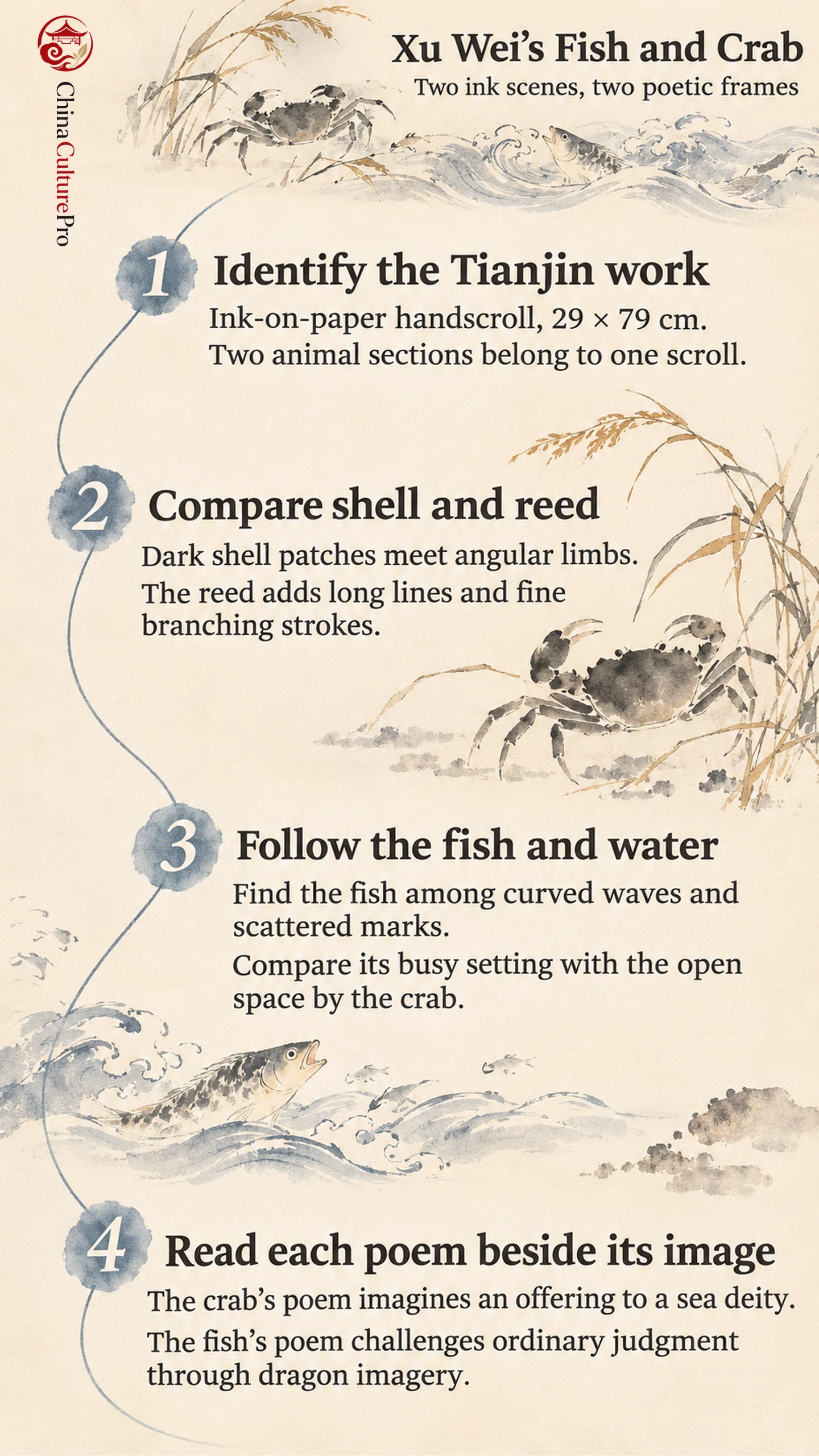
In the full reproduction, the crab occupies the right side and the fish the left. The crab’s dark body and angular limbs stand against open paper; the fish appears amid a much denser pattern of curves and scattered marks.
The two areas give the eye different routes. One concentrates weight in a shell, while the other disperses movement through surrounding water.
Identify the Tianjin Handscroll
The academic catalog appendix records this paper-and-ink scroll at 29 × 79 cm, under the older Tianjin History Museum collection name and catalog reference 津2-023. It distinguishes two sections with different signatures and seals. [1]
Keep that compact work separate from the painter’s longer flower-and-fruit scrolls and other crab pictures. The combination of two animal scenes, dimensions and collection identifies the object more securely than a short English title alone.
The scroll-format guide explains horizontal viewing. Begin with the crab at the right, pause at its writing, and then move toward the water and fish.
Compare the interval between the two subjects. Rather than immediately seeking a continuous shoreline or a detailed habitat, notice the change from spare forms to a crowded surface.
Look Closely at the Crab and Reed
Look first at the shell’s dark patches. They gather into an uneven, weighty center, while the limbs project as sharper, more angular marks.
Then follow the reed. A long, curved line extends away from the animal, and a much finer cluster of branching strokes gives its plume a different texture.
The contrast works at two scales: the crab against the open sheet, and the delicate plant against the concentrated shell. Moving between these comparisons makes the small subject less static.
The painting-techniques guide develops the difference between a wash and a line. Here, compare the width of one limb with the thin strokes at the reed’s end before looking again at the body.
The bird-and-flower painting guide supplies context for animal and plant subjects beyond birds alone.
Follow the Fish through Broken Water
The fish does not sit inside a neatly outlined pool. Curving strokes cross and gather around its emerging form, while dots and short marks interrupt the lighter spaces between them.
Compare the darker head with the surrounding arcs. One provides a concentrated point of recognition; the other carries the eye outward through water that appears restless.
Then find the tail. Following the separation between these visible parts makes the intervening disturbance part of the fish’s movement rather than background decoration.
The crab’s nearby reed can now serve as a useful contrast. Its long stem remains relatively easy to trace, whereas the fish’s surrounding lines repeatedly overlap and change direction.
Look across the whole sheet once more. The left scene has a much busier texture than the space around the crab, so the difference between animals also becomes a difference between areas of ink.
Read the Two Poems as Interpretive Frames
The crab’s poem imagines its reed as an offering to a sea deity. The fish’s poem challenges ordinary viewers to recognize a dragon beneath an unassuming appearance. [2]
A scholarly reading connects these images with frustrated recognition and unequal worldly power. That interpretation extends the poems’ language; it does not identify a named official or a documented incident behind this particular scroll. [2]
The inscriptions-and-seals guide helps keep each written passage attached to its own image. Read the crab’s words before transferring a meaning from the fish’s separate poem.
The literati-painting guide develops this relation between brushwork and literary expression. Here, the poems add an offering and a challenge to recognition, while the visible subjects remain a crab, reed, fish and water.
FAQs About Xu Wei’s Fish and Crab
Where is Fish and Crab kept?
The work is in the Tianjin Museum; the academic appendix lists it under the older Tianjin History Museum name.
Why does the fish’s poem mention a dragon?
The poem uses dragon imagery to challenge a superficial judgment of the fish. A literal painted transformation is not required for that reading.
Is the work a single scene or two sections?
It contains two animal sections, each with its own inscription, within one handscroll.
資料來源
[1] Jui-Hsiang Hsu; National Central University. A Preliminary Study of Xu Wei’s Sobriquets and Leisure Seals, appendix page123
[2] Yang Jin-qi; ARTouch, Ancient Art347. Xu Wei’s Calligraphy and Painting Exhibition at Shaoxing Museum: Fish and Crab discussion