


Quick Answer: How Do the Two Scroll Formats Differ?
A Chinese hanging scroll (立轴, lìzhóu) suspends a usually vertical image from a cord so that viewers can see the whole composition on a wall. A handscroll (手卷, shǒujuàn) opens horizontally on a flat surface, with a section at a time traditionally revealed from right to left. [1][2][3]
Both formats can carry a painting or writing and both can roll up for storage. Look for the mounting and the expected viewing position when a photograph crops the edges. [1][2]
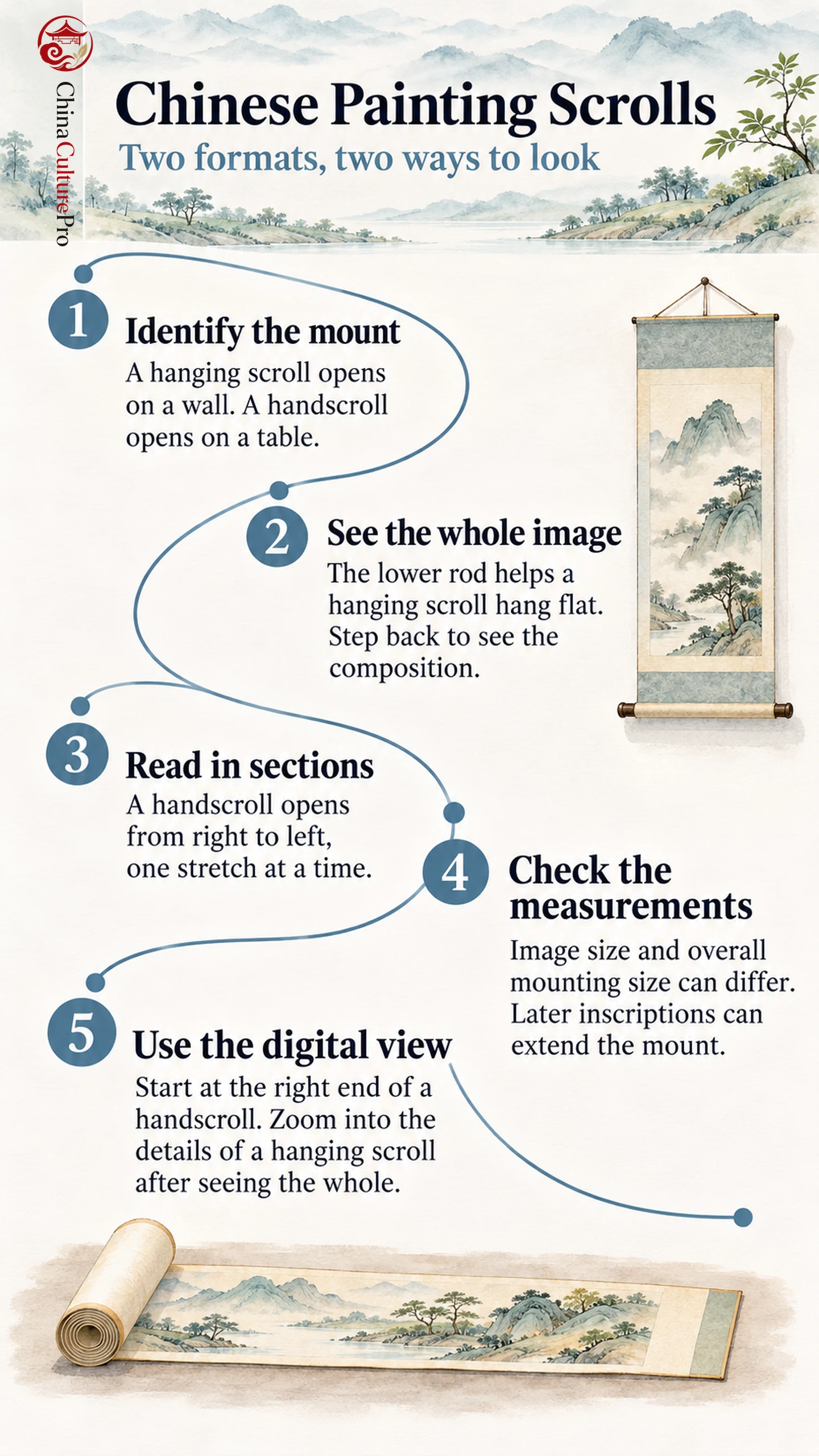
Stand back from a tall mountain painting and you can see the peak and the path below in a single glance. Look at a long city scroll a section at a time and the bridge comes into view only after you have followed the river. Mounting helps determine the order and distance from which you see the image. [3][4][5]
Hanging Scrolls and Handscrolls at a Glance
| 項目 | Hanging scroll | Handscroll |
|---|---|---|
| Display position | Suspended vertically, usually against a wall. [2] | Laid horizontally on a flat surface. [2][3] |
| Viewing field | The composition is visible at once, with room to step back or approach. [1][2] | One manageable section is traditionally open at a time. [1][3] |
| Mounting clues | Cord and strip at the top, weighted roller at the bottom. [2] | A roller at the left end, protective wrapper and tie at the right. [2] |
| Role of added writing | An inscription can appear on the picture or in a separate panel above it. [4] | Comments may be appended on separate sections after the image, with seals on the image or mounting. [1][2][5] |
How a Hanging Scroll Uses the Wall
A typical hanging mount has paper supporting the painting from behind and decorative fabric around it. A cord at the top supports the scroll. A bottom rod keeps the hanging surface extended and serves as the core when it is rolled for storage. Those elements belong to the display structure around the painting. [2]
Hanging scrolls could be shown singly, in pairs or in sets. In some settings, they were changed with a season or occasion. Displaying one work at a time also changes what viewers can take in from across the room. A broad visual structure might be clear before small inscriptions or figures become readable. [1]
In Travelers Among Mountains and Streams (溪山行旅图, Xīshān Xínglǚ Tú), Fan Kuan (范宽, Fàn Kuān) gives much of the height to the mountain above the travelers. The painted silk is 206.3 centimeters high and 103.3 centimeters wide. From a distance, the mountain dominates. Move closer and the tiny travelers establish its scale. The format lets the eye move between those scales in the same open field. [4] A comparison of Fan Kuan and Guo Xi traces how another Song painter used the landscape format.
How a Handscroll Uses Time and Sequence
A traditional viewer opens the right end and works leftward. Only a stretch roughly as wide as the viewer can comfortably hold stays open. The section already seen can be rolled again as the next one appears. That rhythm makes a scene a discovery rather than a single part of a distant overview. [3]
In the Qingming Scroll (清明上河图, Qīngmíng Shànghé Tú), the painted silk is only 24.8 centimeters high and about 5.3 meters wide. At the right, quiet fields and paths begin the sequence. Boats and a crowded bridge appear farther along, followed by the city gate and streets. The scroll makes the crowded crossing a surprise after the open fields. [5]
The Image and Its Mounting Have Separate Histories
The visible silk or paper carrying the artist’s work may be much smaller than the full scroll. A catalogue can give separate dimensions for the image and the mounted work. Look for words such as “image,” “painting” or “overall” before comparing numbers. A long finished scroll may include original artwork, later paper and its protective mounting. [2][4][6]
Night-Shining White (照夜白图, Zhàoyèbái Tú) offers an especially clear example. The small Tang horse painting is about a foot square. Its full handscroll extends roughly twenty feet with later inscriptions and seals. The two sizes describe different things. Read the inscriptions and seals to see how an object accumulated a history of ownership and viewing. [6]
Mountings can change over time. Some works now preserved as hanging scrolls were originally on screens. Painted fans can be remounted as part of an album or scroll. The format on the label describes the object you see today. Other parts of the label can tell you about an earlier form. [1][2]
How to Read Museum Displays and Digital Images
An online museum image may show only the painting’s central area. A full museum display may spread out more of a handscroll than one person would have traditionally held open. When the label identifies a handscroll, open the high-resolution viewer at the right edge of the painted area and linger on one section at a time. For a hanging scroll, use the full composition first, then zoom into details. [2][3]
The formats apply to Chinese calligraphy as well as painting. A long band of writing can be mounted to open in the same way as a long painted scene. The content of the text may have its own reading conventions, while the mount sets the order in which you uncover it. [2][3]
For a fragile original, check the condition and mounting with a qualified conservator before opening or hanging it. Rolling a scroll around a narrow core can contribute to creases or pigment loss, particularly when the material is already vulnerable. Digital images give you a way to study details while leaving handling to the people responsible for the object. [7]
FAQs About Chinese Painting Scrolls
Which Way Do You Read a Chinese Handscroll?
Traditionally, start at the right end and move to the left. View one section at a time so the image, text and later additions emerge in sequence. [3]
Can Calligraphy Appear on Both Scroll Formats?
Yes. A vertical mount can display a calligraphic composition on a wall. A horizontal mount can reveal a longer piece of writing in sections. [2]
Are All Long Paintings Handscrolls?
Check the mounting or catalogue description. The defining feature is a horizontal format made to roll and open in sections. A wide photograph can show part of a panel or the painted area of a remounted work. [1][2]
資料來源
[1] Asian Art Museum. Formats of Chinese Painting
[2] The Metropolitan Museum of Art. Painting Formats in East Asian Art
[3] The Metropolitan Museum of Art. Chinese Handscrolls
[4] National Palace Museum, Taipei. Travelers Among Mountains and Streams
[5] Palace Museum, Beijing. Zhang Zeduan’s Along the River During Qingming
[6] Maxwell K. Hearn. 中國繪畫
[7] National Museum of Asian Art. Making Ethafoam Preservation Rollers for Storing East Asian Scrolls