

Quick Answer: What Is Chinese Literati Painting?
Chinese literati painting (文人画, wénrénhuà) is a tradition associated with scholar artists who used painting to express cultivated judgment, personal feeling and knowledge of earlier art. A work might bring a painted scene, a poem and brush-written text together. [1][4]
- Brushwork: Look for strokes that carry rhythms and forms familiar from writing. [5]
- Inscriptions: A poem, title or dedication can tell you how the work was meant to be read. [5][6][7]
- Relationships: Some works were made for friends or circulated among people who added comments and seals. [3][6]
A spare ink landscape can belong to the tradition, but the label also involves the work’s historical purpose, references and exchange. [1][5][8]
A short line of writing above a painted mountain can change what you see below it. It might name the place, connect the landscape to an earlier painter or address a friend. These relationships are part of how a literati painting works. [5][6]
From Song Ideas to Yuan Painting Networks
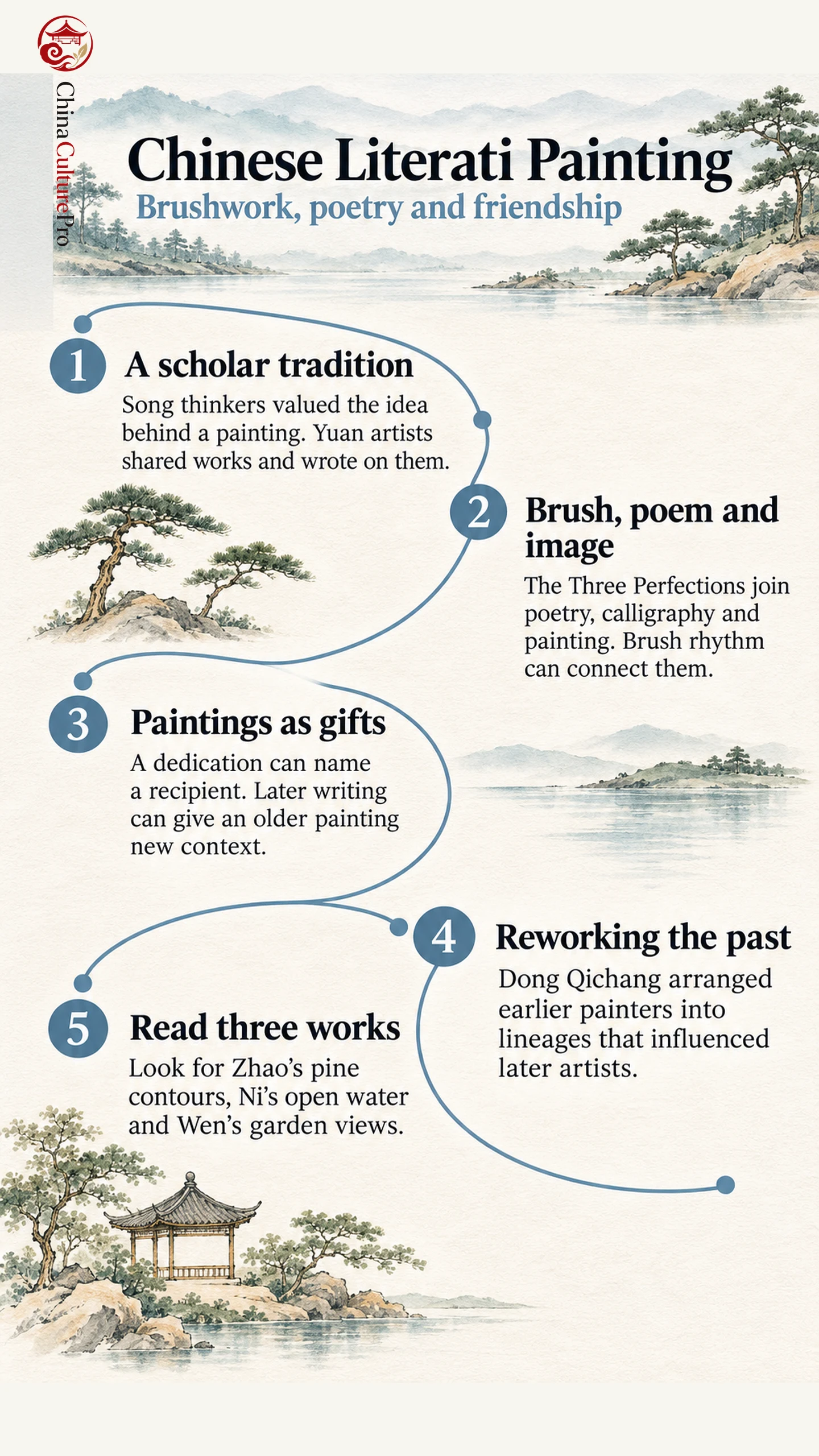
In the Northern Song, the writer and official Su Shi (苏轼, Sū Shì) valued the conception behind a painting as well as its structure. His preference for expressive insight helped articulate a difference between the value scholars claimed for painting and the goals of other painting traditions. Brush skill still mattered. The point was what a painter could make that skill express. [1][4]
Under Yuan rule, the careers and circumstances of educated painters varied. Some withdrew from public life, while Zhao Mengfu (赵孟頫, Zhào Mèngfǔ) served the Yuan government. Scholars also made paintings for one another, collected them and wrote on them. A single scroll could gather the comments and brushwork of several people over time. [2][3]
Brushwork, Blank Space and the Three Perfections
The Three Perfections (三绝, sān jué) are poetry, calligraphy and painting brought together in a work. A poem can name a remembered season or place. The written strokes have their own rhythm on the sheet, and the image gives the words a setting. The phrase describes an important ideal and does not require every literati work to include a poem. [4][5]
In Twin Pines, Level Distance (双松平远图, Shuāngsōng Píngyuǎn Tú), made around 1310, Zhao uses even outlines for the pines and broken, dry-looking lines in the rocks. The title sits to the right of the trees and an inscription lies above the distant hills. The way the strokes move connects the landscape to Chinese calligraphy before you read the text. [5]
Ni Zan (倪瓒, Ní Zàn) uses a very different balance in Rongxi Studio (容膝斋图, Róngxī Zhāi Tú). An empty pavilion and a bank of trees face the far shore across a quiet area of water. The sparse middle makes the spacing of the two banks matter. Ni is associated with the late Yuan, but this painting dates to 1372 in the early Ming. [6]
Paintings as Gifts and Conversations
The date of an inscription can differ from the date of a picture. Ni returned to Rongxi Studio in 1374 to add writing associated with its presentation to the physician Pan Renzhong. The studio named in the title refers to the recipient’s dwelling. This later act helps explain the work’s name and social history. The name thus records a relationship that the uninscribed landscape alone could not identify. [6]
Wen Zhengming (文徵明, Wén Zhēngmíng) used poetry and painting to record views in a Suzhou garden linked to his friend Wang Xianchen. The surviving 1551 album Garden of the Inept Administrator contains eight leaves. Each small scene offers a particular place to pause. The album format keeps the written response and the view close together. [7]
When you read inscriptions and seals, look at their position and date. A line by the painter can describe a gift or motive. Later words and marks may come from viewers, recipients or collectors. [5][6][9]
How Dong Qichang Reframed Older Traditions
The late Ming artist and critic Dong Qichang (董其昌, Dǒng Qíchāng) organized earlier painting into lineages. His Southern School (南宗, Nánzōng) traced a preferred scholar tradition back to the Tang poet and painter Wang Wei (王维, Wáng Wéi). Dong’s categories tell you how a much later thinker selected models for study. Their focus is the ancestry of a style. Painters in a lineage could live and work in different regions. [1][8]
His way of ordering past masters influenced later landscape painters, including Qing artists who returned to older brush methods and compositions. To identify the reference in one work, look for the earlier painter named in its inscription and the particular strokes or arrangement being reworked. [8]
Three Works for Reading Literati Painting
| Work | Look for | What the detail helps explain |
|---|---|---|
| Twin Pines, Level Distance | Even pine contours and an inscription above the hills. | How a landscape can bring brush writing and painted forms together. [5] |
| Rongxi Studio | A quiet stretch of water and writing added two years after painting. | How visual space and the history of the recipient both shape the work. [6] |
| Garden of the Inept Administrator | A small view and its related written response. | How a garden becomes a sequence of observed and remembered places. [7] |
The survey of Chinese painters places these approaches alongside other works and settings. Zhao’s 1295 Autumn Colors on the Qiao and Hua Mountains recalls Shandong for his friend Zhou Mi. The picture uses simple brushwork associated with the older painter Dong Yuan and puts it to a new purpose. [9]
FAQs About Chinese Literati Painting
Is Literati Painting Always Monochrome?
Ink alone is common, but color can belong in a scholar painting. Zhao Mengfu’s Autumn Colors on the Qiao and Hua Mountains pairs colored forms with a dedication that explains why he depicted the region. [5][9]
Were Literati Painters Untrained Amateurs?
The amateur ideal emphasized learned expression and a scholar’s identity. Painters could be deeply trained in brushwork, calligraphy and earlier models. Zhao’s deliberate use of different kinds of line shows how much expertise the practice could require. [1][4][5]
What Is the Southern School of Painting?
It is a lineage of valued painters constructed by Dong Qichang and his circle. They made Wang Wei an early model for later scholar painting. The label is a historical theory of style and inheritance. [8]
資料來源
[1] Chinese Thought and Culture Terminology Project. Literati Painting
[2] The Metropolitan Museum of Art. The Yuan Revolution
[3] The Metropolitan Museum of Art. The World of Khubilai Khan
[4] The Metropolitan Museum of Art. Sparse Trees and Pavilion, a Fan Painting by Wang Meng
[5] The Metropolitan Museum of Art. Zhao Mengfu: Twin Pines, Level Distance
[6] National Palace Museum, Taipei. Ni Zan: Rongxi Studio
[7] The Metropolitan Museum of Art. Wen Zhengming: Garden of the Inept Administrator
[8] The Metropolitan Museum of Art. Wang Hui (1632–1717)
[9] National Palace Museum, Taipei. Zhao Mengfu: Autumn Colors on the Qiao and Hua Mountains