


Quick Answer: What Is Wind in Pines?
Wind in Pines(万壑松风图,Wànhè sōngfēng tú)is a landscape by Li Tang(李唐,Lǐ Táng), dated 1124 and held by the National Palace Museum, Taipei. Its longer English titles include Wind in Pines Among a Myriad Valleys and Whispering Pines in Myriad Valleys.[1]
- Object: A large hanging scroll on silk.
- Visual focus: Rugged mountains above a close, densely wooded valley.
- Key evidence: A dated inscription placed on a slender background peak.
The artist worked across the Northern–Southern Song transition, but this particular painting belongs to the Northern Song.
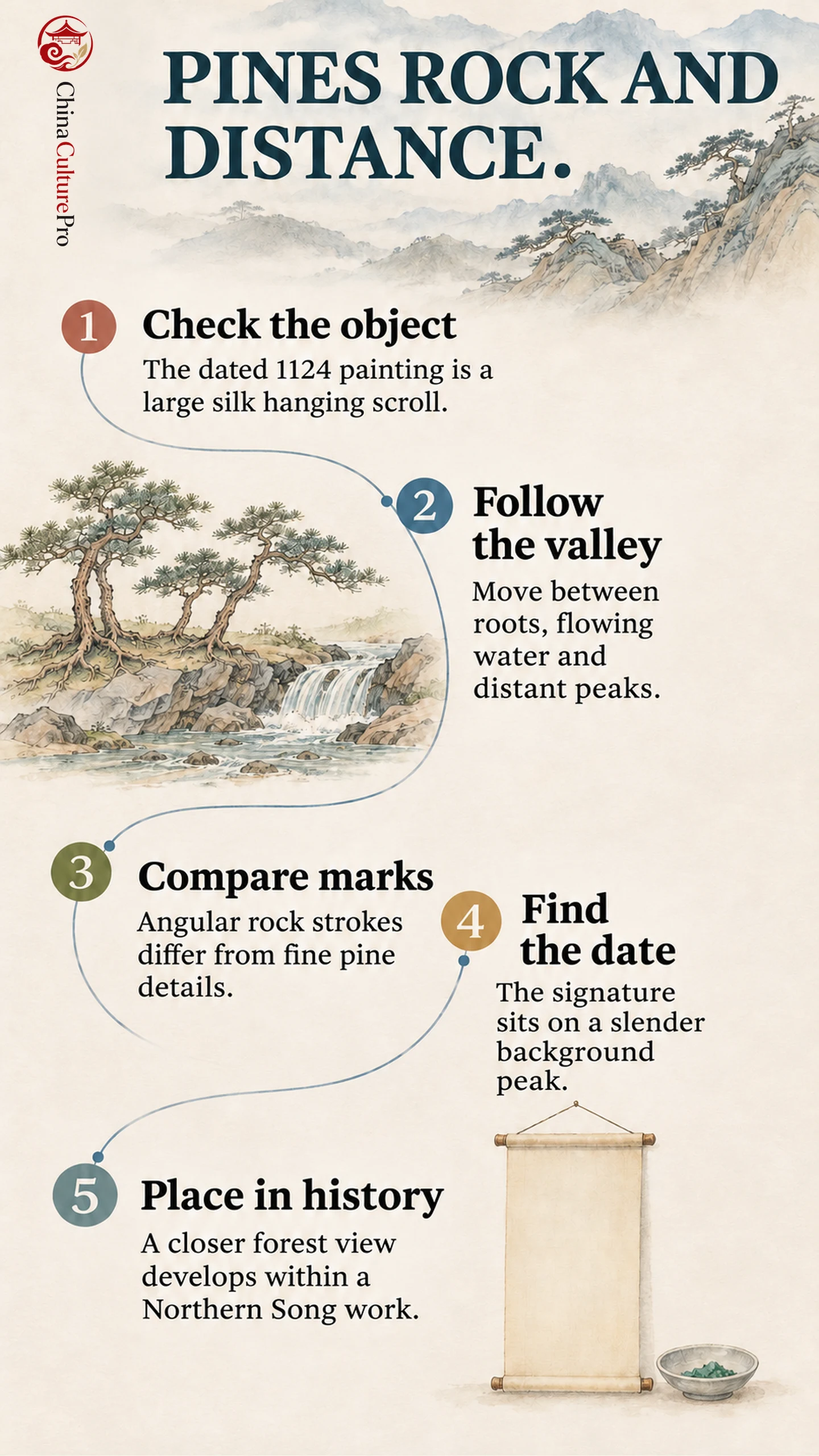
Dark pines crowd the foreground beneath a massive, uneven summit. Water breaks around rocks, while pale cloud passages open between the mountain forms. The eye moves between these very different scales: roots and boulders close at hand, then cliffs and distant peaks rising beyond the valley.
The 1124 Silk Hanging Scroll
The painted silk measures 188.7 × 139.8 cm. Its broad vertical field gives the foreground forest considerable room beneath the central mountain. The support is silk, not paper, and the work combines ink with colour.[1]
As a hanging scroll, the image offers a substantial view all at once. Yet its details resist being reduced to a single mountain silhouette. The lower trees overlap one another, exposed roots grip uneven ground, and the water changes direction around separate rock forms. At closer range, the forest competes with the summit for attention.
From Pine Roots and Water to the Main Peak
Begin near the lower edge. The trunks rise from a complicated foundation of roots, stones and ledges. Their branches spread into darker foliage, making it difficult to reduce each tree to a simple vertical line. This close grouping creates a wooded interior rather than a row of evenly spaced trees.
At the lower left, pale water opens between angular boulders. Its curving marks differ from the heavier surfaces around it. Following that contrast leads into the darker valley, where narrow cascades appear between rock faces.
Above, the main mass rises in broad, irregular planes. Thin peaks beside it introduce sharper vertical accents. A pale cloud opening separates one group of trees from the rock behind, making the same dark foliage read more distinctly against a lighter interval.
The movement between solid surfaces, dark growth and open passages keeps the composition active. The title’s wind and the visible water invite an imagined soundscape. Their suggestion of movement depends on contrasts among the painted forms.[1]
Axe-Cut Strokes and Surviving Colour
The rock faces are associated with axe-cut texture strokes(斧劈皴,fǔpī cūn). The term describes brush marks whose angular, forceful edges suggest chopped surfaces. It names a pictorial effect; the silk was not worked with an axe. Compare the slanting facets of rock with the finer, branching lines of roots to see how different brush strokes distinguish materials.[1]
Optical examination identified residual blue-green pine-needle colouring over ink, alongside ochre on rocks. Pigment loss has reduced the forest’s separation from the rocky background, making the present dark appearance an incomplete guide to the original colour relationships.[2]
These findings do not provide a complete reconstruction of the original palette. They explain why present appearance and original colour relationships need not be identical.
Finding the Dated Signature
The inscription is integrated into a slender peak to the left of the main mountain. It identifies Li Tang of Heyang and dates the work to spring of the jiachen year in the Xuanhe(宣和,Xuānhé)reign, corresponding to 1124. Its position within the landscape makes it quite different from a large title placed above the scene.[1]
Optical examination places the writing beneath a blue-green wash, supporting its identification as an original inscription. The sequence of paint and writing adds material evidence to the written date.[1]
The distinction is useful when reading painting inscriptions and seals. What a text says, where it sits and how it relates to the paint layers are separate questions that can reinforce one another.
A Bridge Between Northern and Southern Song Painting
Li’s painting is often considered alongside the monumental landscapes of Fan Kuan(范宽,Fàn Kuān)and Guo Xi(郭熙,Guō Xī). A comparison with Travelers Among Mountains and Streams is especially useful for considering the relationship between a commanding mountain and the nearer ground. In Wind in Pines, the foreground forest has a strong claim on the viewer’s attention alongside the summit.[1]
Its historical importance is not a simple story of one style replacing another. Research has emphasized the move toward a closer encounter with the wooded valley while questioning the idea that the late Northern Song court wholly rejected Guo Xi’s tradition. Li’s work can be understood through both continuity and change.[2]
That makes 1124 an important anchor. The painting offers evidence of developments already underway before the Southern Song, rather than a work that must be dated after the move south to explain its closer viewpoint.
FAQs About Wind in Pines
Was Wind in Pines painted in the Northern or Southern Song?
It is dated 1124, in the Northern Song. Li Tang’s later southern career does not change this work’s date.[1]
Is Wind in Pines a monochrome ink painting?
No. It uses colour as well as ink, although surviving colour and its visibility have changed.[1][2]
Does axe-cut mean the artist cut the silk?
No. It is a name for angular texture strokes made with a brush.[1]
資料來源
[1] National Palace Museum, Taipei. Whispering Pines in Myriad Valleys: collection record and inscription
[2] Chen Yunru. Li Tang’s position in the transition of Song landscape painting, relevant discussion on pages 75 and 79–81