


Quick Answer: What Is Fairyland of Peach Blossoms?
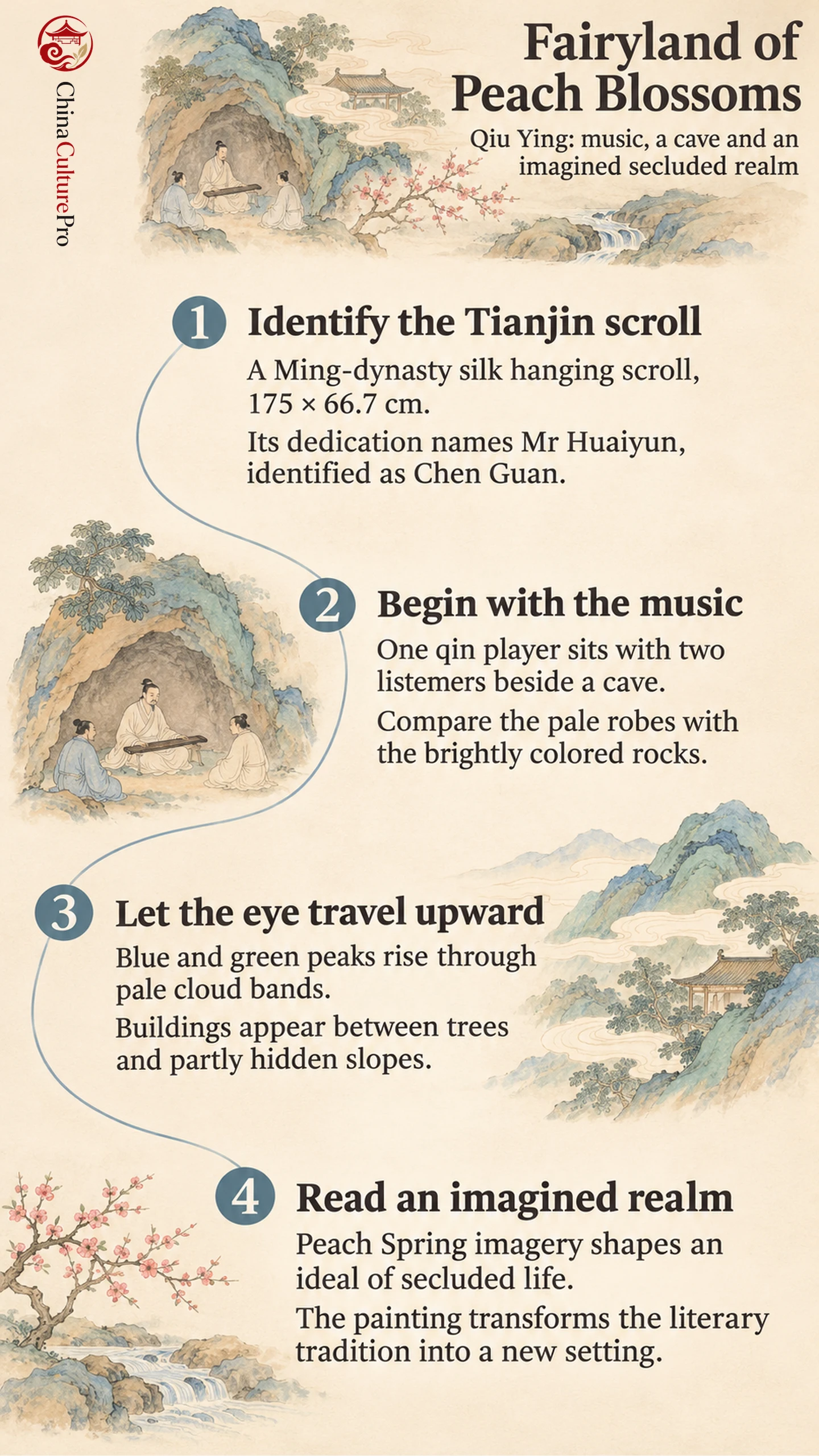
Fairyland of Peach Blossoms (桃源仙境图, Táo Yuán Xiān Jìng Tú) is a richly colored mountain painting catalogued by Tianjin Museum as a work of Qiu Ying (仇英, Qiú Yīng).
- Format: A hanging scroll, ink and color on silk.
- Size: 175 × 66.7 cm.
- Look first: Find the three pale-robed men gathered near the bottom, beside a dark cave.
- Then look upward: Follow the colored rock faces, cloud bands and partially revealed buildings.
Begin with the gathering beside the cave, then compare it with the more remote buildings above.
Near the lower left, three men sit together among bright blue-green rocks. One plays a long zither, while the others attend to the music. An attendant stands nearby, and another approaches across the bridge below.
Above the gathering, the landscape climbs through densely wooded slopes, exposed rock faces and pale cloud bands. Roofs emerge at different heights, giving the distant realm small signs of habitation.
Locate the Tianjin Scroll and Read Its Dedication
Tianjin Museum records the work as a Ming-dynasty silk hanging scroll, 175 cm high and 66.7 cm wide. Its tall proportions allow a long movement from the foreground gathering toward the upper mountains. [1]
The dedication names Mr Huaiyun (怀云, Huái Yún), identified as the patron Chen Guan (陈官, Chén Guān). This connects the ideal landscape with a particular recipient. [1]
The inscriptions-and-seals guide explains how a dedication contributes evidence about a work’s social setting. Here, it gives the scene a documented recipient without identifying each painted figure as a portrait.
Attribution has also been debated. An earlier challenge relied partly on measurements in an old catalog; a 2012 study answered that a different historical ruler length could reconcile them with the surviving work. The museum continues to present it as Qiu’s painting. [2]
The scroll-format guide provides context for the object’s physical form. Begin with the lower gathering, then compare its scale with the highest visible buildings before concentrating on smaller details.
Begin with the Qin Gathering beside the Cave
The qin zither (琴, Qín) links one player with two listeners. In the painting, this musical activity has been interpreted as part of the relationship between the human gathering and the cave’s otherworldly setting. [2]
Look at the group’s arrangement. The figures sit close enough for the gestures of listening and playing to form a compact center of attention within the surrounding rocks.
Their pale clothing contrasts with the saturated stone below them. Fine darker lines distinguish sleeves and folds without making the robes as visually dense as the nearby foliage.
The guqin guide develops the instrument’s cultural setting. Return afterward to the player’s position relative to the listeners, rather than treating the instrument as an isolated decorative object.
The dark opening behind the gathering changes the space again. Its recess contrasts with the exposed surfaces on which the figures sit, placing an interior close to the open-air activity.
Compare the two attendants. One remains beside the gathering; the other moves across the bridge carrying an object. Compare the attendant at rest with the forward step of the figure on the bridge.
Compare the bridge’s straight edges with the curving tree trunk beside the gathering. Follow its edge toward the bank, then look back at how close the gathering sits to the cave.
Follow Color and Clouds toward the Upper Pavilions
Blue-and-green landscape (青绿山水, Qīng Lǜ Shān Shuǐ) provides the painting’s principal color language. Broad mineral blue and green areas contrast with finely drawn cloud shapes, architecture and figure outlines. [3]
Choose one of the large central rocks. Its face changes direction through several angular ridges, with lines and changes of color distinguishing one plane from another.
Compare those large surfaces with the pines at the right. Closely grouped trunks and darker foliage produce a much finer pattern beside the broad colored slopes.
The painting-techniques guide explains differences among contour, texture and color. Here, compare a rock’s outer edge with the smaller marks contained within it.
The clouds create another kind of surface. Their pale bands interrupt the upright rock forms and obscure portions of the ground between one level and the next.
Look for the roofs emerging at the right. Their straight outlines remain distinct from both the uneven foliage and the curling cloud edges nearby.
The landscape-painting guide develops the relation between visible routes and concealed distance. In this scroll, compare a clearly exposed roof with a building partly hidden behind trees or cloud.
Read Peach Spring Imagery beyond a Literal Story
The work draws on the tradition of Tao Yuanming (陶渊明, Táo Yuān Míng) and The Peach Blossom Spring (桃花源记, Táo Huā Yuán Jì). Its subject expresses an ideal of secluded life. [1]
The Tao Yuanming guide provides literary context. In this painting, the relevant question is how familiar imagery becomes a particular kind of landscape.
The cave, peach trees, water and elevated buildings have been read as a combined image of access to an ideal realm. The composition transforms the literary tradition rather than simply retelling its village story in successive episodes. [2]
That interpretation makes the foreground music especially useful for looking. The players and listeners occupy the threshold area below a much larger, more remote landscape.
The guide to painting and scholarly exchange develops the cultural setting of such ideal scenes. Here, compare the recipient named in the dedication with the imagined environment offered by the painting.
Return finally to the pale robes against colored stone. The small gathering supplies a human center, while the clouds and upper buildings extend the scene beyond what the group’s immediate space reveals.
FAQs About Qiu Ying’s Fairyland of Peach Blossoms
Where is Fairyland of Peach Blossoms kept?
It belongs to Tianjin Museum. The hanging scroll’s recorded dimensions are 175 × 66.7 cm.
Are the three men named immortals?
The scene is read as one player and two listeners within an ideal realm. The title alone does not establish individual immortal names or portrait identities.
Is this a literal illustration of The Peach Blossom Spring?
It uses the literary tradition’s imagery to construct a secluded, otherworldly setting. The cave and musical gathering belong to that transformation, rather than a straightforward sequence of village-story episodes.
資料來源
[1] Tianjin Museum. Qiu Ying: Immortal Realm of the Peach Spring, collection entry
[2] National Palace Museum; Hsu Wen-mei. On the Peach Blossom Spring Imagery in Several of Qiu Ying’s Blue-and-Green Landscape Paintings, relevant pages 225–228
[3] Palace Museum; Qian Ling, Tianjin Museum curator. Where Is the Peach Blossom Fairyland? Qiu Ying’s Painting and Reclusion in Wumen Painting, pages 69–70