


Quick Answer: What Happens at a Chinese Wedding Banquet?
A Chinese wedding banquet, or xiyan (喜宴, xǐyàn), brings relatives and friends together for a celebratory meal. It may include shared dishes, the couple’s entrance, speeches, table visits and collective toasts, with details shaped by the family and venue.[2][3]
- Dishes can express good wishes through names, shapes, ingredients and regional associations.
- Guests should follow the actual seating plan and the host’s cues for service and speeches.
- A toast celebrates the couple; it does not require drinking alcohol or emptying a glass.
There is no compulsory menu, course count or seating diagram for Chinese weddings worldwide. The examples below help explain the occasion without replacing the couple’s arrangements.
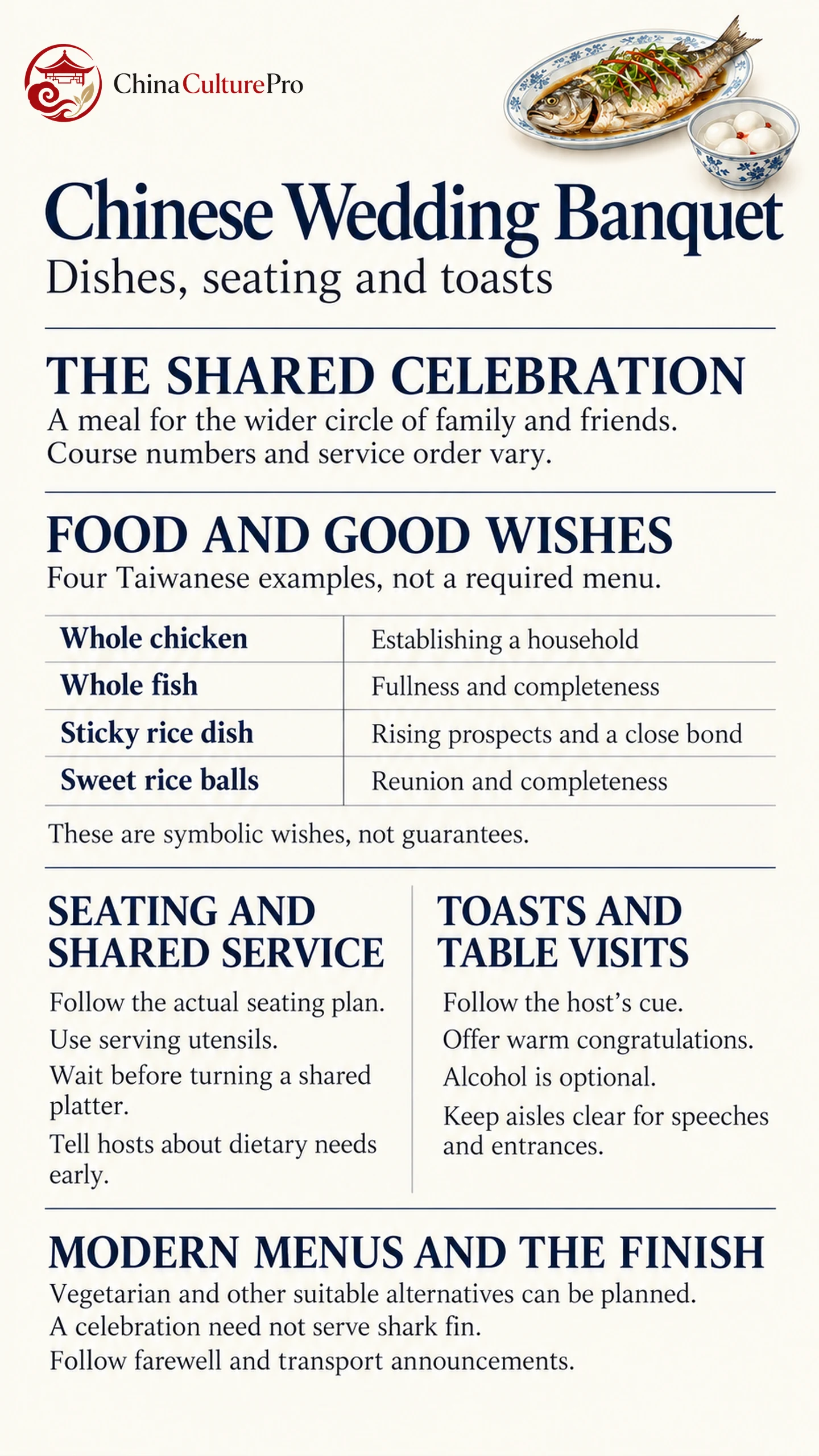
At a wedding banquet, the meal and the social occasion work together. A dish can carry a family association, an elder may have a place of honor, and the couple’s visit gives each table a chance to offer congratulations.
The broader Chinese wedding traditions guide explains the surrounding customs. Here, the focus is what you may eat, how the meal unfolds and how to join it considerately.
The Banquet Is the Shared Celebration
The banquet extends the celebration to the wider circle of family, friends and colleagues. It can be held at lunchtime or in the evening, in a restaurant, hotel, event space or another setting chosen by the hosts. It is distinct from an intimate family tea ceremony, even when both happen on the same day.
A meal may unfold through appetizer platters, hot dishes, soups, substantial rice or noodle dishes, and a sweet finish. The precise order and number depend on the menu. One Bay Area planning account describes eight to twelve courses; this is a useful example of a substantial shared meal, not a national requirement.[3]
Check the invitation for the arrival time and event details. Do not assume a late start or a particular finishing hour. A wedding timeline may combine several events, and a banquet invitation does not automatically include the earlier family rituals.
Dishes and the Wishes Behind Them
Food meanings are often tied to local language and presentation. The following examples come from Taiwanese wedding-menu explanations for chefs. They illustrate how a menu can communicate wishes; they are not a universal list of dishes that must be served.[1]
| Example food | A customary association | What the example helps explain |
|---|---|---|
| Whole chicken | Establishing a family or household, through a Taiwanese-language word association | A complete presentation can emphasize the new household |
| Whole fish | Fullness and completeness | Presentation may carry meaning beyond the recipe itself |
| Sticky rice dish | Rising prospects and the couple’s close bond | Texture and the name of a dish can both inspire wishes |
| Tangyuan (汤圆, tāngyuán), sweet glutinous rice balls | 團聚與圓滿 | A round dessert can express a wish for a happy shared life |
Some older explanations also connect particular foods with hopes for children.[1] These are symbolic associations, not claims that eating the dish produces fertility or determines the couple’s future. Families can choose which wishes they want to emphasize.
The same dish need not carry identical meaning in every language community. Ask the hosts about a distinctive menu name rather than assuming an English translation reveals the whole wordplay. A short explanation can make an unfamiliar dish more meaningful without turning dinner into a test of cultural knowledge.
For the dessert in the table, the tangyuan guide gives more context about fillings and family traditions. Other wedding menus may use a different sweet soup, pastries, fruit or another finish that suits the couple and kitchen.
Where to Sit and How Shared Service Works
Use the table number or seat indicated by the hosts. Places of honor may reflect elders, close relatives and hosting roles, but a generic diagram cannot determine where you should sit in an unfamiliar room. Ask an usher if the arrangement is unclear rather than moving a place card.
Shared platters are a familiar banquet format.[3] Take a modest portion, let dishes reach other guests and use the serving utensils provided. If the table has a rotating center, wait until nobody is serving before turning it. Keep personal utensils and used dishes out of shared platters, and ask for help if you need a serving spoon or an accessible portion.
Follow the table’s pace without feeling obliged to try every dish. Tell the hosts about dietary requirements before the wedding, and check with the serving team when ingredients are unclear. A symbolic name does not tell you everything in a sauce or filling. The Chinese table manners guide covers seating and shared dishes in more detail.
If gifts are being collected at reception, follow the named arrangement. Cash envelopes are familiar in Chinese Singapore wedding descriptions, but the couple may have another preference.[2] Read the wedding gifts guide for that separate decision; a banquet menu is not an invoice setting what a guest owes.
Toasts, Speeches and Table Visits
In some Cantonese-speaking and Chinese Singapore celebrations, a collective toast is called yam seng (饮胜; Mandarin pinyin: yǐnshèng). The Mandarin pinyin identifies the written term; it is not a guide to the Cantonese pronunciation heard in the room. Guests may join a drawn-out cheer while the couple and their party raise their glasses.[2]
Wait for the host’s cue and offer warm congratulations. Water, tea or another non-alcoholic drink can serve your toast; do not pressure a guest to drink or finish a glass. If speaking to an elder, follow the family’s manner and give them space to respond. Our Chinese drinking etiquette guide explains toast contexts more broadly.
The couple may also visit tables to thank guests, make introductions and take photographs.[2] Keep the exchange brief if they are moving around a large room. A collective stage toast and table visits can both appear, but neither should be assumed to follow a fixed number of rounds at every wedding.
Outfit changes can happen between parts of the celebration.[3] They help explain why the couple may briefly leave while service continues. The wedding dress guide distinguishes the clothing you may see. During speeches or an entrance, pause conversations and keep aisles clear instead of gathering around the couple for an unscheduled photo.
Modern Menus and a Considerate Finish
A meaningful banquet can accommodate vegetarian dishes, dietary needs and the couple’s preferences. Hosts can explain what a selected dish symbolizes while choosing another preparation or ingredient when necessary. Guests can appreciate the intention without insisting on one expensive ingredient as proof of authenticity.
Shark fin appears in discussions of older banquet menus, but a contemporary celebration need not serve it. Conservation guidance in Hong Kong encourages hotels and caterers to remove shark fin and provide more ocean-friendly alternatives.[4] A different soup or carefully chosen menu can preserve the generous spirit of the meal.
Toward the end, follow announcements about farewells, transport or any later event. A receiving line at the doorway is one familiar way for the couple and families to thank guests.[2] If you need to leave early, choose a break, avoid interrupting a speech and thank the hosts without creating a disruption.
For clothing and invitation questions beyond the meal, use the wedding guest etiquette guide.
FAQs About Chinese Wedding Banquets
Does every banquet serve eight courses?
No. Course numbers and serving order vary with the venue, region, budget and chosen menu. A symbolic preference for a number does not establish one required meal format.
Can a Chinese wedding menu be vegetarian?
The couple can plan a vegetarian menu or suitable alternatives with the kitchen. Tell the hosts about your requirements early rather than relying on the dish’s celebratory name to identify its ingredients.
What does yam seng mean at a wedding?
It is a collective celebratory toast heard in some Cantonese-speaking and Chinese Singapore settings. Follow the host’s cue, raise your chosen drink and join the congratulations if you wish.
When should a guest leave?
Follow the invitation and closing announcements. If leaving earlier, use a natural break and thank the hosts discreetly; the last course does not automatically mean every wedding has ended.
資料來源
[1] Unilever Food Solutions Taiwan. 宴客菜再進化!兼具創新、傳統料理設計方向,幫助開發菜單靈感
[2] National Heritage Board / Ministry of Culture, Community and Youth, Singapore. Who’s Your Neighbour?
[3] Only Once. A Guide to the Chinese Wedding Banquet, From Seating to Toasts
[4] WWF Hong Kong. What Hotels & Caterers Can Do