


Quick Answer: What Defines Chinese Family Traditions?
Chinese family traditions connect relationships, everyday care, gatherings and remembrance. Their forms vary by region, language, religion, generation and household; historical ideals should not be treated as a description of every family today.
- Kinship: Family terms can distinguish generation, relative age and the maternal or paternal side.
- Care and respect: Supporting relatives and honoring elders are important themes, expressed in different ways.
- Gatherings: Shared meals, festivals and life events bring relatives together.
- Family memory: Stories, names, genealogies and ancestor rites can connect living relatives with earlier generations.
The best way to understand a particular family is to ask which practices matter to them and what those practices mean.
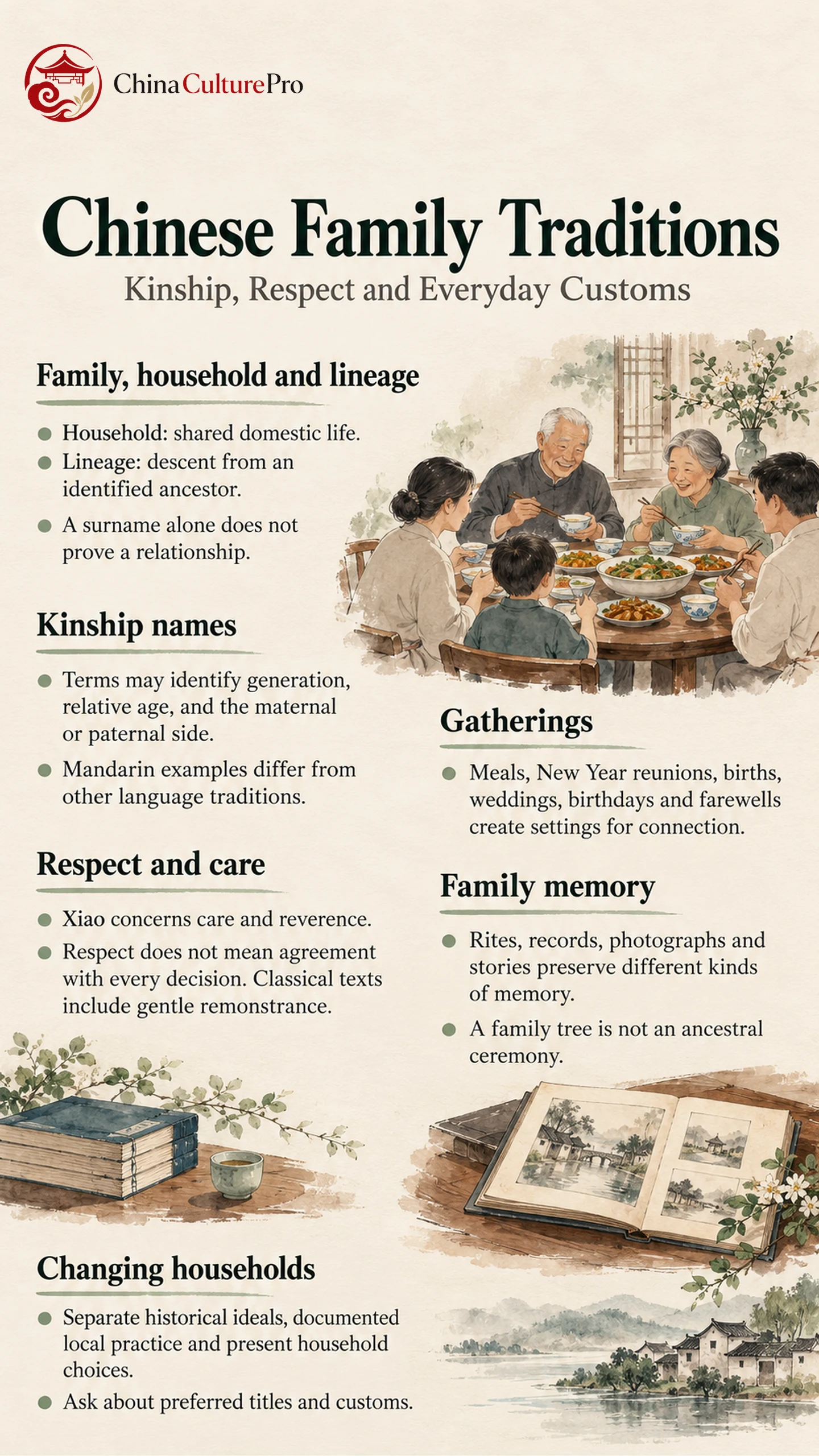
Calling someone “uncle,” serving a meal and returning home for a festival may each express a family relationship. Yet the same action can mean different things in different households. An accurate introduction starts by separating historical institutions from present choices, then looks at how people name, care for and remember one another.
Family, Household and Lineage Are Different Things
Jia (家, jiā) can refer to family or home, depending on context. A household is a domestic arrangement; a wider descent group is another kind of relationship. Zongzu (宗族, zōngzú) commonly names a lineage organized around shared descent. Neither term can simply be replaced by “everyone with the same surname.”[1]
| 概念 | Working distinction | 不能由此證明甚麼 |
|---|---|---|
| Household | People sharing a domestic living arrangement and everyday resources | That every relative lives under the same roof |
| Lineage | A descent group linking members to an identified common ancestor | That all households participate in a formal lineage organization |
| Surname | A family name that does not by itself prove a close or documented relationship | That two people know a common ancestor or belong to the same local branch |
Historical descriptions often emphasize a household led by a senior man, descent through men and a preference for married sons remaining with their parents. These were influential institutions and ideals. They should be identified as historical arrangements rather than instructions for how every modern Chinese household must operate.[1]
Living separately also does not tell you whether relatives remain close. A family can share responsibilities, visits or resources across several homes. Research on extended kinship emphasizes flexible connections and warns that one model of a landowning lineage cannot explain every Chinese family setting.[2]
For names and recorded descent, Chinese surnames 及 family genealogy answer different questions. A surname is a starting clue, while a documented relationship needs evidence.
Kinship Terms Make Relationships Specific
Chinese kinship vocabulary often identifies details that English compresses into “uncle,” “aunt” or “cousin.” The speaker’s relationship to the person matters: the same relative may have different titles when addressed by a child, a sibling or a grandchild.[3]
In common Mandarin usage, these examples show the pattern:
| Relationship to the speaker | Mandarin term | Detail made explicit |
|---|---|---|
| Older brother | 哥哥, gēge | An older male sibling |
| Younger brother | 弟弟, dìdi | A younger male sibling |
| Older sister | 姐姐, jiějie | An older female sibling |
| Younger sister | 妹妹, mèimei | A younger female sibling |
| Father’s older brother | 伯父, bófù | Paternal side and relative age |
| Mother’s brother | 舅舅, jiùjiu | Maternal side |
These are useful examples, not a complete map for every Chinese language or dialect. Cantonese, Hokkien and other speech communities have their own forms, and families may use affectionate or simplified names. Ask how the person is addressed in that household rather than correcting relatives from a dictionary alone.
The fuller Chinese family terms guide explains cousins, in-laws and other relationships. For a visitor, remembering the preferred title is usually more useful than mastering the entire kinship system before a first meeting.
Respect, Filial Piety and Everyday Care
Filial piety (孝, xiào) concerns duties and reverence toward parents and elders. Classical teaching connects it with care, personal conduct and responsibilities extending beyond the household. That is an ethical framework, not a survey showing that everyone behaves in the same way.[4]
Respect is also more complex than agreeing with every parental decision. Analects 4.18 allows a child to remonstrate gently with parents. The passage belongs to an ancient hierarchical setting, but it shows that even a classical discussion of family reverence could include disagreement.[5]
In everyday life, care may involve preparing food, making time for a conversation, helping with travel or sharing a practical responsibility. The appropriate form depends on the relatives’ needs and wishes. It is misleading to judge the quality of a relationship only by co-residence, a public ceremony or the amount of money exchanged.
Family members can discuss expectations directly: who is available, what help is wanted and how responsibilities will be shared. A respectful tone does not remove the need for clear agreement. Nor should an explanation of tradition imply that someone must accept mistreatment to prove cultural loyalty.
The dedicated filial piety guide explores the concept and its historical interpretations. Confucianism supplies a broader philosophical context, while this page keeps the focus on family relationships.
Meals, Festivals and Life-Cycle Gatherings
Food creates repeated opportunities for relatives to meet. A shared meal can make care visible through cooking, serving and making room for different generations. Seating and serving habits vary, so Chinese table manners are best understood alongside the host’s actual arrangements.
Spring Festival is a prominent example of reunion and cultural transmission. Its social practices connect family gatherings with visits, festive preparation and continuity between generations.[6] The New Year reunion dinner gives a specific setting for that relationship; its dishes and timing should not be generalized into every family meal.
Life events organize another set of gatherings:
- Birth: Baby traditions introduce a new family member through naming and chosen celebrations.
- Marriage: Wedding traditions can recognize relationships between the couple and both families.
- Birthdays: Birthday customs may emphasize a child’s growth or an elder’s longevity.
- Bereavement: Funeral traditions provide a setting for farewell, support and continuing remembrance.
These are occasions a family may observe, not a compulsory series everyone completes in the same form. The people concerned should help decide the scale, language and meaning of each event. A small gathering can carry a strong family memory without reproducing every inherited object or restriction.
Ancestors, Genealogy and Family Memory
Remembering earlier generations may involve religious rites, a visit to a grave, a genealogy, photographs or stories told over a meal. These forms have different purposes. An ancestral rite is not the same thing as writing down a family tree, and a family can preserve memories without maintaining a home altar.
Historical lineage organization often connected descent with ritual obligations and shared resources. Contemporary research also shows why that model needs local context: extended kinship can take different organizational forms, and formal descent rules do not capture every relationship people sustain in daily life.[2]
Ancestor worship explores the ritual side. Genealogy and clan books concern records and their limits. Clan associations can create another setting for identity and connection, including overseas communities.
For a family collecting its own history, label what is known and what is remembered. A relative’s story is valuable evidence of memory, but it may need documents to establish a date or relationship. Recording women’s experiences, migration and the lives of less prominent relatives can also preserve parts of the family story that a traditional male-line chart leaves difficult to see.
How Traditions Change Between Households
Region, language, religion, migration and generation all affect which practices remain important. A family may keep kinship titles while simplifying ceremonies, or retain a festival meal while changing its date so distant relatives can attend. Such changes should be described specifically rather than ranked as more or less Chinese.
Distinguish three kinds of statement when reading about family culture: a historical ideal, a documented local practice and a present household preference. “A lineage once traced descent through men” is different from “this family uses a particular surname,” and neither proves how a couple shares decisions today.
The same care applies to diaspora family life. Living outside China does not tell you which language a family speaks, which rituals it keeps or how close its relatives are.
As a guest, ask a few concrete questions: how to address people, whether to bring something, where to sit and which parts of an observance are open to visitors. Clear answers let a visitor participate comfortably and give the hosts less to explain during the visit.
FAQs About Chinese Family Traditions
Do all Chinese families live with several generations?
No. Multigenerational living is one arrangement, not a universal rule. Relatives can maintain close ties and share responsibilities while living in different homes or countries.
Does filial piety mean agreeing with everything a parent says?
It should not be reduced to that. Classical discussions include respectful remonstrance, and contemporary families negotiate care and decisions in different ways.
Do relatives with the same surname belong to one family?
A shared surname alone does not prove a close or documented relationship. A lineage connection requires evidence linking particular people and branches to a common ancestor.
Which customs should a visitor follow in a family home?
Use the household’s preferred forms of address, follow the host’s guidance and ask about gifts, meals or rituals when unsure. Family-specific instructions are more useful than broad assumptions.
資料來源
[1] David K. Jordan, University of California San Diego. Traditional Chinese Family and Lineage
[2] Man Guo and Carsten Herrmann-Pillath. Exploring Extended Kinship in Twenty-First-Century China: A Conceptual Case Study
[3] Open University. The Importance of Family
[4] Columbia University, Asia for Educators. Selection from the Classic of Filiality
[5] Chinese Text Project. The Analects: Li Ren
[6] UNESCO. Spring Festival, Social Practices of the Chinese People in Celebration of the Traditional New Year