

Quick Answer: What Can Chinese Graves Tell Us?
Chinese graves can preserve a person’s identity, a family’s relationships and the history of a community. Their forms and inscriptions vary across periods, regions and religious settings.
- Burial places: A tomb, grave marker and memorial site are related objects, but they are not interchangeable.
- Written memory: Names, dates and commemorative texts need to be read in their own historical context.
- Local history: Cemetery designs can reveal migration, social connections and changing tastes.
- Continuing remembrance: Family memory can continue through visits, archives and memorials beyond an earth grave.
No single grave shape, inscription layout or offering practice represents every Chinese family.
Chinese grave traditions connect physical places with stories about the dead. A marker may help descendants recognize a name; an older inscription may preserve an account that survives nowhere else. Yet a grave is also a historical object whose meaning depends on who made it, when and where.
This guide separates the burial structure, the writing associated with it and the family acts of remembrance. For the ceremonies around a death, start with Chinese funeral traditions.
Tombs Take Different Forms
A tomb is more than the stone visible above ground. It can include a burial chamber, an enclosing structure and objects placed within it. Surviving examples should be understood as evidence from particular communities, rather than models for a national design.
Hong Kong’s Lei Cheng Uk Han Tomb offers one archaeological example. Discovered in 1955, it is a brick tomb attributed to the Eastern Han dynasty from its design and burial objects. That attribution is an interpretation of material evidence, not a date copied from a modern headstone.[1]
Much later cemeteries tell different stories. At Singapore’s Bukit Brown, Chinese narrative carvings appear alongside locally significant features such as Sikh guards, angels and decorative tiles. These combinations reflect Singapore’s social world and the choices of particular patrons.[3]
When comparing graves, begin with the place, approximate period and type of burial. A museum tomb, a modest cemetery marker and an elaborate family enclosure answer different questions. Size or decoration alone cannot measure the affection felt for the deceased.
Headstones and Buried Epitaphs Have Different Jobs
Mubei (墓碑, mùbēi), an above-ground grave marker, is the object a visitor may encounter at a burial place. Muzhi (墓志, mùzhì), an epitaph tablet, is commonly associated with writing placed inside a tomb.
| 用語 | 主要分別 |
|---|---|
| Mubei | An above-ground grave marker bearing an inscription |
| Muzhi | An epitaph tablet commonly placed inside a tomb |
Chung Tai World Museum explains that an epitaph tablet may have a cover identifying the occupant. Its text can combine a prose biography with rhymed praise, recording such matters as family background, life events and burial. This helps explain why an excavated tablet may contain far more narrative than a short surface marker.[2]
A commemorative biography is also a selective account. Praise, formal titles and the interests of those commissioning the text shape what it says. Read it alongside other evidence rather than treating every flattering description as an independently established fact. An inscription is both information about a life and an act of remembrance.
Read Inscriptions as Historical Evidence
Start by distinguishing the person’s name from dates, titles and other text. Do not assume that a familiar-looking column has the same function on every marker, or that one online reading template fits a different cemetery.
Calendars deserve particular attention. Bukit Brown inscriptions include Gregorian dates, Republic-era years, imperial reign eras and Japanese-era dates associated with wartime graves. Some tombs combine Chinese names with English information. The cemetery also contains graves relocated from other burial grounds, so a person’s death date need not date the present setting.[3]
Administrative records provide another layer. The National Archives of Singapore’s digitized Bukit Brown registers run from April 1922 to December 1972. They are in English and arranged chronologically by burial date, with some information withheld for privacy.[4] A burial date should not silently become a death date in a family tree.
Keep the original wording beside any translation or converted date. Separate what the inscription states, what another document states and what you have inferred. If an age appears, consult Chinese age reckoning before calculating a birth year. Compare the results with family genealogy records rather than resolving a discrepancy by guesswork.
Grave Visits and Family Memory
A grave visit can bring relatives together around names and stories that otherwise remain abstract. The stone offers a shared point of reference, while family recollections explain who the person was and why the place matters.
One important seasonal context is 清明節, when many families visit and tend graves. This is distinct from attending the original funeral. Whether a family brings flowers, food or incense, prays, bows or simply spends time remembering depends on its beliefs and local practice. Ask the relatives organizing the visit and follow the site’s rules.
Remembrance can also extend beyond biological descendants. Culturepaedia records that Bukit Brown rickshaw puller Low Nong Nong’s tomb was erected by fellow workers.[3] A grave may therefore preserve solidarity as well as kinship. For the wider religious and family context, see Chinese ancestor worship.
Remembrance Beyond an Earth Grave
An earth grave is one possible focus of memory. Cremated remains may instead be kept in a columbarium, a building or space containing niches for ashes. A memorial location and the place where remains are held need not take the same form.
Hong Kong’s Food and Environmental Hygiene Department describes both columbaria and the scattering of cremated ashes in Gardens of Remembrance. Its gardens also provide for commemorative plaques on dedicated walls.[5] These are examples of memorial arrangements in one jurisdiction, not instructions for every Chinese community.
A plaque, photograph or shared family account can help relatives remember someone without reproducing an older tomb design. The meaningful question is how the particular family preserves a person’s identity and relationships. The broader guide to Chinese family traditions places that work within everyday family life.
How to Record a Grave Respectfully
Treat documentation as observation. A worn inscription is not a reason to apply a substance or attempt a repair. The U.S. National Park Service’s conservation guidance discourages chalk, shaving cream and other materials used to highlight lettering; it also emphasizes photographic documentation and specialist advice for preservation work.[6]
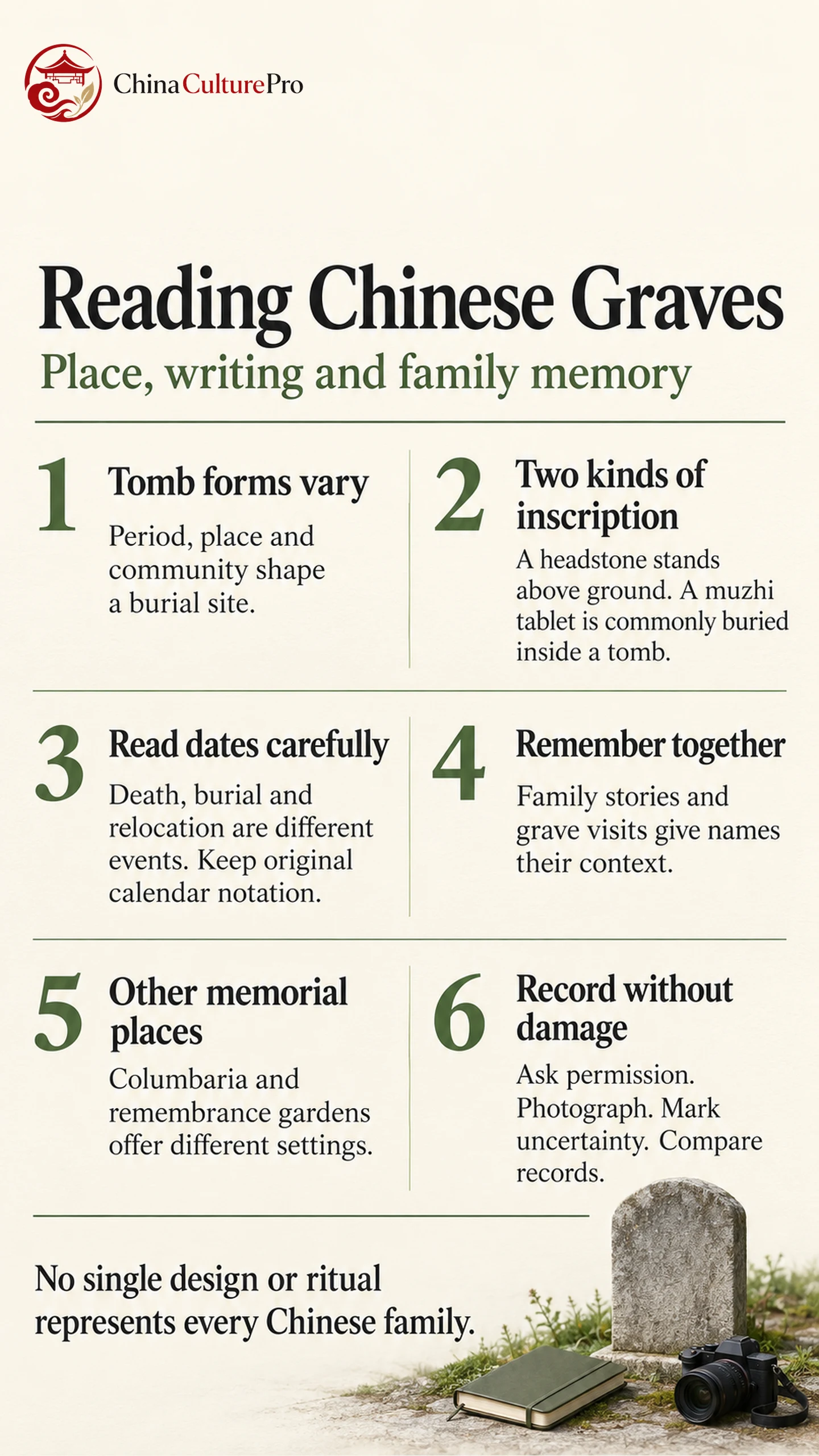
- Confirm permission: Confirm permission and follow the cemetery’s access and photography rules.
- Photograph the setting: Photograph the setting, the whole marker and readable details without moving objects.
- Transcribe cautiously: Transcribe only what you can see, marking uncertain or missing characters.
- Compare records: Compare the transcription with family records and the relevant burial register.
Keep the location, photograph date and source of each interpretation with your notes. Leave unstable stones, vegetation removal and cleaning to the people responsible for the site and appropriately qualified specialists. A partial, honest transcription is more useful than a confident reconstruction that changes the evidence.
FAQs About Chinese Grave Traditions
Do all Chinese graves have the same shape?
No. Burial structures differ by period, locality and community. The Eastern Han brick tomb at Lei Cheng Uk and the later cemetery monuments at Bukit Brown illustrate why one surviving form cannot stand for all Chinese graves.
Is an epitaph tablet the same as a headstone?
No. A headstone is a visible grave marker. The buried epitaph tablets described by Chung Tai World Museum belong inside tombs and may include a biographical narrative and commemorative verse.
Can an inscription give a different date from a burial register?
Yes. First check what each date describes. Death, burial, relocation and the erection of a marker are different events. Calendar systems can also differ; preserve the original notation before making a conversion.
Does a family need an earth grave to remember its ancestors?
No single memorial arrangement defines all Chinese families. Hong Kong’s columbaria and Gardens of Remembrance illustrate alternatives to an earth grave. Families may also preserve memories through photographs, stories and records.
資料來源
[1] Antiquities and Monuments Office, Hong Kong. Lei Cheng Uk Han Tomb, Sham Shui Po
[2] Chung Tai World Museum. Commemorative Inscription: Life Journey of the Ancients
[3] Singapore Chinese Cultural Centre, Lee Chyen Yee. Stories behind the stones: Bukit Brown Cemetery
[4] National Archives of Singapore. Burial registers of Bukit Brown Cemetery
[5] Food and Environmental Hygiene Department, Hong Kong. Scattering of Cremated Ashes in Gardens of Remembrance
[6] U.S. National Park Service. Preserving Grave Markers in Historic Cemeteries, Preservation Brief 48