

Quick Answer: How Are Chinese Calligraphy and Painting Related?
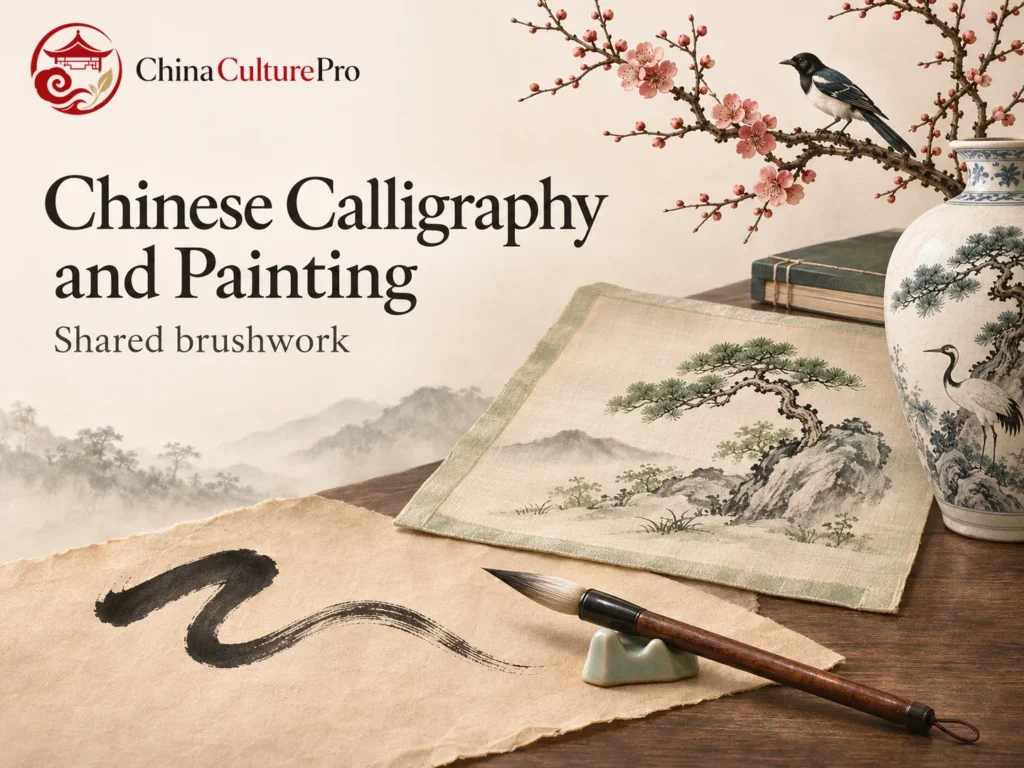
Chinese calligraphy and many kinds of Chinese painting share brush, ink and ways of shaping a line. Calligraphy organizes strokes into written characters. Painting uses lines, washes and sometimes color to describe forms or spaces. A single work can bring the two together through an inscription or a poem. [1][2][3][4]
- Shared motion: Pressure, lifting and direction can change a mark in either art. [1][3]
- Different reading: A line in a character helps make written language. A line in a landscape can make the edge of a tree or the texture of rock. [1][3]
- Combination: The subject of a poem, its written forms and a painted image can each add something to the work. [2][5][7]
Identify what each mark does before deciding how the arts work together. [1][2][3]
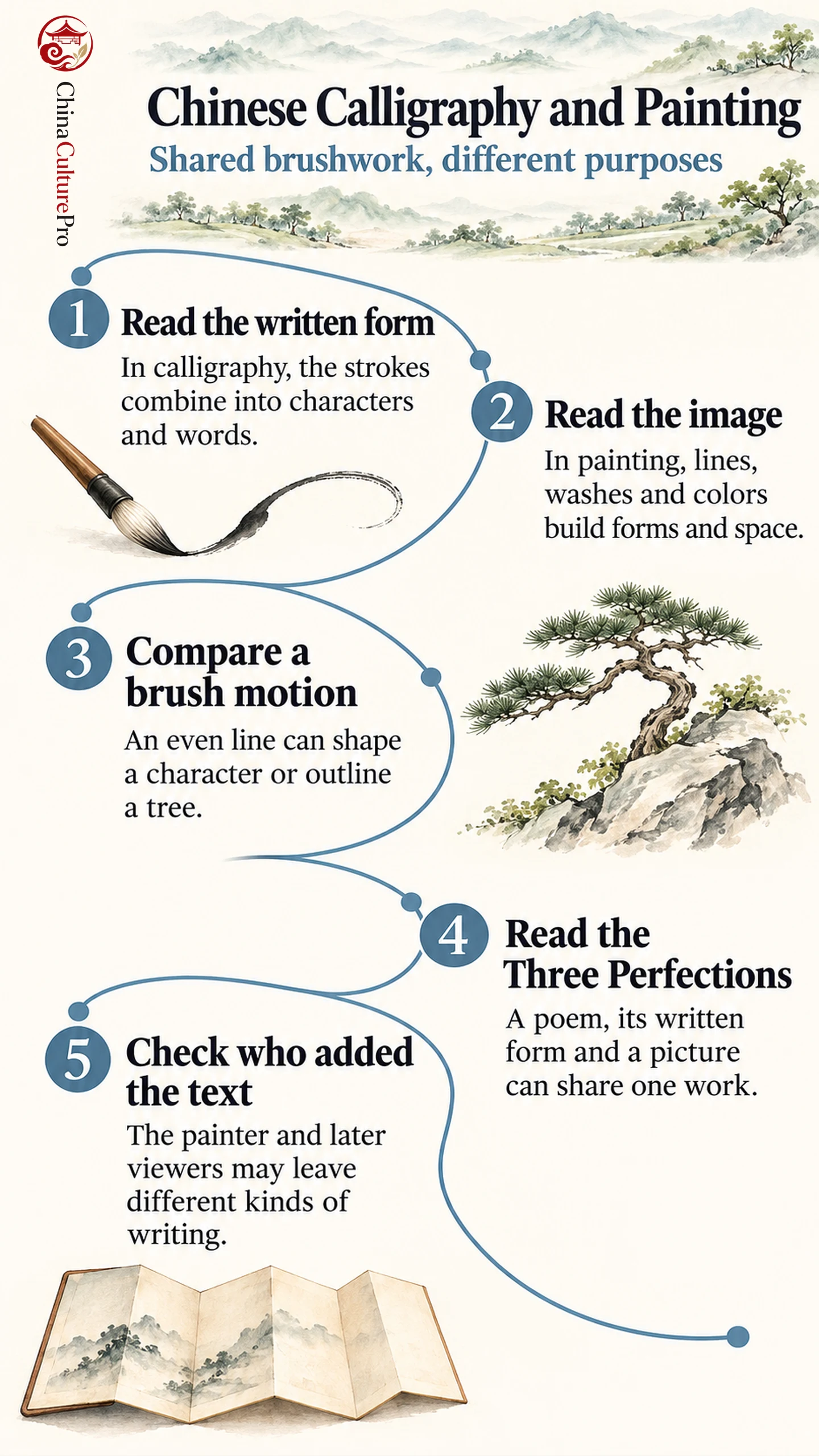
Imagine a dark line that narrows as the brush lifts. In a character it may complete a written form. In a landscape the same motion might end a twig. To see what the two arts share, look at how the line was made. To see how they differ, look at what it belongs to.
What Each Art Asks a Brushstroke to Do
| 藝術 | What its marks organize | What to compare |
|---|---|---|
| Chinese calligraphy | Written characters, spacing and sequences | Look at how the stroke fits into a character and how characters form a line or column. [1] |
| Chinese painting | Pictorial forms, textures, washes and space | Look at how the marks give an image depth, shape or movement. Color may have a large role. [2][3][4] |
The brush, ink, paper and inkstone of the Four Treasures of the Study can serve both. Materials still vary by work. An image may be painted on silk, for example, and use pigments alongside ink. [1][4]
What Shared Brushwork Looks Like
In Twin Pines, Level Distance, Zhao Mengfu gives his pine trees even contours that recall seal-script lines. The rock surfaces are made with broken marks associated with dry cursive brushwork. The pine line encloses a form. The broken rock strokes make texture. Their resemblance to written strokes lies in brush handling, while their role in the painting is pictorial. [3]
Shared ink techniques explain only part of painting. Wang Ximeng’s A Thousand Li of Rivers and Mountains uses mineral blue and green on silk across a painted field nearly twelve meters long. Color helps organize broad stretches of mountain and water. Look at the placement of color across hills and slopes as well as the outlines. The choices are part of the range of Chinese painting techniques. [4]
The Three Perfections on a Scroll or Album
The Three Perfections (三绝, sānjué) bring poetry, calligraphy and painting together. A poem can suggest a scene or a mood. Calligraphy gives the words a visible form, while the image contributes details of its own. The combination is especially useful in reading Chinese literati painting. [2][5][7]
Zou Fulei’s A Breath of Spring, dated 1360, shows a plum branch in ink. In the artist’s poem, moonlight and the shadow of a branch give the painted motif a particular setting. The painted field joins two sheets of paper, and the artist’s inscription sits on the work. Other writing and seals came with later viewing and collecting. Identifying the poem by the artist and the texts added by later viewers helps keep those contributions separate. See Chinese painting inscriptions and seals for that distinction. [5][6]
Wen Zhengming’s 1551 Garden of the Inept Administrator uses an album of eight views. In this format a view can be read as one unit with its poem before the next view comes into sight. A handscroll and an album give a reader different ways of encountering the three arts, as the guide to Chinese scroll painting formats explains. [2][7]
FAQs About Chinese Calligraphy and Painting
Do Chinese Calligraphy and Painting Use the Same Tools?
Brush and ink serve both arts. Paper and inkstones are also part of their shared studio equipment. Some paintings use silk or pigments, so the materials depend on the work. [1][3][4]
Is All Writing on a Painting by the Painter?
A painter may add a title, poem or signature. A later viewer or owner may also write on the painting or on a sheet attached to it. [2][6]
Does Every Chinese Painting Include a Poem?
Poetry is one way to combine writing and image. An inscription can instead be a title, a date or a later comment. Check what the text actually says before calling it a poem. [2][4][5][7]
資料來源
[1] The Metropolitan Museum of Art. 中國書法
[2] The Metropolitan Museum of Art. 中國繪畫
[3] The Metropolitan Museum of Art. Zhao Mengfu: Twin Pines, Level Distance
[4] The Palace Museum. Wang Ximeng: A Thousand Li of Rivers and Mountains
[5] Smithsonian National Museum of Asian Art. A Breath of Spring
[6] 史密森尼國立亞洲藝術博物館。 A Breath of Spring: Documentation
[7] The Metropolitan Museum of Art. Wen Zhengming: Garden of the Inept Administrator