


Quick Answer: Who Was Yan Zhenqing?
Yan Zhenqing (颜真卿, Yán Zhēnqīng) was an eighth-century Tang official and calligrapher. His formal writing survives on monuments such as the Duobao Pagoda Stele (多宝塔碑, Duōbǎotǎ Bēi). His Draft of a Requiem for My Nephew (祭侄文稿, Jì Zhí Wéngǎo) preserves a different kind of writing, with ink revisions still visible on paper. [1][2][3][5]
- Regular writing: Yan’s steles offer models of clear character structure, strong turns and deliberate stroke endings. [2][4]
- Running writing: The Requiem shows changes of spacing, joins and visible edits in a working draft. [5]
- Transmission: Rubbings can transmit a carved inscription or a later engraved version of an ink work. [1][4][7]
To compare two examples, check the occasion for writing and the medium of the surviving object. [2][3][5]
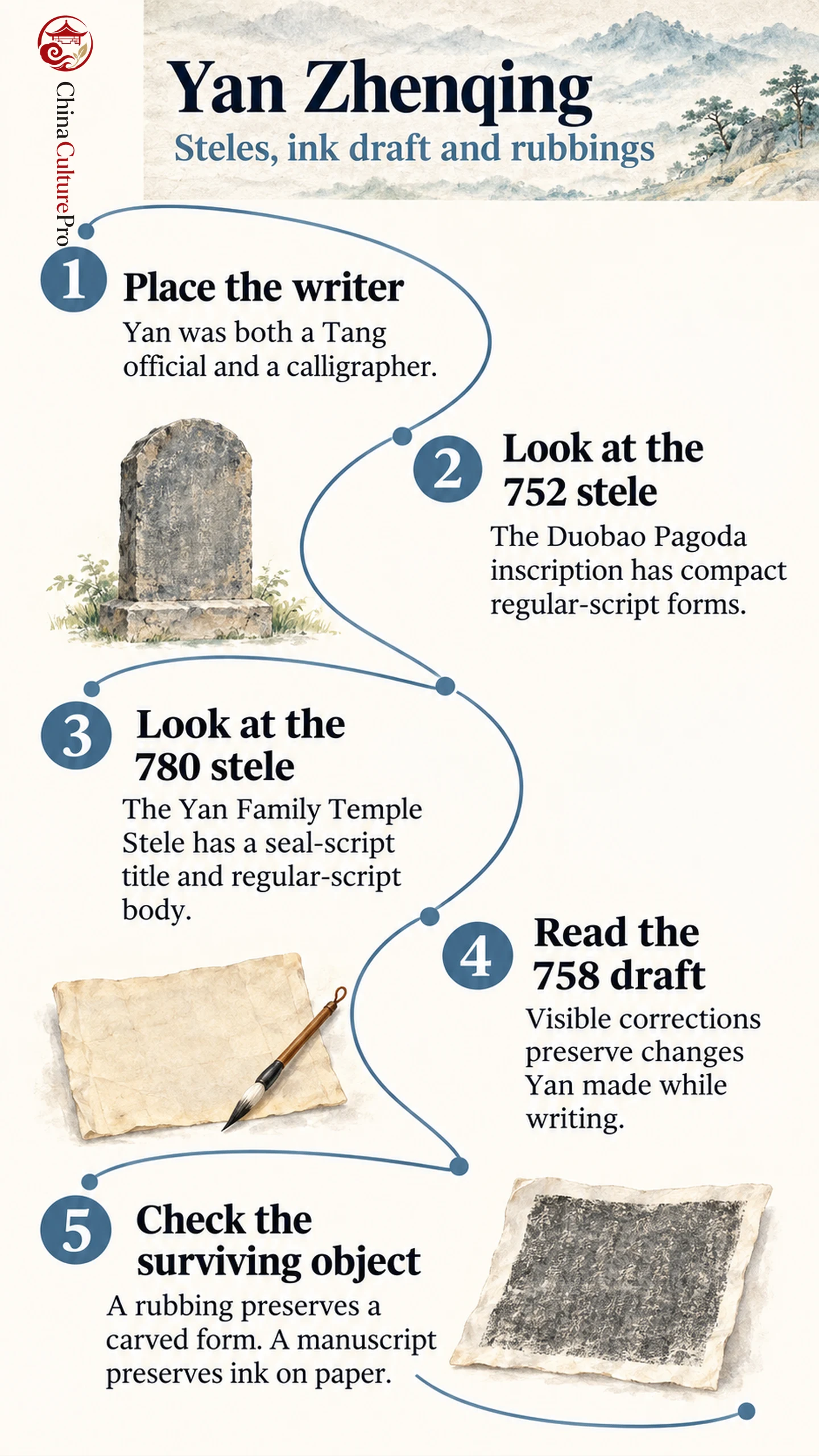
A stone monument and a page with crossed-out words ask the eye to notice different things. Yan wrote for both settings. Read his work through the reason it was made and the way the strokes reached the surface you see today.
Yan Zhenqing’s Life in the Tang Dynasty
Born in 709, Yan held office under the Tang and came to be known as the Duke of Lu. While serving in Pingyuan, he helped organize resistance during the An Lushan Rebellion. Later in his career he was sent to confront Li Xilie, whose forces captured and killed him in the mid-780s. Catalogs give both 784 and 785 for his death. His official roles and his family’s experiences provide context for the documents he wrote. [1][3][6]
Two Steles and Two Moments in Yan’s Regular Script
The Duobao Pagoda inscription was erected in 752 at a temple in the Tang capital of Chang’an. Cen Xun composed the text, Yan wrote the calligraphy and Xu Hao supplied the heading. The characters sit close together, with carefully defined turns. The 752 design is an early example of the regular-script work for which Yan became known. A Ming rubbing and a twentieth-century rubbing document the same inscription in different impressions. This is one way Chinese stone rubbings spread a model of regular script. [1][2]
The Yan Family Temple Stele (颜氏家庙碑, Yánshì Jiāmiào Bēi) dates to 780. Yan composed and wrote its text in honor of his father, while Li Yangbing supplied the seal-script heading. The stone is 338 centimeters high and carries text on front, back and sides. A viewer can distinguish the large title from the columns that record the family’s history. Look for clearly articulated hooks and turns in those body columns. [3][4]
Draft of a Requiem for My Nephew
Yan wrote the 758 memorial draft for his nephew Jiming, who died during the rebellion. The main field measures 28.2 by 77 centimeters. Canceled words and rewritten passages remain visible, including changes to the phrases describing the siege and the fate of Jiming and his father. These marks give evidence of rewriting. The subject of the draft explains its emotional context, while the ink shows exactly where Yan revised the words. [5]
Later calligraphy copybooks also circulated engraved versions of the draft. The paper manuscript is classified as running script. Its changes in spacing and ink density have a place in visual analysis. The transcription gives the underlying words and some edits, while the image shows the size and placement of those edits. See how to read Chinese calligraphy for ways to compare both kinds of evidence. [5]
Three Works to Compare
| Work | Date and surviving form | 辨識重點 |
|---|---|---|
| Duobao Pagoda Stele | Inscription of 752, known through stone and rubbings | Compare the close spacing and the angular turning strokes. [1][2] |
| Yan Family Temple Stele | Inscription of 780, with later rubbings | Distinguish the seal-script title from the regular-script body. [3][4] |
| Draft of a Requiem for My Nephew | Paper manuscript of 758, also transmitted in modelbooks | Compare the visible cancellations and the later engraved form used in modelbooks. [5][7] |
FAQs About Yan Zhenqing
What Is Yan Style in Calligraphy?
The label is often applied to his influential regular-script manner. It is associated with strongly defined strokes and substantial character forms. The 752 and 780 inscriptions let you compare different examples within the same tradition. [2][3][4]
Did Yan Write Only in Regular Script?
His running and semi-cursive writing also survives. The Requiem is an ink draft, and the Argument Over Seating offers another example of joined, changing strokes through a rubbing. [5][6]
Is Every Yan Zhenqing Rubbing From a Tang Stone?
A rubbing records the engraved surface from which it was taken. The Ming modelbook rubbing of the Requiem is a separate object from the Tang ink manuscript it transmits. [5][7]
資料來源
[1] Smithsonian National Museum of Asian Art. Duobao Pagoda Stele in Standard Script
[2] The Palace Museum. Ming Rubbing of the Duobao Pagoda Stele
[3] Xi’an Beilin Museum. Yan Family Temple Stele
[4] The Metropolitan Museum of Art. Yan Family Temple Stele
[5] National Palace Museum. Draft of a Requiem for My Nephew
[6] National Palace Museum. Rubbing of the Argument Over Seating
[7] National Palace Museum. Ming Rubbing of Draft of a Requiem for My Nephew