


Quick Answer: Which Autumn Colors Painting by Lan Ying?
This guide concerns Autumn Colors among Streams and Mountains (溪山秋色图, Xī Shān Qiū Sè Tú), a 1613 handscroll by Lan Ying (蓝瑛, Lán Yīng) in the Tianjin Museum.
- Subject: A horizontal landscape of water, hills, trees and small settlements.
- Look first: Follow changes between open water and denser landforms.
- Read next: The artist’s inscription names earlier masters as models.
- Keep distinct: Related autumn landscapes in other collections have their own dates and materials.
Collection, artist and format are more reliable identifiers than an English title alone.
A quiet stretch of water leads toward a small island and a group of trees. Larger hills gather farther into the image, opening again into shallower banks and distant views. The landscape offers repeated changes of density, with restrained color helping the forms remain distinct.
Follow the changing landforms, then read the inscription’s statement about artistic models.
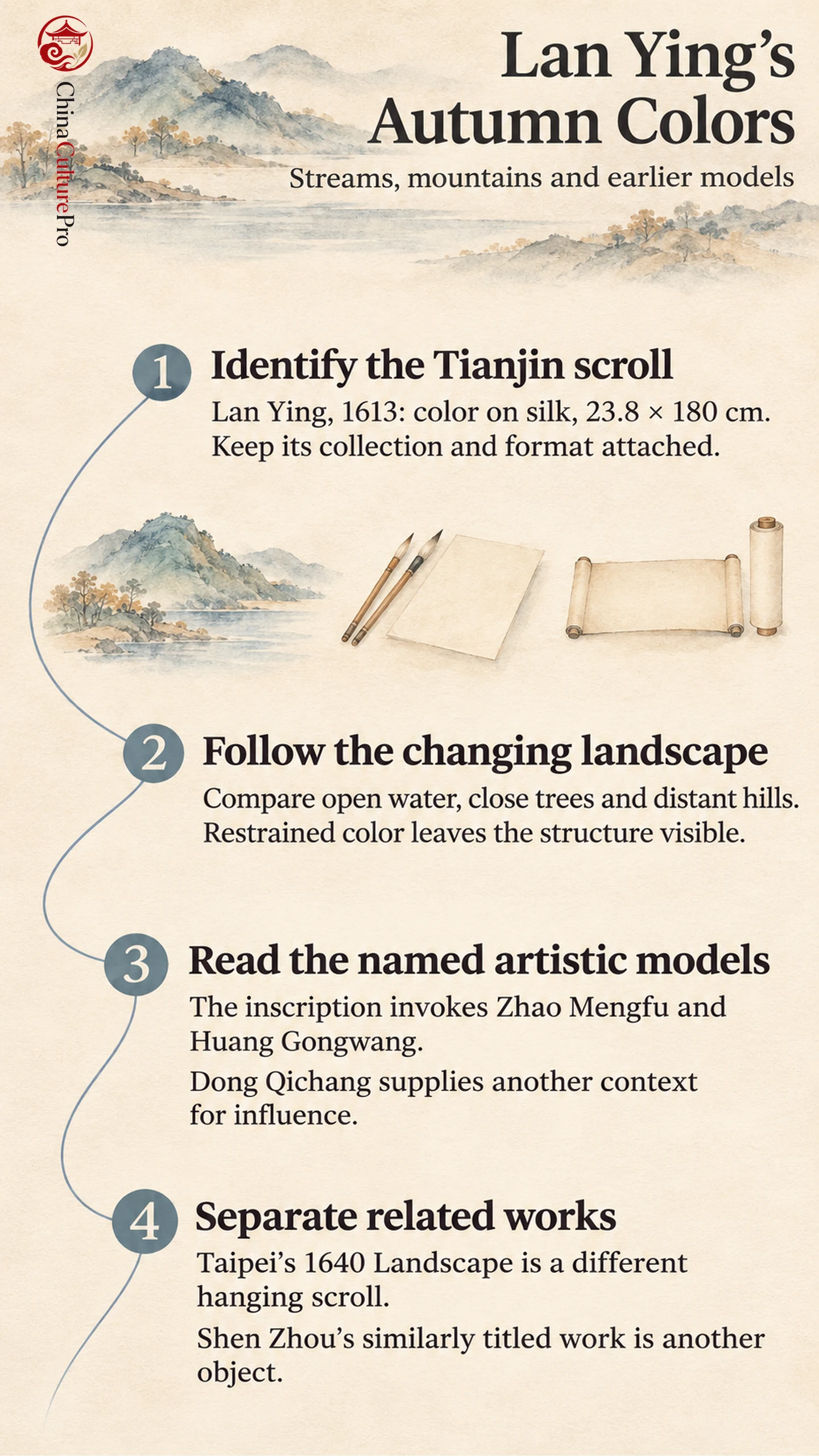
Identify the Tianjin Handscroll of 1613
The museum exhibition record identifies the work as color on silk, 23.8 cm high by 180 cm long, dated to early autumn in 1613. It belongs to the Tianjin Museum. The record treats it as one of Lan Ying’s early surviving landscapes. [1]
A loan to an exhibition elsewhere does not change that collection identity. Keep the Tianjin label with a reproduction, especially when search results introduce a different Lan Ying landscape or another artist’s autumn scene.
Traditional handscroll viewing proceeds from right to left in successive sections, with pauses before further unrolling. A full digital panorama is a convenient overview, but it compresses that changing experience into one display. [3]
The scroll-format guide provides the physical context. For this scroll, start with the opening water at the right, then examine a larger section without losing its position in the whole.
Follow the Water, Hills and Restrained Color
At the right, open water surrounds a low island with a small group of trees. Nearby, much larger rock forms rise sharply. Their blue-green faces and warmer slopes create a contrast with the pale water around them. Small buildings sit higher among the landforms, giving the scene a human scale without dominating it.
Farther along, tall foreground trees interrupt the horizontal movement. Beyond them, lower banks and distant vegetation lead the eye toward another group of hills. Compare a close, dark tree trunk with the faint forms across the water: their difference in prominence helps establish layers of distance.
The left portion changes the balance again. Broader, rolling slopes replace some of the sharper rock faces, while low vegetation and small structures appear between them. The artist’s inscription occupies the quiet end of the painted sequence.
Compare what each section contributes to the unfolding view. Some passages slow attention around trees or buildings; others open a wider interval across water. The landscape-painting guide develops the relationship between such forms and the viewer’s movement through a painted landscape.
The museum describes transparent blue-green coloring and an emphasis on washes over dense texture strokes in this early work. [1]
In the reproduction, compare the colored surface of a hill with its darker outline and small vegetation marks. The color need not obscure the underlying structure. At the same time, the warmer tree accents are selective: autumn is conveyed through the whole arrangement, rather than an evenly red forest.
- Intervals: Find where water separates one group of landforms from the next.
- Scale: Compare a small building with its surrounding hill.
- Color: Notice where blue-green and warm earth tones meet.
- Density: Move between close tree clusters and quieter distant banks.
The painting-techniques guide offers material background. The digital image supports comparisons of visible color and mark-making, but it does not by itself identify the original pigments chemically.
Read the Earlier Masters Named in the Inscription
Lan’s inscription states that he follows Songxue, an art name of Zhao Mengfu (赵孟頫, Zhào Mèng Fǔ), while also using the brush method of Dachi, an art name of Huang Gongwang (黄公望, Huáng Gōng Wàng). The statement presents more than one source for the painting. [1]
That combination is an invitation to study interpretation, rather than a guarantee of an exact replica. A painter can invoke an earlier model through brush language, arrangement or an understood artistic lineage while producing a new work.
The Zhao Mengfu guide provides one starting point. For Huang’s best-known landscape tradition, see Dwelling in the Fuchun Mountains. These links supply context; neither should be treated as a claim that this scroll copies that particular surviving painting.
A further connection is Dong Qichang (董其昌, Dǒng Qí Chāng). The museum’s exhibition account places Lan’s early work within the artistic circles around Dong and compares this scroll with Dong’s Zhoujintang landscape (昼锦堂图, Zhòu Jǐn Táng Tú) in its structure, brushwork and coloring. That is a curatorial comparison of influence, not an identification of the two as the same composition. [2]
The literati-painting guide helps explain why references to earlier masters mattered. Here, keep the artist’s own stated models distinct from the later curator’s comparison. Both illuminate the work, but they are different kinds of evidence.
Keep Related Autumn Landscapes Separate
A descriptive title can be shared, while closely related subjects may carry different titles altogether. Use the following records to separate objects encountered during research.
| Work | Collection and date | Material and format |
|---|---|---|
| Lan Ying: Autumn Colors among Streams and Mountains | Tianjin Museum; 1613 | Color on silk handscroll; 23.8 × 180 cm. [1] |
| Lan Ying: Landscape | National Palace Museum, Taipei; 1640 | Paper hanging scroll; 144.3 × 60.4 cm. [4] |
| Shen Zhou: Autumn Colors among Streams and Mountains | Metropolitan Museum of Art; about 1490–1500 | Ink-on-paper handscroll; 20.6 × 640.7 cm. [5] |
The Taipei record’s winter date belongs to its vertical Landscape, not the Tianjin silk handscroll. The longer work by Shen Zhou belongs to another artist and another period.
The guide to inscriptions and seals explains further evidence that can help distinguish works. Check artist, collection, format and date before attaching a description to a reproduction.
FAQs About Lan Ying’s Autumn Colors
Where is Lan Ying’s 1613 Autumn Colors scroll?
It is in the Tianjin Museum. The Zhejiang museum exhibition record identifies that collection, even though the work was included in an exhibition elsewhere.
Is it the same as the work by Shen Zhou?
No. Shen’s similarly titled handscroll in New York is a separate ink-on-paper work, about 640.7 cm long.
Does painting after an earlier master mean an exact copy?
Not necessarily. In this scroll, Lan explicitly names more than one artistic model. The reference can guide interpretation without establishing a line-for-line reproduction.
資料來源
[1] Zhejiang Provincial Museum. Lan Ying, Autumn Colors among Streams and Mountains: exhibition object record
[2] Zhejiang Provincial Museum, published by the Chinese Museums Association. Rare Peaks by the Lake: Lan Ying and His Artistic Sources
[3] The Metropolitan Museum of Art. Chinese Handscrolls
[4] National Palace Museum. Lan Ying, Landscape
[5] The Metropolitan Museum of Art. Shen Zhou, Autumn Colors among Streams and Mountains