
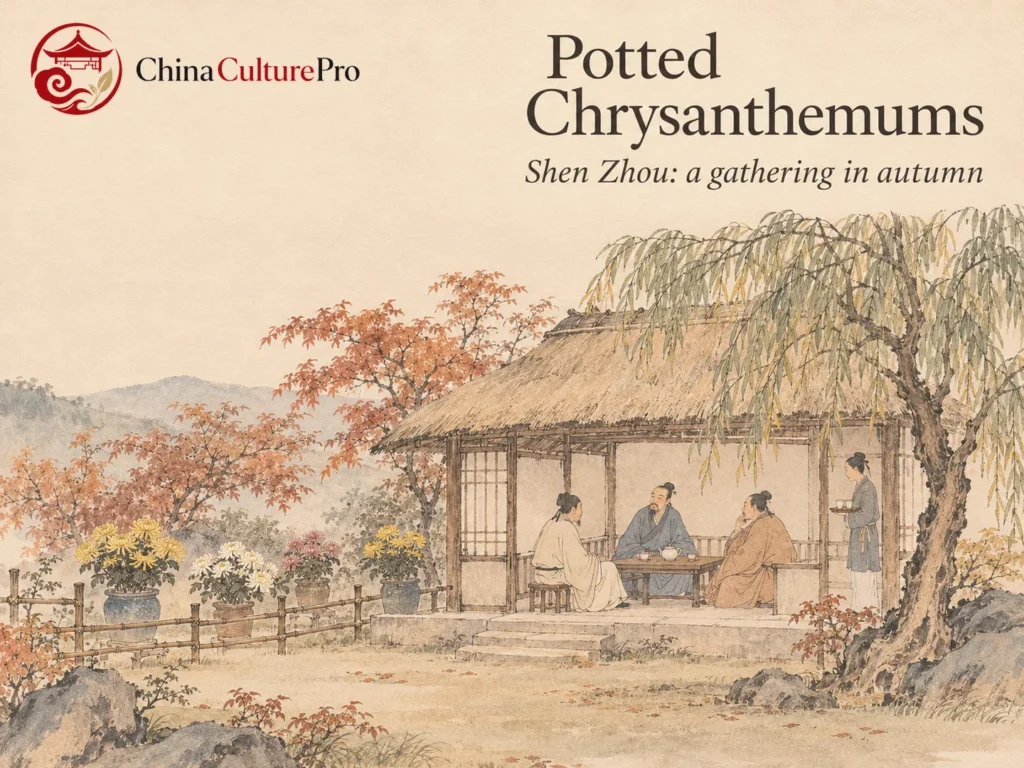

Quick Answer: What Is Shen Zhou’s Potted-Chrysanthemum Scene?
Appreciating Potted Chrysanthemums in Tranquility (盆菊幽赏图, Pén Jú Yōu Shǎng Tú) by Shen Zhou (沈周, Shěn Zhōu) shows friends gathered in an autumn garden. The work is held by the Liaoning Provincial Museum.
- Look first: Find the pavilion, seated company and pots beside the railing.
- Read next: The poetry turns waiting for flowers into a shared literary occasion.
- Keep distinct: The painting, the painter’s inscription and later additions have different histories.
A cropped reproduction cannot represent every part of the mounted scroll.

The flowers are small, but they give the gathering its subject. A pavilion shelters the company beside a quiet yard; trees, rocks and water extend the setting beyond its fence. Compare the small pots and seated figures with the broader enclosure, trees and banks.
Identify the Liaoning Handscroll
A Palace Museum publication identifies the painting as a Ming work by Shen Zhou, in ink and color on paper, measuring 23.4 × 86 cm and held in Liaoning. Those published dimensions identify the painted section discussed here. They should not be relabeled as the length of the mounted scroll with its attached writings. [1]
The horizontal format lets a viewer move from one area to another, rather than treating the pavilion as an isolated miniature. See the scroll-format guide for the distinction between a handscroll and a hanging scroll. On a screen, alternate a full view with a crop whose position you can identify.
The useful starting point is the object’s collection and format, not an exact year inferred from the artist’s lifespan. This guide does not assign a documented creation year to the painting. It also keeps the painted gathering separate from other chrysanthemum studies by Shen.
That distinction matters visually. A flower study may isolate a stem, leaves and blossoms. Here, the potted flowers belong to a setting inhabited by people, furnished with a pavilion and extended through trees and open ground.
Look from the Pavilion into the Landscape
In the published pavilion detail, three people sit around a table while an attendant stands with a pitcher. The pavilion roof gives the group a clear center. Its posts and railings frame the figures without hiding them, so the viewer can see the social activity and the surrounding yard together.
The pots form a much smaller rhythm near the fence. Their upright stems contrast with the drooping willow branches above the roof. To the right, denser trees gather into dark masses, broken by lighter trunks and patches of autumn color.
Compare the roof’s closely repeated lines with the less regular foliage. Both contain many marks, but they describe different structures. The roof reads as a continuous shelter; the leaves gather into clusters through which trunks remain partly visible.
A relatively open area beside the pavilion keeps the pots and railing distinct. Beyond the enclosure, trees and uneven banks enlarge the scene. The garden-design guide supplies broader context for built and planted elements, while the garden-plants guide explains how seasonal changes can become part of a garden’s experience.
The companion published detail shows another bank with trees, low rocks and brush-marked ground. Follow its irregular edge before returning to the pavilion’s straight railing. The difference keeps a simple garden occasion from becoming a diagram of furniture and flowerpots.
- Scale: Compare the small flowers with the broad shelter and surrounding trees.
- Texture: Separate the roof’s repeated lines from clustered foliage and broken ground marks.
- Space: Notice where open paper allows dense passages to remain distinct.
Read the Poems That Urge the Flowers to Open
The Double Ninth Festival (重阳节, Chóng Yáng Jié) provides the gathering’s seasonal context. A museum researcher’s account describes friends exchanging poems because the chrysanthemums had not fully opened. Their verses playfully urge the flowers to bloom. Shen’s own answering poem asks when the potted chrysanthemums will open and turns to nature’s power to bring them forth. [2]
This is more specific than saying that chrysanthemums always mean reclusion or longevity. The flowers create something to anticipate and discuss together. The friends answer the delayed flowering with poems.
For the wider observance, see Double Ninth traditions. The guide to chrysanthemum meanings explores other associations; those do not replace the particular poem attached to this painting.
Shen’s engagement with chrysanthemums also included cultivation and close observation. Museum research on a different flower album connects his chrysanthemum poems with Tao Yuanming (陶渊明, Táo Yuān Míng), and notes that Shen wrote about recognizing varieties and watering plants. Literary association and practical gardening could coexist. [3]
The Tao Yuanming guide develops that earlier poetic context. Keep the connection at that level: an established chrysanthemum association does not make the men in this pavilion portraits of Tao or turn the scene into his biography.
Separate the Painted Gathering from Later Additions
The scroll combines material made at different moments. The museum researcher explains that calligraphy by three participants was mounted after Shen’s painting, and that the work later passed through collections before entering the Qing imperial collection. Qianlong added his own poem to the painted field. [2]
In the reproduced inscription detail, Shen’s compact writing and signature can be compared with the larger imperial inscription nearby. Their different placement is visible even before their texts are read. Red collector’s seals add another layer of marks across the painted surface.
Use the guide to inscriptions and seals to distinguish an artist’s statement, later commentary and collecting evidence. The calligraphy guide addresses writing as an art, while literati painting supplies context for poems and images circulating together.
For this work, preserve three questions in your viewing notes: what the scene shows, what the answering verse says, and what a later collector added. Attach each observation to its place on the scroll and to the person who contributed it.
FAQs About Shen Zhou’s Potted Chrysanthemums
Is this a flower study or a landscape painting?
It is a garden gathering within a landscape. The potted chrysanthemums give the occasion its focus, but people, architecture, trees and water shape the image.
Do the dimensions include all the later calligraphy?
The 23.4 × 86 cm measurement used here identifies the published painting. Do not apply it to the complete mounted scroll and its additional writings.
Was Shen Zhou certainly present at the gathering?
The museum researcher suggests he may have painted it at a friend’s invitation. That possibility does not establish his presence at the original event.
資料來源
[1] The Palace Museum, Forbidden City magazine. Zhang Wei, Human Worlds Contain Many Peach Blossom Springs, pages 82–83, 2019 issue 6
[2] Dong Baohou, Liaoning Provincial Museum. Poetry and Painting Urge the Chrysanthemums to Bloom
[3] National Palace Museum. Shen Zhou’s Observation of Nature: Plants