
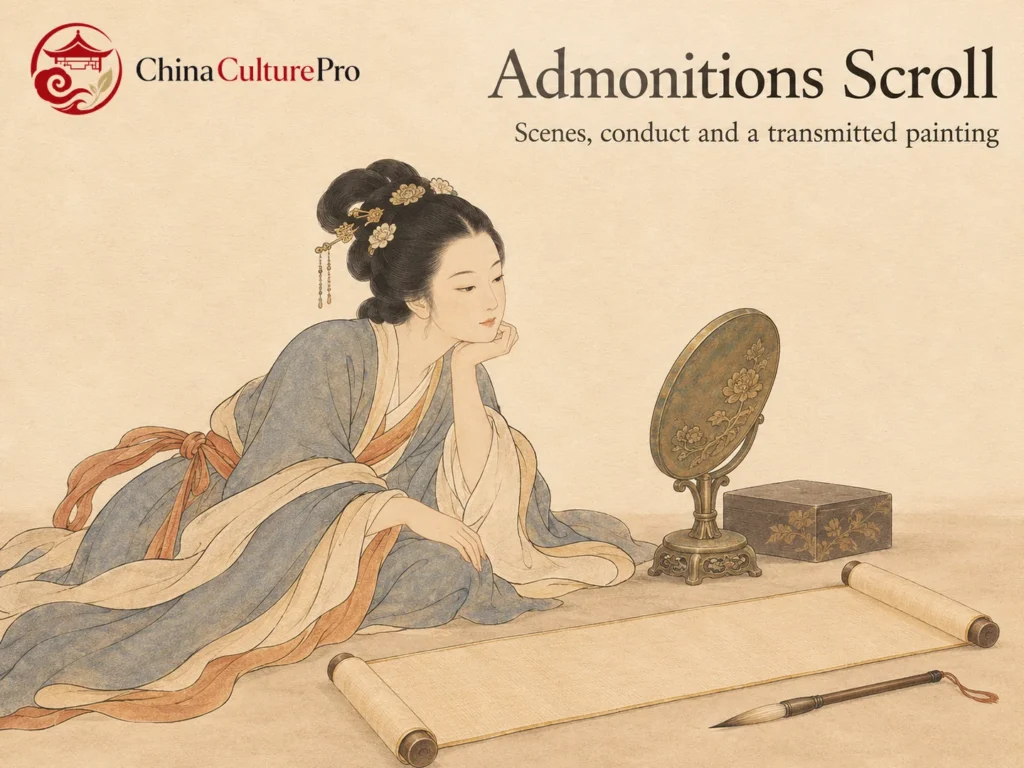

Quick Answer: What Is the Admonitions Scroll?
The Admonitions Scroll (女史箴图, Nǚ Shǐ Zhēn Tú), formally Admonitions of the Instructress to the Court Ladies, illustrates a poem about courtly conduct. The London silk painting is traditionally associated with an early master, while its physical date and authorship require qualification.
- Subject: Historical examples and moral instruction addressed to women at court.
- Survival: Nine painted scenes remain in the London version; the opening is incomplete.
- Viewing: Read the relationship between text, gesture and successive scenes.
- Comparison: Beijing holds a separate Song-period ink-on-paper copy.
Treat the poem, the traditional painter’s name and each surviving version as different layers of evidence.

This work makes a moral argument through people: how they act, how they relate to one another and how a written passage frames their behavior. Read it as a sequence, a transmitted composition and a fragile surviving object.
Separate the Poem, Gu Kaizhi and the Surviving Painting
Gu Kaizhi (顾恺之, Gù Kǎi Zhī) is traditionally associated with the composition. The museum programme account dates the London painting broadly to 400–700 CE, rather than certifying it as his autograph. [1]
The Gu Kaizhi guide develops the artist’s broader reputation. Here, distinguish the design tradition associated with a master from the physical object that survives. A later work can preserve an earlier visual language without settling exactly whose brush made it.
The London work is painted in ink and color on silk. Its registration is 1903,0408.0.1. Use that identity when looking up photographs, since the title also belongs to other versions and transmitted compositions. [2]
Courtly Instruction Becomes a Sequence of Images
Zhang Hua’s third-century admonitions criticized an empress and set expectations for court women. The instructress and exemplary situations convey that moralizing purpose. [1]
Read those expectations as part of the historical court’s political and gender order. Depicting an ideal of obedience or restraint does not turn it into advice for present-day readers. Ask who is being instructed, who holds authority and what conduct the picture presents as admirable.
The sequence proceeds from right to left, alternating written passages and painted scenes. [1]
This gives text and image different jobs. The words state or frame an admonition; the figures make conduct visible through an action or encounter. Try reading a translated passage before looking at its scene, then reverse the order and notice what the words add to your first visual impression.
The overview of Chinese figure painting provides genre context. In this work, human relationships carry the instruction, rather than a continuous landscape connecting every episode.
Look at the Bear and Mirror Scenes
The bear scene presents a court lady facing a bear, an exemplary act of courage and composure. The mirror scene turns attention toward self-examination: outward appearance is placed beside the cultivation of inner character. These are different ways of making an ethical lesson visible. [2]
For the bear episode, begin with the arrangement of the figures and animal. Consider how intervening in danger differs from merely watching it. Keep a reliable scene explanation beside the reproduction so that a dramatic grouping is not turned into an invented conversation.
For the mirror episode, compare the ordinary activity of attending to appearance with the moral lesson attached to it. The object becomes meaningful through the written instruction and the figure’s activity together. A mirror in another painting need not carry the same lesson.
In both cases, attend to outline and gesture. Follow the line defining a sleeve or a body, then compare how the figures face or turn away from one another. Describe those relationships before assigning a precise emotion to a tiny face in a reproduction.
The guide to calligraphy and painting helps distinguish the work of written characters from the lines constructing a figure. Shared use of the brush does not make those two functions interchangeable.
Compare the Beijing Paper Copy
The Palace Museum holds a separate Song-period copy in ink on paper, measuring 27.9 × 601 cm. Its eleven illustrated sections differ from the surviving London sequence. The paper version should not be described as the same physical scroll or used to fill a missing London passage without explanation. [3]
Its plain-line drawing (白描, bái miáo) constructs figures with ink outlines rather than applied color. The museum relates its firmer, continuous lines to the tradition of Li Gonglin. In the published detail, pale surfaces leave the flowing outlines especially exposed to view. [3]
Compare corresponding subjects only after checking which copy and which section you are seeing. For a useful first exercise, select one figure group and compare the role of color, line and blank ground. Check whether each reproduction shows a complete version or only a detail before comparing the sequences.
The Song dynasty guide provides the later copy’s historical setting. The difference in material is immediately useful: paper and silk belong to distinct surviving objects, even when they transmit related compositions.
A Fragile Work with a Complex Collection History
The London painting and later inscriptions were separated and mounted onto panels in 1914. Its present format therefore differs from the earlier handscroll encounter. [1]
The general handscroll format encourages successive attention, while later inscriptions can record responses and ownership over time. [4]
Keep those additions distinct from the illustrated admonitions. The guide to inscriptions and seals explains how such evidence contributes to an object’s history.
The painting passed from the Qing imperial collection into Captain Clarence Johnson’s possession and was purchased by the British Museum on 8 April 1903. The conservator’s account states that how Johnson obtained it is unknown. Preserve that documented gap when describing the transfer. [2]
Conservation addresses the silk’s vulnerability to light, environmental fluctuation and vibration. Restricted light exposure and a carefully controlled display case protect the material; current public viewing dates need a separate check. [2]
FAQs About the Admonitions Scroll
Is the surviving scroll definitely Gu Kaizhi’s original?
No. Its association with him is traditional, and the surviving painting’s date and maker are debated. Keep that qualification attached to reproductions and descriptions.
Are the London and Beijing versions the same object?
No. The London version is on silk, while Beijing’s Song-period copy is an ink-on-paper work with a different surviving sequence.
Why can the silk painting not remain under bright light?
Light can damage the silk and affect pigments. Conservation therefore limits exposure rather than treating continuous illumination as harmless.
資料來源
[1] British Museum International Training Programme. The Admonitions Scroll
[2] Keeley Wilson, British Museum conservator, Institute of Conservation. The Art of Preventive Conservation: Ensuring the Longevity of the Admonitions Scroll
[3] The Palace Museum. Admonitions handscroll: Song copy
[4] The Metropolitan Museum of Art. Chinese Handscrolls