
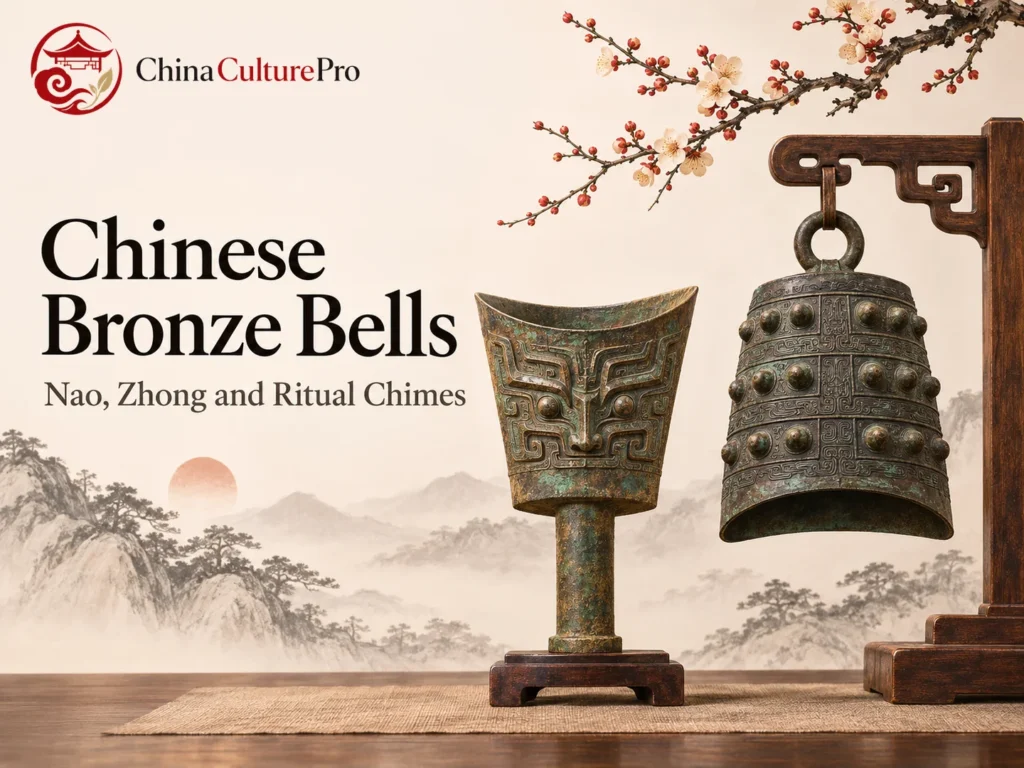

Quick Answer: What Are Chinese Bronze Bells?
Chinese bronze bells take several forms. A Shang upright bell, or nao (铙, náo), can be played with the mouth facing up. Many Zhou musical bells, or zhong (钟, zhōng), hang mouth down and are struck on the outside. Shape, mounting and strike location affect the sound.[1][2][3]
- Mouth up: Some nao were held or supported upright.[1][2]
- Mouth down: Suspended bells can have a long stem or a small loop for mounting.[3][6]
- In sets: Groups of tuned bells supplied different notes in ritual and other performances.[1][6]
A museum label can identify an individual bell by its shape or its former place in a set.

Look at the wide opening and the small end before looking at the decoration. A bell with a stem can stand on it or hang from it, depending on the type. The opening and the shape of the mount together suggest how a player approached the bell.
Read the Mount and the Mouth
The Metropolitan Museum of Art records a Shang nao, object 49.136.10, as an upright bell. In this family, small bells could be held by the stem and larger examples supported on a frame. The face-like design on this piece sits on a bell whose opening was above it during use.[1][2]
In a suspended Zhou set, the stemmed bell called a yongzhong (甬钟, yǒngzhōng) could hang at an angle. A loop-knob bell called a niuzhong (钮钟, niǔzhōng) could hang from the loop. A Met niuzhong also has a slightly raised rim. That object shows why the shape of the mouth and the shape of the suspension can be considered together.[3][6]
A chunyu (錞于, chúnyú) is another bronze bell form. The Met describes examples from regions along the Yangtze and as far south as Guangxi. Some researchers have proposed a signaling role. The function of particular examples is still under study.[4]
What Shapes Can Tell You About Sound
On certain nao and zhong, the opening is elongated in cross-section and the rim rises at the center in profile. The bell can respond with one pitch to a center strike and another to a strike nearer the side. The external blow makes the cast metal wall vibrate.[1][3]
A mounted bell’s mouth can be hard to see. Look for a view from below or a catalogue photograph that shows the shape of the opening. The guide to Chinese bianzhong looks at how different pitches are combined across an entire rack.[1][6]
Bells in Ritual and Court Music
Musical bells and bianqing stone chimes occur together in early ritual ensembles. In these ensembles, a cast hollow bell and a solid stone plate could each carry a distinct pitch. The broader bayin classification groups bronze under metal and chime plates under stone.[1][6]
Imperial workshops made new bells long after the Bronze Age. A gilt copper-alloy bell in the Met is dated 1715 and named for the pitch jiazhong. It bears the eight trigrams in relief. The museum links the commission to the Kangxi emperor’s reform of court ceremonial music in 1713. Its named pitch places it within a musical system. The gilding and relief decoration mark its court setting.[5]
FAQs About Chinese Bronze Bells
Did Chinese bronze bells have clappers?
Many bronze bells in ancient Chinese musical sets were clapperless and struck on the outside. Check the construction and catalogue description when identifying a particular bell.[1][3]
Is an individual bell a bianzhong?
Bianzhong means a set of tuned bells. An individual bell can be one component of that set.[3][6]
資料來源
[1] The Metropolitan Museum of Art. Music and Art of China
[2] The Metropolitan Museum of Art. Shang Upright Bell
[3] The Metropolitan Museum of Art. Eastern Zhou Niuzhong
[4] The Metropolitan Museum of Art. Bell (Chunyu)
[5] The Metropolitan Museum of Art. Ritual Bell, Note Jiazhong
[6] Hubei Provincial Museum. Chime-Bells From the Tomb of Marquis Yi of Zeng