
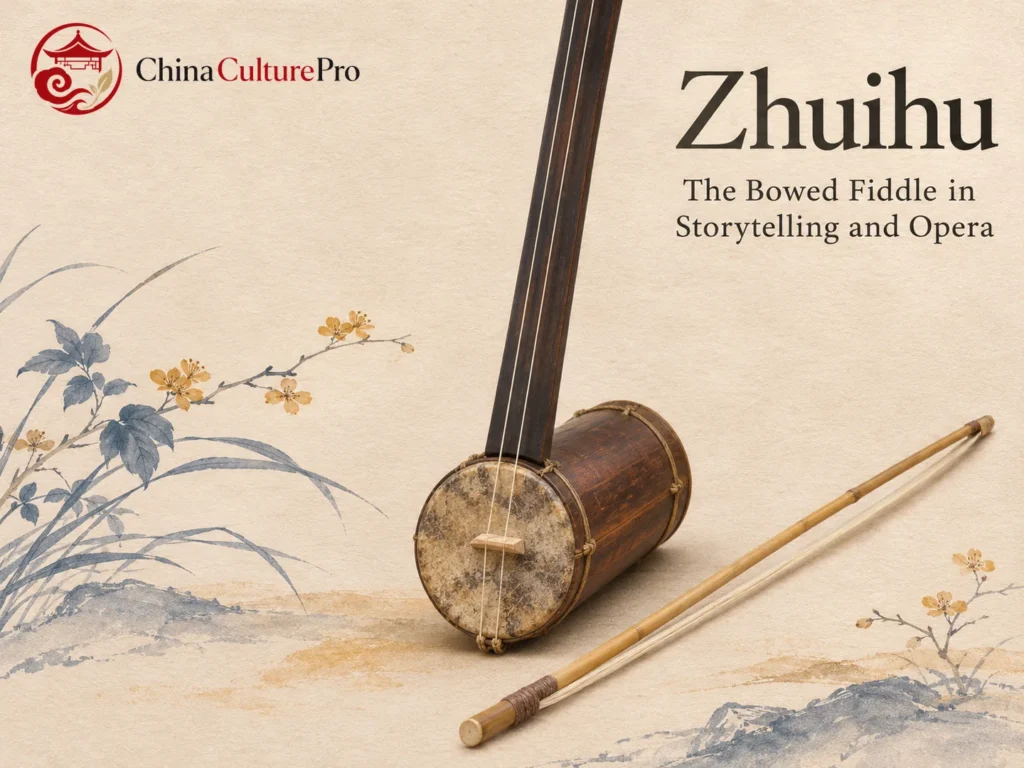

Quick Answer: What Is the Zhuihu?
The zhuihu (坠胡, zhuìhú) is a Chinese bowed fiddle associated with regional storytelling and opera. Sources sometimes use the name for the zhuiqin (坠琴, zhuìqín) and sometimes reserve the names for instruments with different resonators.[2][3]
- Look: The form described in instrument guides has two strings and a fingerboard.[3][4]
- Listen: A bow can carry a sustained note or slide between pitches.[2][3]
- Context: Henan zhuizi (河南坠子, Hénán zhuìzi) is a sung storytelling form with fiddle accompaniment.[1]
Use the performance tradition and the instrument’s construction together when reading a label.

The same family of names can appear on a fiddle, a storytelling performance and a staged drama. Start with what the musician holds, then look for the genre named in the program.
How the Neck and Bow Work
A comparative instrument guide describes a long neck with a fingerboard, similar to the neck of the plucked sanxian. The player draws a bow across two strings. The fingers can slide along the board while the bow keeps the note sounding. That board is an identification clue beside the neck of an erhu or zhonghu.[3]
The same guide describes a tuning a fourth apart for the regional form it calls zhuihu. Treat that fourth as an interval for the documented form. Check the version or instrument before assuming specific open pitches.[3]
Why Zhuihu and Zhuiqin Can Overlap
ChinaCulture.org uses zhuihu and zhuiqin for the same general instrument. The Chinese Music Archive and the comparative guide use a narrower distinction. They describe the zhuiqin used in Henan narrative singing with a thin wooden face. The instrument they call zhuihu combines a similar neck with an erhu-like resonator.[2][4]
The national heritage entry for Henan zhuizi uses zhuizixian (坠子弦, zhuìzixián) and gives zhuiqin as an alternate name for the accompanying fiddle. A source about a staged version may use zhuihu for its main accompaniment.[1][5]
Listen to the Fiddle Beside the Singer
The Henan heritage entry describes a performance in local speech that alternates sung lines with spoken delivery. Singing takes up most of the performance. Listen as the voice approaches a pause, then listen for any tone the fiddle carries through that break. Listen to the next sung line as well, since the timing of the fiddle’s response can vary across performances.[1]
From Storytelling to Stage and Concert
The heritage record traces zhuizi opera to the storytelling form. The staged version belongs to a broader world of 中國戲曲, where instrument choices depend on the genre and local practice.[5]
A Hong Kong Chinese Orchestra program credits Ma Dongyan on long- and short-neck zhuihu in Liu Wenjin’s Zhong-Zhou-Yun. Those labels identify two forms within a concert work. The Chinese musical instruments guide puts them in the wider bowed-string family.[6]
FAQs About the Zhuihu
How many strings does a zhuihu have?
A standard description of the Shandong regional form gives two bowed strings and a fingerboard.[3]
Is zhuihu another name for zhuiqin?
Some sources use both names for the same instrument. Others distinguish a wooden-faced zhuiqin from a zhuihu with an erhu-like chamber.[2][4]
What is Henan zhuizi?
It is a Henan tradition of sung storytelling with spoken passages. Its name refers to the fiddle used for accompaniment.[1]
資料來源
[1] China Intangible Cultural Heritage Digital Museum. Henan Zhuizi, National Inventory Entry V-20
[2] ChinaCulture.org. Zhuihu, Bowed String Instrument
[3] Australian National University repository. Chinese Musical Instruments: Zhuiqin, Zhuihu and Leiqin
[4] Chinese Music Archive. Zhuizi and Zhuihu in the Bowed Instruments Collection
[5] China Intangible Cultural Heritage Digital Museum. Zhuizi Opera, National Inventory Entry
[6] Hong Kong Chinese Orchestra. Commander Hu: Programme