


Quick Answer: What Is the Zhonghu?
The zhonghu (中胡, zhōnghú) is a two-string Chinese bowed fiddle in the huqin (胡琴, húqín) family. Its resonator is larger than that of the erhu (二胡, èrhú), and its range reaches lower notes.[1][6]
- Shape: A slender neck rises from a compact resonating chamber.[1]
- Tuning: G3 and D4 are one common pair of open pitches.[3]
- Role: It gives the bowed section a rounded middle-to-low voice and can play the tune itself.[2][5]
In an orchestral passage, follow the line beneath or alongside the brighter bowed strings.
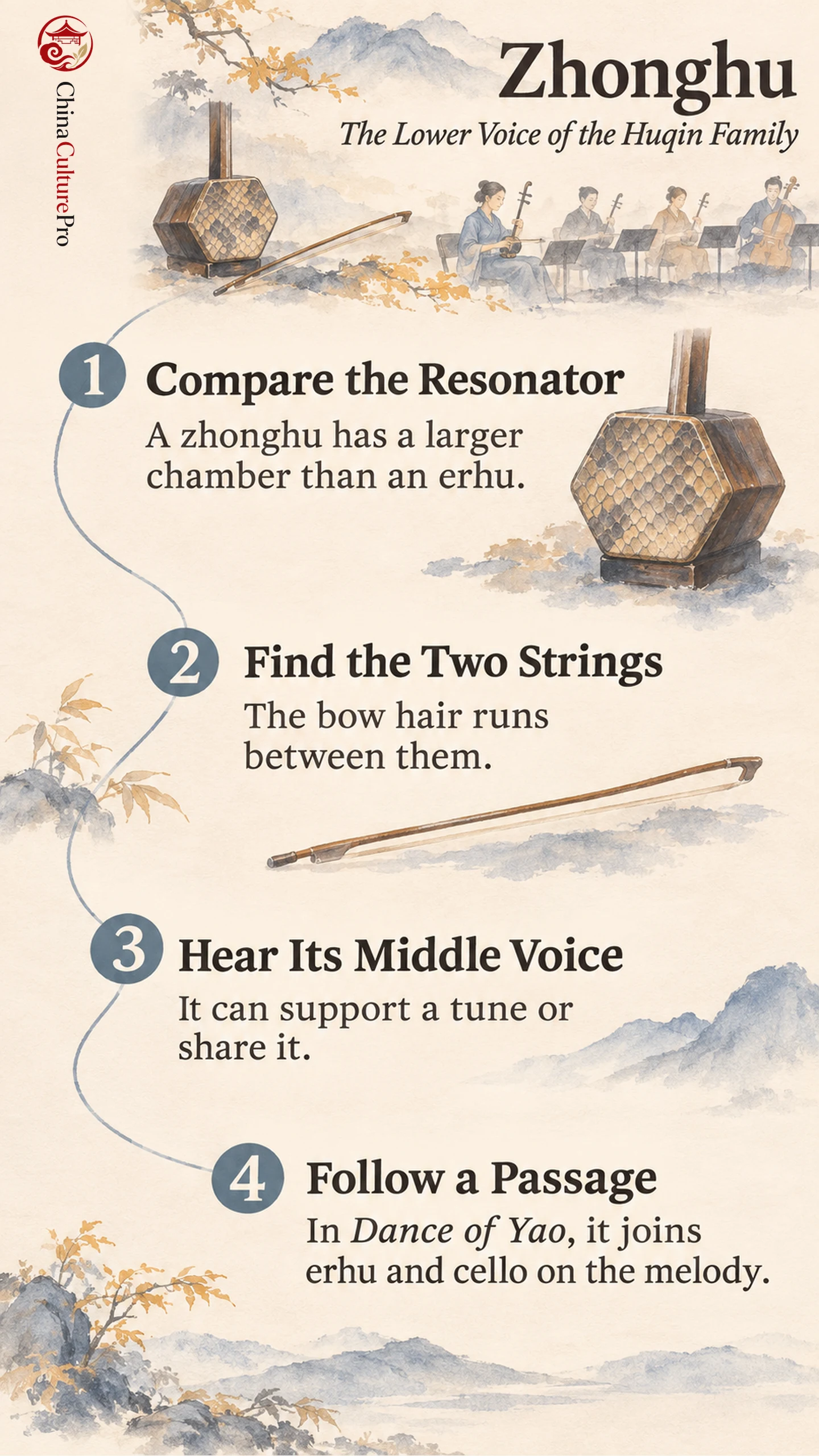
At a distance, a zhonghu and an erhu can look almost alike. The larger chamber and lower tuning help explain why a composer gives them different parts, even though their players use closely related bowing and fingering techniques.
A Larger Relative of the Erhu
The zhonghu developed from the erhu in the twentieth century as Chinese orchestras took shape. Hong Kong’s Education Bureau describes the enlarged sound chamber and longer neck as features of a lower instrument. The Chinese Music Archive associates the early development with fiddle player Liu Mingyuan.[1][5]
A front view of a lone instrument offers little scale for comparison. In an ensemble photograph, look at the size of the chamber next to the erhu. A sihu uses four strings, so string count is another useful clue when comparing upright fiddles.
How Its Bow and Strings Work
The bow hair passes between the two strings, as on an erhu. The bridge passes string vibration to the stretched face over the wooden chamber. A loop around the strings and neck, the qianjin (千斤, qiānjīn), brings the strings toward the neck. There is no fingerboard for pressing the strings against.[2][6]
The tuning G3–D4 lies a perfect fifth below the familiar D4–A4 on erhu. One reference also describes zhonghu tunings a fourth apart. Use the stated open strings in a score or instrument chart when comparing tunings.[3][6]
What It Does in an Orchestra
Zhonghu can hold longer notes under a melody, supply a line within a harmony, or reinforce the erhu’s tune. Its lower register can blend into the section, while a separate moving part makes it easier to pick out.[2]
The Hong Kong Chinese Orchestra’s published range table lists eight zhonghu positions alongside separate erhu, gaohu, gehu and bass gehu positions. This is one orchestra’s layout. A smaller ensemble may use fewer players or a different mix of Chinese musical instruments.[4]
The zhongruan covers a middle register in the plucked section. Its part can have a more pronounced attack alongside sustained bowing.
Two Passages to Listen For
In the scored Dance of Yao excerpt in the Timbre and Orchestration Resource, the zhonghu joins erhu and cello on the long melody. The higher gaohu carries a separate answering line. Look for the theme at about four minutes in the recording attached to the excerpt.[2]
The Education Bureau’s guide to New Tunes of the Herdsmen points out a slide in the introduction. The zhonghu evokes the matouqin horsehead fiddle while accompanying the solo flute. Listen for the continuous slide between pitches.[1]
FAQs About the Zhonghu
How is the zhonghu tuned?
G3 on the lower string and D4 on the higher string is common. Tunings can vary with the instrument and music.[3][6]
Is the zhonghu a bass instrument?
It usually sits below erhu in the middle-to-lower bowed register. A modern orchestra can give its deepest bowed parts to instruments such as bass gehu.[1][4]
Is zhonghu the same as zhongruan?
Zhonghu is a bowed fiddle. Zhongruan is the middle-sized member of the plucked ruan family.
資料來源
[1] Hong Kong Education Bureau. Listening to Chinese Music
[2] Timbre and Orchestration Resource. Bowed Strings in the Chinese Orchestra
[3] Qi Yao. An Instrumental Guide to the Chinese Orchestra
[4] Hong Kong Chinese Orchestra. Instrumentation and Range Table
[5] Chinese Music Archive. Zhonghu in the Bowed Instruments Collection
[6] Australian National University repository. Chinese Musical Instruments: Bow-String Instruments